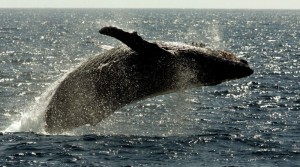
All over the world, whales leap high into the air and crash back into the water, slapping their tails and fins on the ocean’s surface on the way down. Since breaching (as the behavior is called) demands so much energy—especially when whales are fasting during migrations—scientists assume it plays a crucial role in cetacean life, but what exactly that role is remains murky.
To find answers, University of Queensland marine biologist Ailbhe Kavanagh spent September and October of 2010 and 2011 at Australia’s Peregian Beach observing 76 groups of humpback whales migrating to the Antarctic for more than 200 hours. Their findings, published this January in the journal Marine Mammal Science, show breaching is far more common when pods of humpback whales are far apart (at least 4,000 meters or 2.5 miles), and fin or tail slapping is more frequent as groups split or come together. The authors say these patterns suggest breaching and slapping play a role in both long-distance and close-range communication. By slamming their massive bodies into the water, the resulting sounds, like a drum, can travel enormous distances.
“This makes absolute perfect sense,” Chris Parsons, a cetacean biologist at George Mason University in Virginia not associated with this research, told Hakai Magazine. “Even though these whales can produce calls that travel great distances, if there’s a lot of noise, it might be easy to drown out. Leaping up in the air and splashing down is equivalent to the really keen kid in a classroom jumping up and down waving his arms.”
Whale communication remains one of the planet’s most spectacular mysteries. Almost all whale species use a collection of low-frequency moans, grunts, and knocks or higher-frequency cries and whistles to navigate, find food, and chat with each other across hundreds of miles of ocean.
Researchers have yet to decipher this communication, but have detected regional accents, and specific calls for family units, locations, and even “names” of a sort. All Caribbean whales, for example, share a unique “1+1+3” call suggesting a shared culture in which vocalizations are learned—though there’s no conclusion on what the call means.
New equipment and computational techniques are now being marshalled in the effort to translate cetaceans’ sounds, but the work is complicated by the fact that humans are drowning out whales’ habitat. Motors, underwater explosions, and other manmade din are shattering the silence of the seas. National Geographic reports blue whales, which can emit one of world’s most powerful biological sounds, have seen their range of hearing shrink from 1,000 miles (1,600 kilometers) in 1940 to 100 miles (160 km) today due to background noise.
Ask me anything
Explore related questions