




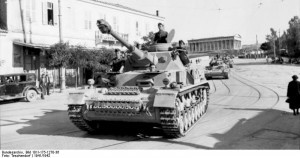
Greece is continuing to demand around €270 billion from Germany in reparation payments for war crimes committed by Third Reich in the Second World War. Athens is considering legal action to force Germany to make the payments.
While visiting Kommeno in commemoration of the 1943 massacre there, Greek Prime Minister Alexis Tsipras said, “Greece and its people will not forget the slaughter and war crimes of the Nazi army, and demand tangible recognition by the German government. Greece will do whatever is necessary, mainly at a diplomatic level, and if necessary, at a legal [level].”
Germany is now one of Greece’s biggest creditors; however, relations between the two countries have severely deteriorated in the years following the financial crisis. As part of the bailout agreements in 2010 and 2012, which together represent some $240 billion Euros, strict austerity conditions were imposed. Greece’s new left-wing government strongly opposes these conditions, while Germany supports them. In the past, the Greek government has threatened to seize German property and assets in order to cover the reparations.
Marina Prentoulis is a member of Syriza, the current ruling party in Greece, and a political theorist. Eike Hamer is a political commentator from Germany. They have different views on whether Greece should pursue the reparations from Germany.
Prentoulis does not dispute that a lot of time has gone by, but she argues that “crimes against humanity never expire.”
Citing the huge number of massacres committed by occupying troops, she said, “The people of Greece will always have to live with the memories of the Nazi occupation.” Prentoulis highlighted the Kokkinia massacre as particularly gruesome.
On the 17th of August, 1944, 20,000 people were marched into the the local square of Kokkinia, in Western Athens. 350 of them were executed on the spot, and a further 800 were taken hostage and tortured by the Gestapo.
Hamer feels that fairness is not the issue. He states that “there is hardly any other country that got as much money from Germany as Greece.”
In 1960, the West German government made a payment of 115 million Deutsche Marks as compensation for Nazi war crimes. The Greek government agreed as part of the deal not to pursue any further compensation claims against Germany.
The goal now should be to “live together again in peace and with respect to each other,” he said. If one side keeps reminding the other of past crimes “to blackmail the other one and demand any money or whatever from them,” then that goal will never be reached.
Prentoulis agrees that peace is critical. However, she insists that there is a “historical responsibility” to recognize the devastation of Greece by the Nazis.
She thinks that the 1960 payment was only a fraction of what Germany owes. Germany’s wartime occupation of Greece was brutal; some 250,000 Greeks were killed. The Nazi regime forced the Greek government to pay for the cost of the occupation, as well as provide all necessary food and raw materials for free. In addition to this, the Greek Central Bank was forced to pay an interest-free loan of 476 million Reichsmarks to the Third Reich. By the end of the war, around 80% of Greek industry was destroyed.
“And now it is time to recognize that, as comrades and for the good of the whole of Europe, in order to be able to put this story in history and remember the horrific things that happened to Greece,” said Prentoulis.
Hamer argues that, since the 1960 reparations, Greece has enjoyed benefits worth “a couple of hundred billion” euros. They have received low-interest rates, European aid, and other indirect payments that mostly came from Germany, including a number of contracts awarded by German business.
“There is no other country in the world paying Greece that much as Germany through the EU,” he said.
“It is funny that you can pay Greece as much money as you want and the elites divide this money amongst each other… Now, when the people are left behind from their own elites, they are demanding more money from Germany,”
But Prentoulis feels that Greece is getting treated unfairly.
“Greece is getting one of the worst treatments across the Eurozone,” she said. She added that economic issues and war reparation payments should be separate.
“But if you want to talk about the situation in Greece now, I have to remind you again about the 1953 London Debt Agreement.”
The London Agreement on German Debts (which actually took place 1952) was a debt relief agreement signed between West Germany and a large number of its creditors.
The agreement mostly focussed on 16 billion Deutschemarks of debt left over from the Treaty of Versaille after WWI, and a further 16 billion Deutschemarks of post-war loans from the US. The agreement canceled approximately 50% of that debt and tied the repayment of the remaining 15 billion to certain conditions such as West Germany’s trade performance.
“This was an act of goodwill from the people of Europe,” Prentoulis said.
“The Greek people have been totally brought to the knees, once again because of austerity, because of the decisions of the conservative government of the EU, including the German one,” she said.
Ask me anything
Explore related questions