

×
GreekEnglish

×
  • Politics
  • Diaspora
  • World
  • Lifestyle
  • Travel
  • Culture
  • Sports
  • Cooking
Thursday
15
Jan 2026
weather symbol
Athens 9°C
  • Home
  • Politics
  • Economy
  • World
  • Diaspora
  • Lifestyle
  • Travel
  • Culture
  • Sports
  • Mediterranean Cooking
  • Weather
Contact follow Protothema:
Powered by Cloudevo
> Science

Astronomers discover 7 potentially habitable exoplanets orbiting nearby dwarf star

It is "just" about 39 light-years away

Newsroom February 22 09:31

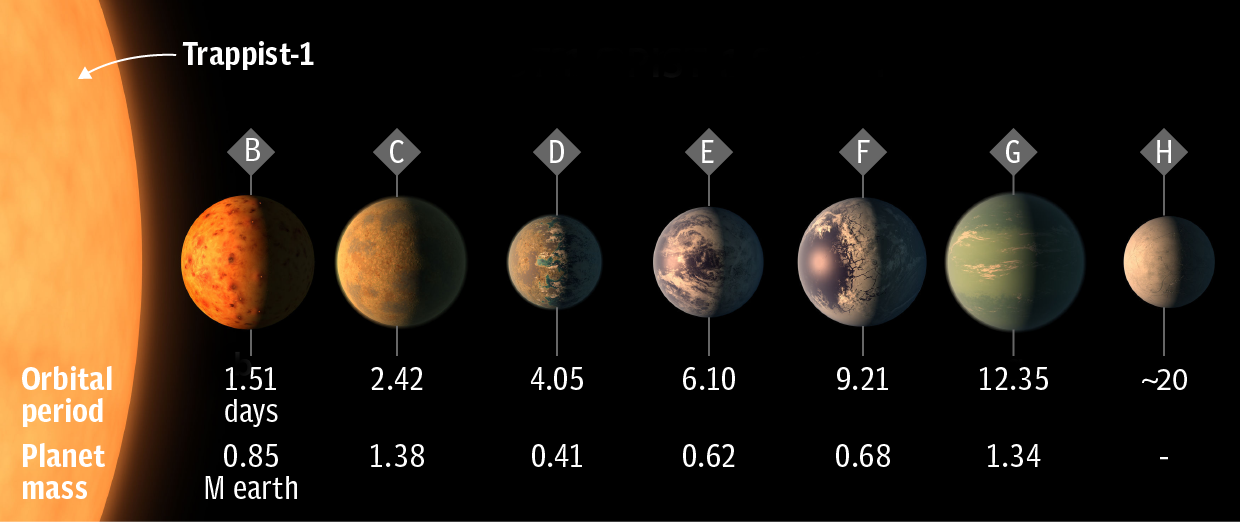
An international team of astronomers has discovered seven potentially habitable exoplanets — or planets outside our solar system — that could have liquid water on their surfaces, according to a paper published Wednesday in the journal Nature.

It is unclear whether any of the newly discovered planets can harbor life. However, scientists pointed out that the new planetary system orbits TRAPPIST-1, a dwarf star that is much younger than our sun and that will continue to burn for another 10 trillion years — more than 700 times longer than the universe has existed so far.

Astronomers said that is “arguably enough time for life to evolve,” the article reported.

TRAPPIST-1 is about 39 light-years away, in the constellation Aquarius.

The seven newly discovered planets orbiting TRAPPIST-1 have been nicknamed “Earth’s seven sisters” and have masses similar to that of Earth’s, in addition to having rocky compositions like our planet, scientists said.

Astronomers noted, though, that they are awaiting the scheduled launch of NASA’s James Webb Space Telescope in 2018 to confirm what conditions — such as atmospheric composition and climate — are like on the exoplanets. The James Webb Space Telescope is expected to be significantly more powerful than the Hubble Space Telescope.

The discovery of the new planetary system has also indicated that Earth-sized planets are much more abundant and common in the Milky Way galaxy than previously thought, researchers said.

>Related articles

Sick astronaut on mission – NASA considers early return of International Space Station crew

NASA published a new map of the universe; the “SPHEREx” space telescope changes the data landscape

NASA will send astronauts around the Moon in February, hopes for a landing in 2027

The international team of astronomers that discovered the new exoplanets said they will be ramping up their efforts to locate and identify other planets around small stars in the vicinity of our sun through project Search for Habitable Planets Eclipsing Ultra-Cool Stars (SPECULOOS).

Additionally, NASA said it plans to launch the Transiting Exoplanet Survey Satellite (TESS), a space telescope that will spend two years finding planets orbiting over 200,000 of the brightest stars in the sky.

Source

Ask me anything

Explore related questions

#Aquarius#nasa#Search for Habitable Planets Eclipsing Ultra-Cool Stars (SPECULOOS)
> More Science

Follow en.protothema.gr on Google News and be the first to know all the news

See all the latest News from Greece and the World, the moment they happen, at en.protothema.gr

> Latest Stories

FBI searches the home of a Washington Post journalist who covered the Trump administration’s firing of federal employees

January 14, 2026

RealPolls: New Democracy above its European election result, Plefsi returns to second place – With a change of leader ND loses nearly two points, PASOK gains 5.5

January 14, 2026

Countdown to a U.S. strike on Iran: Americans and Britons evacuate bases, direct assassination threat against Trump from Tehran – Live

January 14, 2026

Direct assassination threat against Trump from Iran: “This time the bullet will not miss the target”

January 14, 2026

32 dead after a crane falls on a passenger train in Thailand

January 14, 2026

Meeting between Mitsotakis and the “agro-leaders” of the blockades set for Friday

January 14, 2026

Pierrakakis: We will achieve even more through collective effort

January 14, 2026

“All cash”: Netflix is preparing a strategic move to accelerate its $83 billion deal with Warner Bros.

January 14, 2026
All News

> Science

How was cancer treated in ancient Greece?

According to Galen, the most common types of cancer were the uterus and breast cancer found in women

July 11, 2018

Reptilian-mammal fossil changes the timeline of supercontinent breakup

May 25, 2018

Russia & US will cooperate to build moon’s first space station

September 28, 2017

Computer solves a major time travel problem

June 15, 2017

Why we can’t trust academic journals to tell the scientific truth

June 6, 2017
Homepage
PERSONAL DATA PROTECTION POLICY COOKIES POLICY TERM OF USE
Powered by Cloudevo
Copyright © 2026 Πρώτο Θέμα