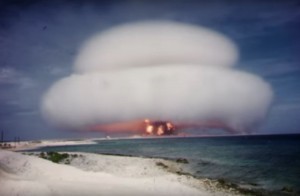
Because of their top secret status, about 10,000 reels of film recording the 210 above-ground nuclear tests conducted by the United States between 1945 and 1962 were allowed to rot in high-security vaults across the country. Now partly declassified, they are the focus of a project at the Lawrence Livermore National Laboratory (LLNL) that has spent the past five years transferring the decomposing images to digital format so as to preserve their content.
The US atmospheric tests represent a vital treasure trove of data for physicists and weapons engineers. Because no US above ground tests have been conducted in 55 years and no American tests at all have taken place since 1991, the records of those first fission and fusion bomb explosions are a literally irreplaceable resource for scientists and engineers tasked with maintaining and modernizing the US nuclear arsenal, as well as for pure research.
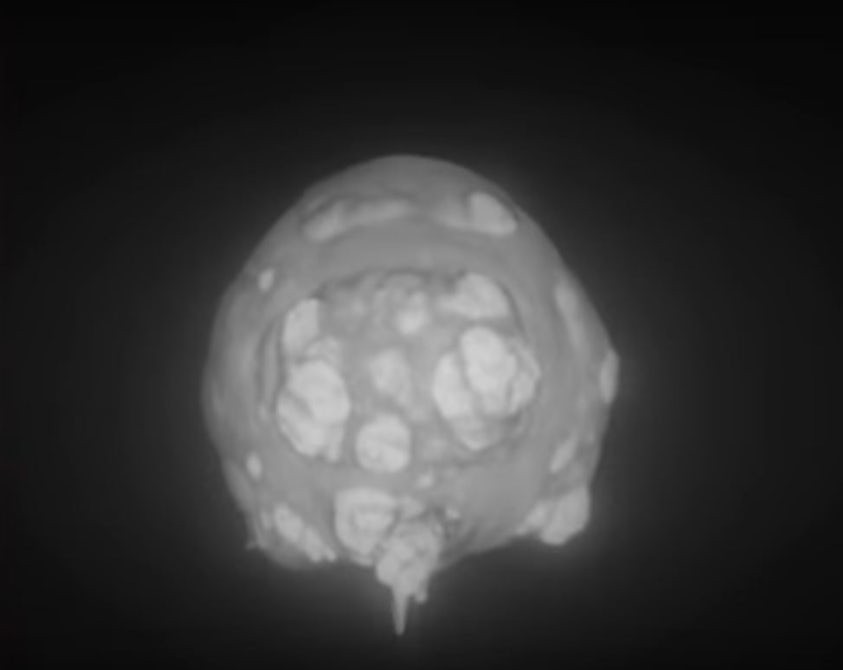
Conducted by LLNL weapon physicist Greg Spriggs and a team of film experts, archivists, and software developers, the project’s goal was to track down as many as possible of the ten-thousand 2,400 frames per second reels of film. This was because the cine film, and its immense historical and scientific value, was in danger of being lost for all time. The reels were mostly of acetate stock that was not stored under anything like ideal conditions and was slowly decaying or being attacked by fungus and microbes.
“You can smell vinegar when you open the cans, which is one of the byproducts of the decomposition process of these films,” says Spriggs. “We know that these films are on the brink of decomposing to the point where they’ll become useless. The data that we’re collecting now must be preserved in a digital form because no matter how well you treat the films, no matter how well you preserve or store them, they will decompose. They’re made out of organic material, and organic material decomposes. So this is it. We got to this project just in time to save the data.”
According to LLNL, the preservation process was anything but straightforward. Not only did it involve rescuing the film, but also required the modification of a digital scanner to handle the optical density of the film, as well as hunting down data sheets of the many tests to find the camera location, its speed and focal length for analysis.
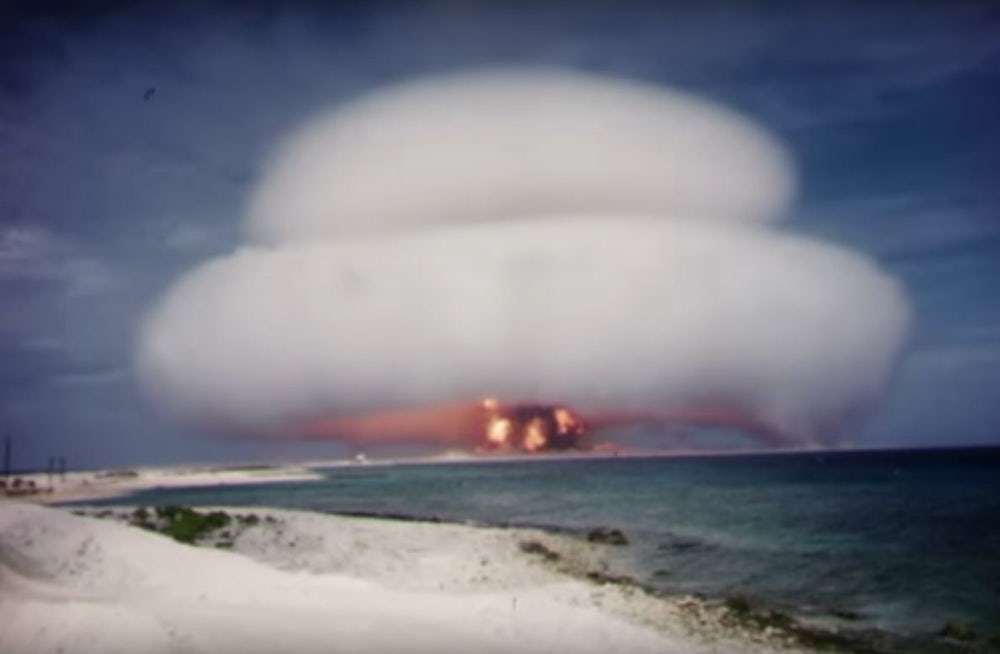
When the first films were analyzed, it became apparent that much of the published data from the early tests were wrong – often by as much as 30 percent. According to Spriggs, this was because the original analysis was done manually using blown up still frames and eyeball measurements. Even with a thousand analysts, that meant a very large workload and a very high chance of error.
For the LLNL project, the much smaller team relied heavily on automation to scan the film at thousands of frames per second, so what took days in the 1950s could be accomplished in minutes. So far, 6,500 reels of film have been recovered, of which 4,200 have been scanned and about 400 to 500 analyzed. In addition, 750 have been declassified and 63 are available for public viewing on YouTube. Though this data will be used for the US nuclear weapons program, Spriggs hopes that the new videos will make using such devices less likely.
“It’s just unbelievable how much energy’s released,” he says. “We hope that we would never have to use a nuclear weapon ever again. I think that if we capture the history of this and show what the force of these weapons are and how much devastation they can wreak, then maybe people will be reluctant to use them.”
The video below discusses the film preservation project.
This is the first portion of the declassified tests released so far:
Ask me anything
Explore related questions