




Scientists have known for a while that the Arctic is melting. The signs are everywhere—from the famed Alaskan Iditarod course being moved multiple times due to lack of snow, to the emergence of starving polar bears with nowhere to hunt.
But while scientists are certain that the Arctic is melting at an alarming rate, they aren’t really sure why.
Although anthropogenic climate change accounts for some of the melting, Arctic ice is disappearing much faster than climate change models predict it should. A new study in Nature Climate Change sheds new light on the mystery.
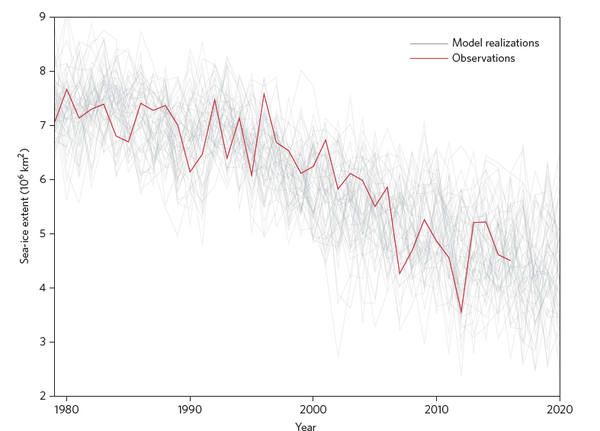
“There is a mismatch between the model’s output and the observation,” said lead author Qinghua Ding, a professor in the Geography Department at the University of California Santa Barbara. “Observation shows very fast, very abrupt sea ice melting, whereas the climate model cannot capture the fast melting.”
(Neil Swart/Nature Climate Change)
September Arctic sea-ice extent. The red line shows satellite observations, and the grey lines show 50 possible alternative realizations of internal variability, derived from the (mean adjusted) Canadian Earth System Model version.
To understand why, Ding and his team focused on the connection between September sea-ice extent (or how much of the Arctic sea had at least 15 percent sea ice) and the preceding summer’s (June-August) atmospheric circulation. Ding knew from earlier work that tropical circulation can affect seasonal variability of sea ice in the Arctic.
Under normal conditions—in other words, when climate change isn’t a factor—the North Atlantic Oscillation (a weather phenomenon due to a mass of air over Greenland that controls wind patterns and storm tracks) causes year-to-year weather variability in the Arctic. When the North Atlantic is in its positive oscillation (circulating from left to right), it keeps the jet stream high and keeps cooler air in the Arctic. When it’s in its negative oscillation, it allows the cooler air to escape the Arctic, resulting in warmer Arctic temperatures. These are broad trends, and some areas can warm up during a negative oscillation and vice-versa—but the Arctic overall will behave accordingly. What Ding’s previous work showed was that tropical air patterns from the Pacific can affect the North Atlantic Oscillation. The new study uses this knowledge to model how these natural patterns change the Arctic.
“In the model we turned off all CO2 forcing,” said Ding, or all climate changes that were “forced” by the addition of carbon dioxide into the atmosphere. “And we still got some sea ice melting, that was very similar to the observation.”
To understand how adding more air to the North Atlantic Oscillation could warm the Arctic, Ding says it helps to think of a flat bicycle tire.
“If you keep pumping air into a flat tire, if you touch your frame of your tire it gets warmer and warmer,” said Ding. “You’re doing some work to push air into your tire, and the tire has just a certain volume, so as you push air into a certain volume it becomes very condensed and becomes warmer.”
But even if the added air is warming the Arctic, who’s to say that the shifting circulation isn’t itself due to climate change?
“If the circulation changes are caused by anthropogenic greenhouse warming (or other human or natural external forcings such as ozone depletion, aerosol emissions, or solar activity) this pattern of atmospheric change should emerge as a clear signature when averaging together many climate model simulations of this period,” Neil Swart, a Research Scientist with Environment and Climate Change Canada who wasn’t involved in the new study, wrote in an accompanying article.
But when Ding averaged the climate models together, the air circulation changes canceled each other out—like a balanced equation. They only data that remained in the models was responding to external forcings, like greenhouse gas emissions. In other words, Ding found that between 30-50 percent of the arctic melting is due to these unforced, or non-climate change caused variations—and that with this factored in, the climate models were generally accurate. The increased rapidity of Arctic melting was due to natural variations outside of the scope of the climate change models.
Ding is quick to point out that this doesn’t mean that climate change isn’t real. He equates these natural variations to putting a blanket on the sea ice, while climate change is turning up the thermostat. And as anyone who has huddled under a blanket in a toasty house knows, the end result is a whole lotta sweat.
Ask me anything
Explore related questions