





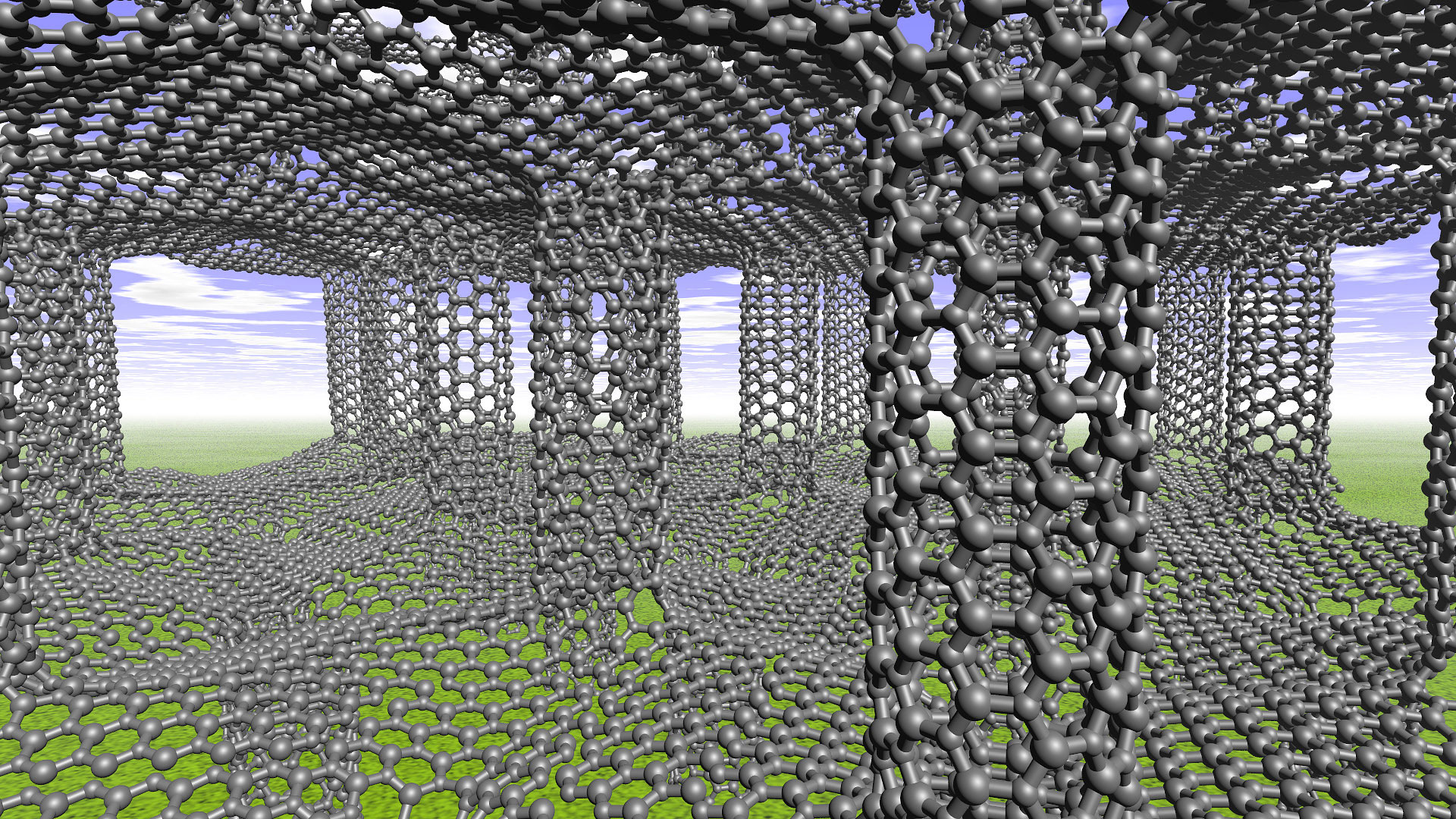
In case it wasn’t already awesome enough, physicists have found a new way to turn ‘wonder material’ graphene into a ridiculously powerful superconductor, capable of shuttling electricity with zero resistance.
Graphene is already an overachiever – just one atom thick, it’s stronger than steel, harder than diamond, and incredibly flexible. And last year, it became even more amazing, when scientists found a way to unleash its long-rumoured superconductive abilities. Now, for the first time, scientists have shown that they can achieve a new type of superconductivity simply by putting graphene in contact with other superconductors.
Superconductivity is a big deal, even for a material as talented as graphene. Normal conductors such as silver and copper are good at carrying an electrical current, but electrons travelling through them still bounce off defects in the material, losing energy as they go.
But inside superconductors, electrons pair up and move through the material as one, without losing any energy to friction.
That’s important, because if we could find a way to achieve superconductivity at room temperature, it would lead to vastly more efficient electronic devices, not to mention power lines. Right now, energy companies are losing about 7 percent of their energy as heat as a result of resistance in the grid.
So far, graphene has only been shown to become superconductive at super-chilled states, and this new experiment is no different.
But thanks to the material’s other remarkable properties, that’s still worth getting excited about, seeing as we could one day use graphene to build tiny, high-speed electronic devices that don’t waste any energy as heat.
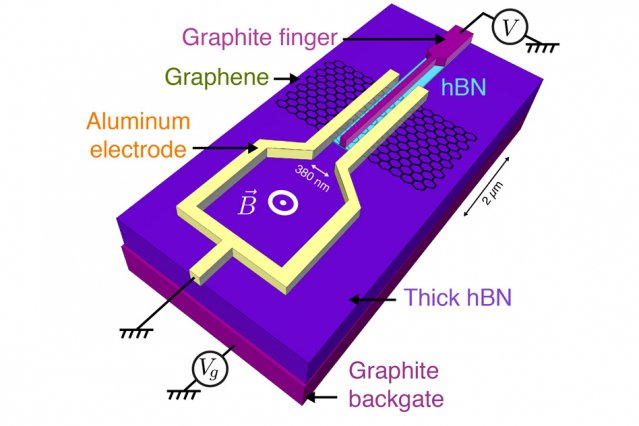
In the latest study, physicists from MIT took a flake of graphene and sandwiched it between aluminium, which behaves at a superconductor at low temperatures.
They chilled the entire set-up to around 20 millikelvin (-273.13 degrees Celsius or -459.6 degrees Fahrenheit), switching on aluminium’s superconductive abilities.
When that happened, the team showed that it caused graphene to changes its electronic state dramatically and actually take on some of the qualities of the superconductors.
“[The superconductors] are actually giving graphene some superconducting qualities,” said lead researcher Landry Bretheau.
“We found these electrons can be dramatically affected by superconductors.”
Most importantly, instead of the electrons in graphene acting as individual, scattering particles, they started to pair up into what’s known as ‘Andreev states’ – a configuration that allows materials that traditionally aren’t superconductive to carry a ‘supercurrent’ that flows without losing energy.
Unlike electron pairs in traditional superconductive materials, which are known as Cooper pairs, the electrons in graphene actually pair up out of frustration, as they’re being pulled two different directions by the superconductors on either side of the sandwich.
“Electrons in a superconductor dance harmoniously in pairs, like a ballet, but the choreography in the left and right superconductors can be different,” said Bretheau.
“Pairs in the central graphene are frustrated as they try to satisfy both ways of dancing. These frustrated pairs are what physicists know as Andreev states; they are carrying the supercurrent.”
This effect was first predicted back in 1962 by British physicist Brian David Josephson, but this is the first time it’s ever been shown to be possible within graphene, or any two-dimensional material.
Other teams have also managed to turn graphene into a superconductor without the influence of any other materials.
But not only does this technique offer a simpler way to unleash the superconductive power of graphene, it also opens up the possibility of studying even more lucrative and exotic particles that might appear within graphene.
Of particular interest are Majorana fermions, which are thought to arise from Andreev states and could be used to one day build powerful, error-proof quantum computers.
“There is a huge effort in the condensed physics community to look for exotic quantum electronic states,” said Bretheau.
“In particular, new particles called Majorana fermions are predicted to emerge in graphene that is connected to superconducting electrodes and exposed to large magnetic fields. Our experiment is promising, as we are unifying some of these ingredients.”
The research has been published in Nature Physics.
Ask me anything
Explore related questions