




The batteries of North Korean artillery lie just on the other side of the divided peninsula’s demilitarized zone. There are thousands of them—some hidden, others out in the open. Artillery shells are stored in an elaborate network of tunnels; and though much of the weaponry and ammunition is old, U.S. forces stationed in South Korea have no doubt they would be effective.
Less than 40 miles to the south is the sprawling city of Seoul, the capital of South Korea, with a metropolitan area of 24 million inhabitants. Ever since a cease-fire ended hostilities between North and South Korea in 1953, the residents of Seoul have lived with the knowledge that a war with their brethren in the north could break out again; it is a notion not often acknowledged but embedded in their DNA. And now, again, the fraught Korean Peninsula seems a single miscalculation away from calamity. Since his election, President Donald Trump and his foreign policy team have escalated their rhetoric about the North, insisting that U.S. patience with North Korea’s nuclear and missile program has run out. Pyongyang has responded with rhetoric even more bellicose than usual. On April 20, a state-owned newspaper threatened that Pyongyang would deliver a “super-mighty pre-emptive strike’’ against the U.S., whose forces were in the midst of massive military exercises with their South Korean ally.
No one in Seoul is heading for the bomb shelters yet. Pragmatism, and an abiding assumption that nothing terribly bad will actually happen, prevails. “No matter how much tensions increase, we just go about our lives,” says Park Chung Hee, a 40-year-old businessman whose grandfather was killed in the Korean War. “What else can we do?” But everyone living on the peninsula knows that those North Korean artillery batteries are there to pummel Seoul if another war breaks out. And that if it does, Seoul will get hit, and hit hard. The amount of time from the instant a shell is fired to impact in the South Korean capital? Just 45 seconds.
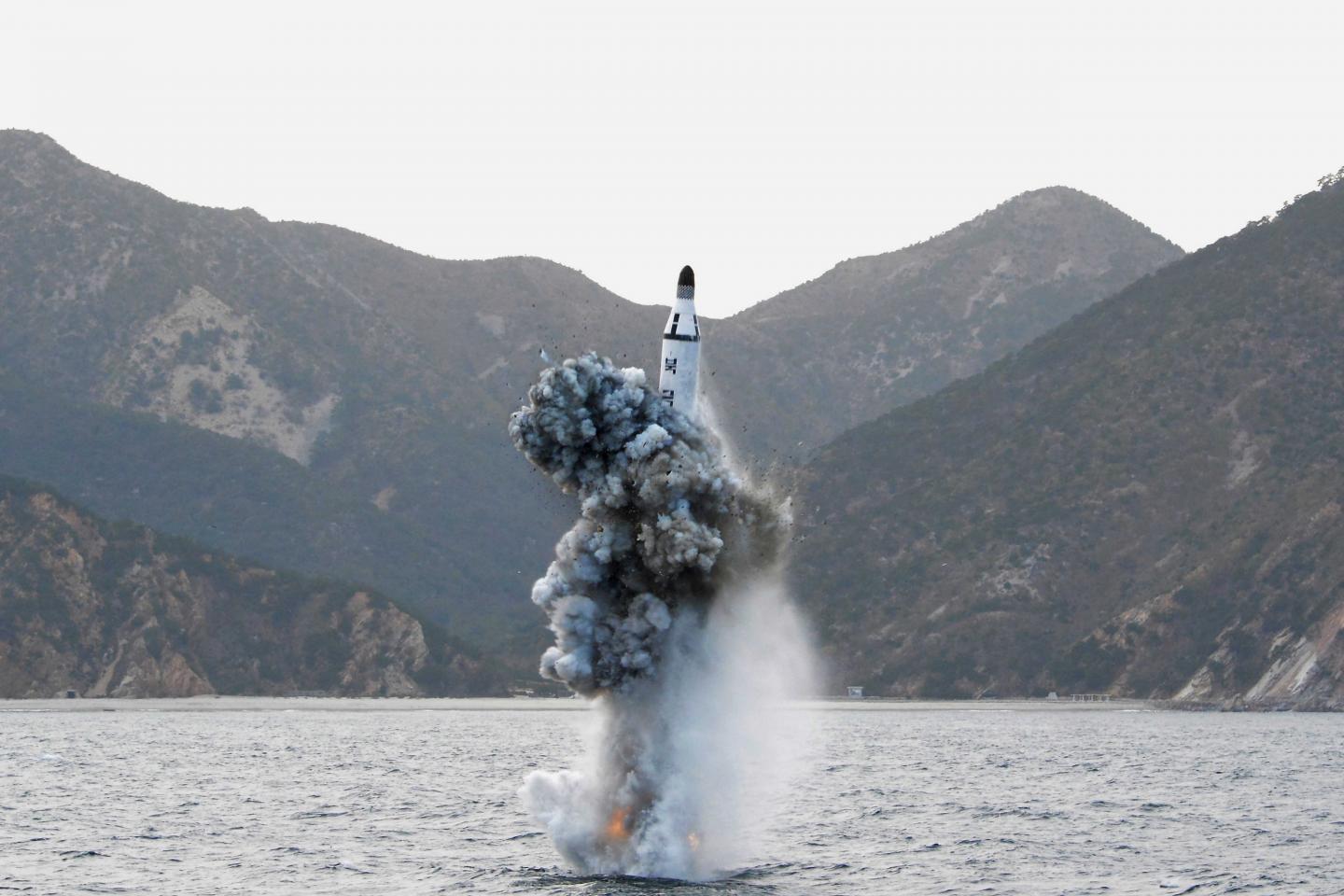
U.S. alarm about North Korea has spiked for two main reasons: The first is the aggressive missile-testing regimen Pyongyang has carried out under Kim Jong Un. During his four-year reign, Pyongyang has already test-fired 66 missiles, more than twice as many as his father Kim Jong Il did during his 17 years in office. Kim’s regime has gradually increased the range of its missiles. Combine that with the North’s efforts to miniaturize its nuclear arsenal, so that its 10 to 16 bombs can fit onto a warhead, “and you have two streams coming together—range and miniaturization—that you don’t want to cross,” says retired Admiral James Stavridis, now dean of the Fletcher School for diplomacy at Tufts University.
(An underwater test-firing of a strategic submarine ballistic missile in an undated photo released by North Korea’s Korean Central News Agency -KCNA- in Pyongyang on April 24, 2016)
Some U.S. commanders fear the North can already put a nuclear warhead on a missile. Admiral Bill Gortney, head of the North American Aerospace Command, told Congress two years ago that he believes Pyongyang can use a medium-range missile to deliver a nuclear payload, meaning it can hit South Korea or Japan. The consensus intelligence estimate is that the North is now 18 to 36 months away from sticking a nuke on a missile that can reach Los Angeles. All that explains why from both current and former military officials, there has been increasing talk of pre-emption. In November 2016, General Walter Sharp, former commander of U.S. Forces Korea, stated that if North Korea puts a long-range missile on a launch pad, and the U.S. is unsure of its payload, Washington should order a pre-emptive attack to destroy that missile.
But the grim reality is that a pre-emptive strike, against North Korean missiles or nuclear facilities—or both—could well mean war. Should the day come when President Trump believes he needs to order a pre-emptive strike against targets in North Korea to eliminate a direct threat, the U.S will not be able to take out all of the North Korean artillery front loaded near the border. “Not,” says former National Security Council staffer Victor Cha, “without using tactical nuclear weapons,” which is not something the U.S. would consider, given that Seoul is right down the road. A U.S. strike, simply put, could well trigger the second Korean War.
What would another armed conflict on the peninsula look like? During the Korean War, which lasted from 1950 to 1953, some 2.7 million Koreans died, along with 33,000 Americans and 800,000 Chinese. In any pre-emption scenario now, the U.S. would try keep the strike limited to the task at hand; at the same time Washington would signal in any way it could—probably via the North’s ally in Beijing–that it did not seek a wider war.
For the past two years, the U.S. and South Korea have been practicing pre-emption exercises. In 2015, they adopted a new war plan, OPLAN 5015, which includes attacks on the North’s nuclear and missile facilities, as well as “decapitation attacks” against Kim Jong Un and the rest of the North Korean leadership.
South Korea also developed its own pre-emptive attack plans, and has acquired, U.S. and Korean officials say, weapons capable of destroying some of North Korea’s weapons of mass destruction. Seoul has also built an elaborate defense system, which includes the recent delivery of the U.S. terminal high altitude area defense system, which shoots down incoming missiles in the final phase of their descent.
The U.S. does not want to have to pre-empt, of course. As Trump’s National Security Adviser H.R. McMaster said on April 16, every option “short of war” is on the table in order to dissuade the North from deploying nukes on long-range missiles. “No one is looking for a fight here,” insists another Trump adviser not authorized to speak about this matter on the record.
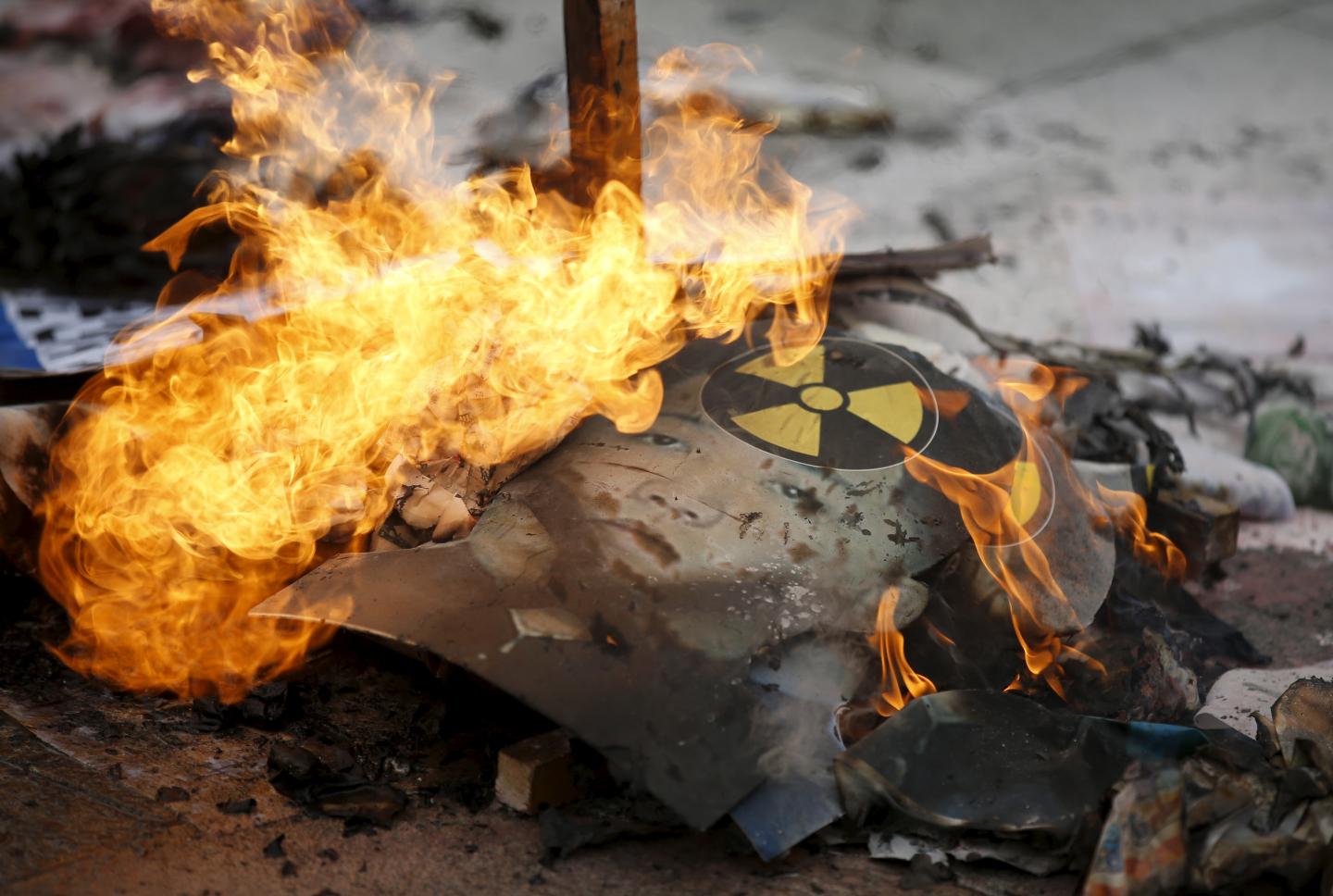
(A cutout of North Korean leader Kim Jong Un is set alight during an anti-North Korean rally in Seoul, South Korea, on August 21, 2015)
Read the rest of the article HERE
Ask me anything
Explore related questions