





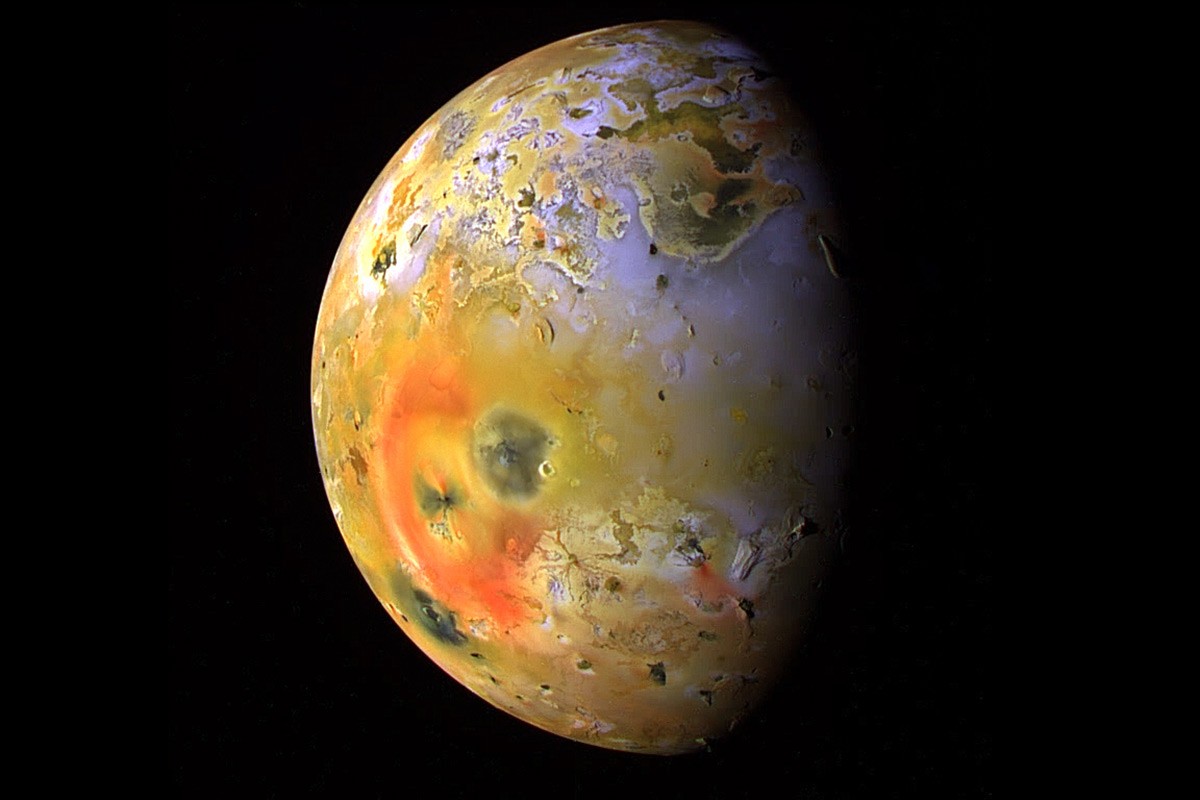
Surf’s up on Jupiter’s moon. Magma waves travelling both clockwise and anticlockwise have been spotted on the surface of a lava lake on Io, the most volcanically active body in the solar system.
The lake, called Loki Patera, is a bowl-shaped volcanic crater on Io, Jupiter’s innermost moon. It is roughly 200 kilometres across, and responsible for 10 to 20 per cent of the heat that the jovian moon puts out.
We’ve known that Loki periodically brightens and dims since the 1970s. Previous observations suggested that these changes are due to the lake recycling itself. As the top layer of lava cools, it solidifies and grows dense, until eventually it sinks beneath the underlying magma and pulls nearby crust with it in waves moving across the surface.
But most of those observations, based on a technique for reducing atmospheric blurring called adaptive optics, were only sharp enough to tell which direction the waves were moving, not how fast or where they started.
Now, Katherine de Kleer at the University of California, Berkeley and her colleagues have taken advantage of a rare collusion between Jupiter’s moons to get a high-quality time lapse of the lava lake’s surface.
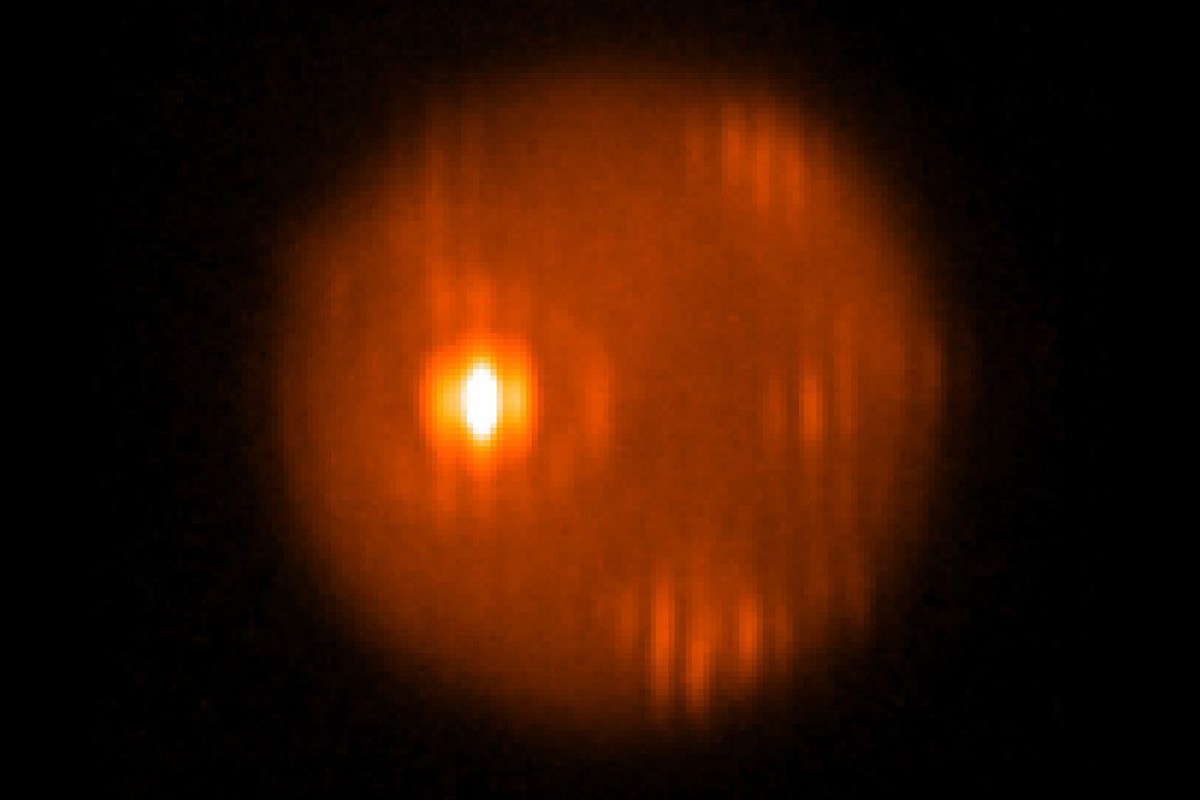
(Time-lapse images of the lake’s surface reveal how its surface regenerates)
Every six years, the orbits of Io and Europa – a moon of Jupiter best known for its ice shell covering a liquid water ocean – align, then cross one another from the point of view of Earth.
On 8 March 2015, de Kleer and her colleagues turned the Large Binocular Telescope Observatory in Arizona on the criss-crossing moons to observe the heat coming from Loki Patera in unprecedented detail.
By combining adaptive optics with the binocular observations, they were able to make a map of changing temperatures over time across the lava lake surface with 10 times better spatial resolution than previously possible. “People have looked at Io with each of these methods, but not together,” de Kleer says.
Double wave
Knowing the temperature of different parts of the lake and how fast the magma cooled and sank helped de Kleer’s team decipher which parts of the surface recycled at which times.
Surprisingly, the temperature map revealed not one, but two waves, one clockwise and the other anticlockwise, moving from the west to the southeast of the lake. The waves started at different times and ran around a cool island in the lake’s centre.
“It’s a giant bowl of molten rock; it should all be behaving the same,” says Julie Rathbun at the Planetary Sciences Institute in Tuscon, Arizona. “But having two waves suggests there are compositional differences within the lake, and that’s strange.”
De Kleer thinks understanding how new magma is exposed on Loki Patera’s surface can offer insight into volcanism on planets and moons that are different from Earth. Io is in an almost constant state of eruption, but it lacks the plate tectonics that are responsible for much of our own planet’s volcanic activity. Instead, its volcanoes are largely driven by tidal heating from Jupiter’s enormous gravity.
It could also shed light on subsurface oceans on moons like Europa and Saturn’s Enceladus, which are also probably kept warm by tidal heating.
“The same process might lead to volcanic activity at the bottom of those oceans that injects the raw materials that would make these systems able to host life,” de Kleer says. “Understanding how heat is deposited in and transported through satellite interiors is therefore important for understanding the potential habitability of these other worlds.”
Ask me anything
Explore related questions