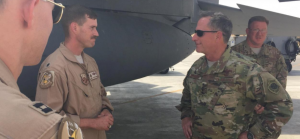
U.S. Air Force pilot Lieutenant Colonel Jeremy Renken knew that whatever happened next might escalate the war in Syria.
The 40-year-old father of four was flying his F-15E Strike Eagle fighter jet in “a race track” pattern around an Iranian-made drone, which had just tried to kill U.S.-backed forces and their advisers on the ground.
After the drone’s first shot failed to detonate on impact, it was positioning to strike again.
So, on June 8, in what was an unprecedented move in the U.S. air war over Syria to that point, Renken shot it down, even as two Russian fighter jets watched from a distance.
“When we saw the drone turn back towards friendly forces, we weren’t waiting around for anybody’s permission. We destroyed it,” Renken said in his first interview about the incident.
Renken’s downing of the Iranian drone, a Shaheed 129, was the first in a series of several defensive U.S. air-to-air shootdowns over several weeks in June that at first appeared to signal a tipping point to a far more dangerous air war in Syria.
But since the decisions by Renken and other U.S. pilots to fire at two drones and a manned Syrian fighter jet in June, there haven’t been similarly provocative actions by pro-Syrian forces. U.S. officials say they seem to have delivered the message.
Renken’s case, in many ways, highlights not just the risks of Syrian conflict in which Russia, Syria, the United States and its allies are flying military jets within targeting range of each other.
But it also illustrates the tremendous responsibility entrusted to U.S. pilots to make life-or-death decisions in an instant, with broad, strategic implications for the war.
Renken spoke with Reuters from a U.S. military installation in the Middle East, which does not disclose its location at the request of the country hosting it.
LETHAL INTENT
Renken, a squadron commander, developed his Air Force career in the shadow of the Sept. 11, 2001 attacks on the United States by al Qaeda. He was training as a pilot when suicide hijackers flew into the World Trade Center and has since deployed over and over again to the Middle East.
But Renken acknowledges that the Syrian air war is, in his view, unique.
U.S. pilots, who have enjoyed air supremacy against the insurgents they’ve been battling in Afghanistan, Iraq and Syria, cannot be sanguine about the risks posed by advanced Russian or Syrian jets or ground-based air defense in Syria.
Armed aircraft from Syria, Russia, the United States and its coalition allies are all flying within a “no escape” range of each other’s weapons.
“We can all engage each other. So it takes a lot of discipline and studying the nuance of a circumstance to (determine): ’Was that an escalation?’,” Renken said.
As U.S.-backed and Russia-backed ground forces scramble to capture what is left of Islamic State’s caliphate, the risk of accidental contacts between the sides is growing, raising the stakes both on the ground and in the air.
But while the U.S. military has had years to iron out how and when to engage Islamic State fighters on the ground, American pilots are still gaining experience deciphering hostile intent by other aircraft in the skies above Syria.
CLOSER THAN THOUGHT
The U.S. Air Force proudly boasts that no U.S. soldier has been killed by enemy aircraft since 1953. But the drone attack threatened to change that, if accounts by two U.S. officials of a limited American presence in the convoy that day are correct.
The U.S. military initially said the drone dropped a bomb that missed the convoy, which included U.S.-backed fighters and their advisors. Renken offered a slightly different account.
He said the drone was actually carrying missiles. When it fired, it hit the door of one of the vehicles with a munition that failed to detonate, he said.
“It was a dud round. So, very lucky,” Renken said. “It was definitely intended to be a lethal shot.” The criteria needed to fire the drone had been clearly met, he said.
Still, one factor complicating his decision to return fire was the presence of the Russian “Flanker” fighter jets, who might think that Renken was shooting at them.
“Is (the Russian pilot) going to see a missile come off of my aircraft and consider that a potential aggression against him?” he explained.
Another problem was that the drone was small enough that the missile Renken would fire could potentially go long and inadvertently head toward the Russian jet.
“(There) was a lot of potential for escalation,” he said.
For Renken, the big takeaway for pilots is that the war in Syria has evolved far beyond simply striking Islamic State targets on the ground.
U.S. pilots have to be prepared for anything.
“What this recent event has proven is that you can’t take for granted that you know what the fight is going to look like,” Renken said.
“You need to walk in ready for it to metastasize into any hybrid variation.”
Ask me anything
Explore related questions