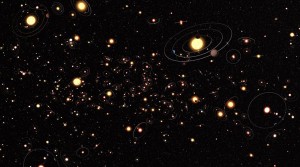
The number of exoplanets has risen by almost 100, as an international team of astronomers confirms a new batch found in data captured as part of the K2 mission – the NASA Kepler telescope’s new lease on life.
They have been analysing the first batch of K2 data, and have just announced the discovery of another 95 planets – bringing the total number of exoplanets discovered by K2 to nearly 300.
“We started out analysing 275 candidates of which 149 were validated as real exoplanets. In turn 95 of these planets have proved to be new discoveries,” said PhD student Andrew Mayo from the Technical University of Denmark, and lead author on the project.
The Kepler mission was launched in 2009. Since then, it has trailed Earth’s orbit around the Sun, searching for exoplanets using the transit method – photographing stars over time, and looking for changes in the brightness.
If a star dims, then brightens again on a regular basis, that more than likely means it’s being orbited by a body large enough to block at least some of its light.
The method requires a lot of painstaking work poring over data to find the periods of dimness, and then confirm them. It also only works if the planet orbits between the observer (us, or rather the Kepler telescope) and its star.
Nevertheless, it’s very effective. The Kepler main mission found 2,341 confirmed exoplanets, according to NASA.
But then disaster struck in 2013, when the second of the telescope’s four reaction wheels failed. The mission was revived as K2 when NASA figured out a way to use Kepler’s thrusters as a makeshift reaction wheel, therefore retaining the ability to reorient the telescope to look at different parts of the sky.
Thankfully, it’s still at work to this day.
The data used for Mayo’s team’s analysis was collected in 2014. They had to comb the data thoroughly to make sure the stars’ dimming was not caused by other factors.
“We found that some of the signals were caused by multiple star systems or noise from the spacecraft. But we also detected planets that range from sub-Earth-sized to the size of Jupiter and larger,” Mayo said.
“We validated a planet on a 10 day orbit around a star called HD 212657 [about 254 light-years away], which is now the brightest star found by either the Kepler or K2 missions to host a validated planet.”
The brighter the host star, the more we can determine about the planet that orbits it – perhaps even more so when the next generation of much higher resolution space telescopes is launched.
Astronomers may be able to even glean information about its atmosphere, as they have done for TRAPPIST-1 planets.
Between them, the Kepler and K2 missions have been used to find over 5,100 candidate exoplanets to date.
This is partially about the search for extraterrestrial life, but also because statistical data about the universe around us – such as how many planets there are, the average number of planets per system, and the number of rocky and gaseous planets – can tell us more about how typical (or not) our own Solar System is, and how it fits into our Universe.
source: sciencealert.com
Ask me anything
Explore related questions