




What is the back story?
Czechoslovakia – modern day Czech Republic and Slovakia – was firmly under the influence of the communist Soviet Union after WWII.
After the death of dictator Joseph Stalin in 1953, the Soviet satellite states that had been under his power began to relax controls.
Nevertheless, by 1967 there were more voices speaking out against the regime over freedoms and the economy.
Czechoslovakia going into recession in 1963 was a blow to communist central planning and planted further doubts about the Soviet system, according to Kieran Williams, visiting professor of political science at Drake University in Iowa.
“The search for a more appropriate, responsive economic model then led to the realization that changes were needed in politics: there had to be greater freedom to discuss the country’s problems, and decision-making had to be nimbler and less bureaucratic,” he said.
“Slovaks were especially resentful of the concentration of power in Czech hands in Prague. Intellectuals who had once been loyal Communists became restless. A new generation of young people was coming of age that wanted more freedom, including contact with the west.”
What happened during the Prague Spring?
The realization that political change was necessary saw Antonin Novotny replaced as head of the Communist Party of Czechoslovakia in January 1968.
His replacement, Alexander Dubcek, was a reformer and in April 1968 his government announced a change of direction.
It was branded as “socialism with a human face”.
It saw the introduction of freedom of speech, prompting magazines to spring up and political debates on television.
There were also economic alterations. Instead of producing what the state told them to, farmers were allowed to form independent co-operatives and direct their own work.
“The most important issue is to change the bearing of our economic planning in such a direction so that the results of the work of the whole society correspond to our needs,” Oldrich Cernik, Czechoslovakia’s Prime Minister is quoted as saying.
“That is, so that production is directed towards satisfying the miscellaneous needs of the people. It often happened in our economy that we produced for the sake of production.”
What happened next?
Dubcek had attempted to reassure Moscow over his reforms but in July 1968, after a meeting between the Soviet Union and other satellite states, a letter was sent to Czechoslovakia warning it against carrying on with the reforms.
“We will keep following the direction that we started pursuing in January of this year,” responded Dubcek in an address on television.
“The Party is supported by the trust of our people. The people will not allow any return of pre-January times. Our journey will not be easy. What we need is to work quietly and in solidarity on the common task. We need to rectify errors and deformations, while getting away from the narrow group of people who bear responsibility for them.”
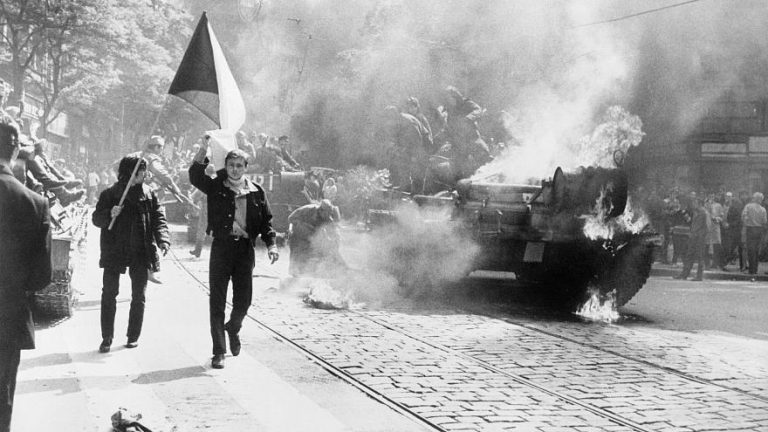
Then, four months after the reforms were introduced, on the night of August 20/21, 1968, Czechoslovakia was invaded.
Troops from mainly the Soviet Union — but also from Bulgaria, Hungary, East Germany and Poland — moved into Prague in a huge show of power.
Czechoslovakia’s military was told to not intervene and Dubcek pleaded with his people not to use force.
The death toll from the invasion has been put at between 82 and 137 people.
Dubcek’s reforms were abandoned and he was arrested and taken to Moscow. After being told what was expected of him, he returned to Czechoslovakia and stayed in power until April of the following year.
What is the legacy for Czechs and Slovaks?
“It damaged, if not destroyed a history of positive feelings toward Russia, and cemented a reorientation toward the west culturally,” Dr Williams told Euronews.
“A minority remained committed communists and pro-Moscow, and those voices can still be heard in the successor states today.
“The invasion also ssensitizedCzechs and Slovaks even more than they already were to the problem of sovereignty of smaller nations, which may account for some of the reservation Czechs express today toward the European Union.”
Source: euronews
Ask me anything
Explore related questions