





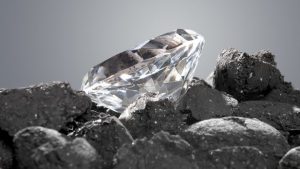
In case you weren’t already sure that diamonds aren’t as unique or valuable as advertisers want us to believe, the next blow to Big Diamond might have just arrived. Using sound waves, geologists have discovered a gigantic stash of the so-called precious stones deep in the Earth’s interior, possibly to the tune of a quadrillion tons.
The study began when an international team of researchers set out to solve a long-standing geological mystery. Scientists can infer what kinds of rock makes up different parts of the planet by studying seismic activity. Basically, the sound waves created as the result of earthquakes or volcanic rumblings will travel at different speeds through different types of rock, painting a picture of what’s down there.
But one area doesn’t behave like it would be expected to. Cratons are the oldest and most immovable slabs of rock on (or rather in) Earth, with roots stretching down from the center of the tectonic plates to a depth of up to 200 mi (320 km). The assumed makeup of these pillars would produce faster sound waves, but not to the speeds that have been observed.
“The velocities that are measured are faster than what we think we can reproduce with reasonable assumptions about what is there,” says Ulrich Faul, an author of the study. “Then we have to say, ‘There is a problem.’ That’s how this project started.”
To figure out what the cratonic roots could be made of, the team studied seismic data gathered by the US Geological Survey and other organizations to create a 3D model of how these waves propagate through cratons. Then, they simulated sound waves moving through a wide range of different combinations of rock types to find one that matches the observed velocities.
In the end, only one particular rocky recipe produced the same sound wave speeds. Cratons would need a diamond content of about one to two percent, with the rest made up of peridotite and small amounts of eclogite.
That might not sound like very much diamond, but given the entire volume of cratons on Earth, the team estimates there could be up to a quadrillion tons of the stuff down there – about 1,000 times more diamond than was previously known.
“This shows that diamond is not perhaps this exotic mineral, but on the [geological] scale of things, it’s relatively common,” says Faul. “We can’t get at them, but still, there is much more diamond there than we have ever thought before.”
The find is just the latest trove of inaccessible diamonds that show the gems aren’t all that rare after all. They’ve been found in meteorites from long-lost worlds, raining down on Neptune, floating in clouds around distant stars, and may even make up entire planets.
The research was published in the journal Geochemistry, Geophysics, Geosystems.
Source: MIT
Ask me anything
Explore related questions