




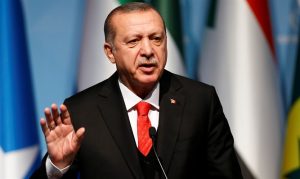
“The one who comes by way of crisis goes away by way of crisis” is a mantra that one often hears in Turkey’s opposition quarters. It’s about President Recep Tayyip Erdogan, who was propelled to power by a crisis that erupted in 2001, then the worst Turkey had ever seen. In early elections in 2002, voters held the ruling coalition responsible for the joblessness and abrupt impoverishment the crisis had caused. All three coalition parties were ousted from parliament, and Erdogan’s Justice and Development Party (AKP) won a mandate to govern the country alone.
After 16 years of AKP rule, Turkey is again facing an economic crisis, fueled by the meltdown of the Turkish lira. The first omen came when the lira began to slide ahead of the 2017 constitutional referendum that Erdogan called to pave the way for an executive presidential system. The currency crisis worsened abruptly in early August, following Erdogan’s victory in the June 24 presidential polls. The lira lost 23.3% of its value in a single day on Aug. 10. US President Donald Trump’s decision to raise tariffs on steel and aluminum imports from Turkey played a triggering role, but the central problem was Turkey’s increased economic fragility under the growing weight of bulky foreign debts.
The lira’s depreciation has led to a sharp surge in inflation, an economic slowdown and more jobless people. So the one projected to “go away by way of crisis” is, of course, Erdogan. But is it that easy?
Anticipation of his demise appears to be sprouting among some foreign observers. Take, for instance, the Sept. 25 report by the Washington Post.
The report is about Turkey’s building spree now “crashing to a halt.” Referring to the Turkish Central Bank’s mid-September rate hike, it reads, “The belated rate increase virtually guarantees a recession — with unpredictable political fallout, economists say. In the months ahead, the president will face more tough decisions, including over a potential IMF bailout, that will test his ability to balance crowd-pleasing rhetoric and the economy’s need for bitter medicine. The danger is that Erdogan’s slow-motion pragmatism may not move fast enough to prevent a Turkish meltdown. ‘Authoritarian regimes run into trouble when the economy runs into trouble,’ said Harvard University government professor Jeffry Frieden, author of ‘Global Capitalism.’”
The scholar sees Turkey as an “authoritarian” regime, a description that has gained general acceptance in the Western hemisphere in recent years. One could also speak of a general consensus that economic growth requires intolerance of corruption, merit-based decision-making, sound legal guarantees for private property and business contracts and a properly functioning judicial system.
In Turkey, those prerequisites have become increasingly elusive since the failed 2016 coup attempt that led to a state of emergency that virtually suspended the rule of law, and the ensuing transition to a presidential regime under which this situation has continued largely unchanged. In a country that lacks those prerequisites, one can speak only of misgovernment or the lack of the ability to govern. It was no coincidence that the first signs of Turkey’s currency crisis emerged ahead of last year’s constitutional referendum, which marked the prelude to an authoritarian presidential regime.
In comments to Al-Monitor, Ersin Kalaycioglu, a political science professor at Istanbul’s Sabanci University, described the most crucial element that Ankara needs to steer the country out of crisis.
Read more HERE
Ask me anything
Explore related questions