





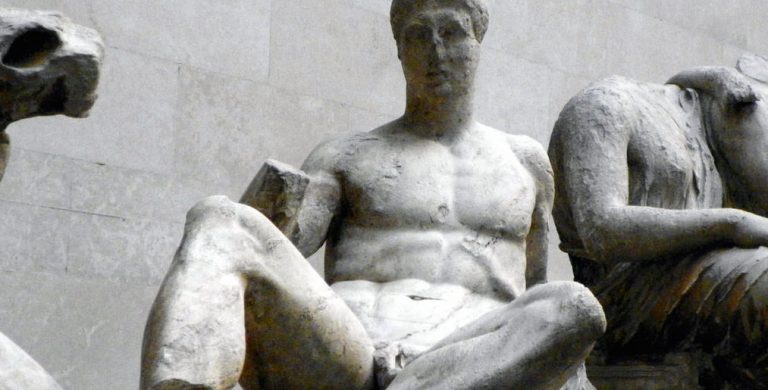
The ancient Greeks famously fetishised the male body in sculptures that represent powerful, illustrious men as hulking figures with taut, rippling muscles. Sometimes these figures appear partially clothed in drapery or cloth; often, they are stark naked.
To the contemporary eye, their bodies are ideal—except for one, ahem, seminal detail. “They have small to very small penises, compared to the average of humanity,” art historian Andrew Lear, a specialist in ancient Greek art and sexuality, says. “And they’re usually flaccid.”
Countless contemporary art lovers and historians have been struck by the modest nature of the phalluses that feature in classical sculptures of gods, emperors, and other elite men—from Zeus to celebrated athletes. The small members seem at odds with the massive bodies and mythically large personalities they accompany. But the ancient Greeks had their reasons for this aesthetic choice.
Rewind to the ancient Greek world of around 400 BC, and you’ll find that large, erect penises were not considered desirable, nor were they a sign of power or strength. In his play The Clouds (c. 419–423 BC), ancient Greek playwright Aristophanes summed up the ideal traits of his male peers as “a gleaming chest, bright skin, broad shoulders, tiny tongue, strong buttocks, and a little prick.”
In ancient Greek art, most of a great man’s features were represented as ample, firm, and shiny—so why weren’t these same aesthetic principles applied to the penis? As Lear and other historians suggest, part of the answer lies in how the phalluses of less admirable men were portrayed.
Lustful, depraved satyrs, in particular, were rendered with very large, erect genitals, sometimes almost as tall as their torsos. According to mythology, these creatures were part-man, part-animal, and totally lacked restraint—a quality reviled by Greek high society. “Big penises were vulgar and outside the cultural norm, something sported by the barbarians of the world,” writes Chrystal. Indeed, across many an amphora pot and frieze, well-endowed satyrs can be seen drinking and pleasuring themselves with abandon.
In Greek comedy, fools also routinely sported large genitals—“the sign of stupidity, more of a beast than a man,” according to Chrystal. So, too, did artistic representations of the Egyptians, says Lear, who were long-time enemies of the Greeks.
In this way, satyrs, fools, and foes served as foils to male gods and heroes, who were honoured for their self-control and intelligence (along with other qualities requiring restraint, like loyalty and prudence). If large phalluses represented gluttonous appetites, then “the conclusion can be drawn that the small, flaccid penis represented self-control,” explains Lear.
more here
Ask me anything
Explore related questions