

×
GreekEnglish

×
  • Politics
  • Diaspora
  • World
  • Lifestyle
  • Travel
  • Culture
  • Sports
  • Cooking
Tuesday
13
Jan 2026
weather symbol
Athens 4°C
  • Home
  • Politics
  • Economy
  • World
  • Diaspora
  • Lifestyle
  • Travel
  • Culture
  • Sports
  • Mediterranean Cooking
  • Weather
Contact follow Protothema:
Powered by Cloudevo
> World

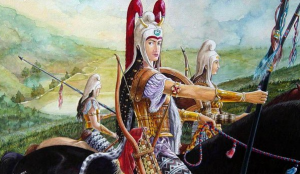
Tattooed Scythian warriors, descendants of the Amazons? (Part Three)

Royal Scythians were tattooed and apparently those tattoos attested to their elite status

Newsroom June 12 09:14

The origin of the word Amazon may have come from the Iranian language.  The work ha-mazan (phonetic pronunciation) meant warrior and the nomadic Scythians that migrated into the eastern European region are believed to have been Indo-Iranian tribes so the etymology of the word seems right.  As the Scythian nomads moved across the area, described in Herodotus’ third story of their origin, a stratified society developed  in which the farmers and herders (the earlier inhabitants) were lower status and the newer Scythian warrior class became the royal or ruling class.

>Related articles

Maria Machado at the Vatican, a few days before she meets Trump

Erich von Däniken, Swiss bestselling author who linked ancient civilizations to extraterrestrials, dies at 90

Who are the Basij militias who are spreading terror among protesters in Iran?

However, unlike most societies that are absorbed by a warrior based culture, this one did not immediately or exclusively denigrate women to the lowest status.  It seems that in their world there was a place for the warrior woman, a practice perhaps influenced by their female deities. Herodotus believed that the Samatians were the result of the merging of the Scythian and Amazon cultures. Whether this acceptance came from the merging of a society, such as the Amazonians that already had such practices, or it was inherent in the customs of the early nomads is not clear, but archaeological evidence shows that women both as warriors and as high status individuals existed in the Scythian society and similar cultures in the region of Pazyryk.

The Scythians buried their high status dead in mounds called kurgans or tumuli. The dead were laid out often as if asleep in a hollowed out log, facing the east.  Grave goods included fine clothes, jewellery, food, cannabis, hand mirrors (also carried by the followers of Hathor), horse tack, bows, swords, shields, entire chariots and often other humans and horses.  The horses were sacrificed by axe blow and then buried with the deceased.  A later excavation, such as the one of the Pazyryk mummy known as the Ice Maiden excavated by Natalia Polosmak, has shown that at least in this instance the horses were older rather than younger stock suggesting a hint of practicality when killing the livestock.  The bodies were mummified in a complex process involving the removal of internal organs, packing the body cavity with aromatic herbs and spices and then embalming the flesh with oils and resin.  Some of the kurgans also filled with ground water and subsequently sealed the mummies in ice which further preserved all of the burial goods. The craftsmanship of the gold work, textiles, leather items and wood carving is exceptional and equally so for both male and female burials.

Read more HERE

Ask me anything

Explore related questions

#amazons#archaeology#history#Scythians#tattos#warrior#world
> More World

Follow en.protothema.gr on Google News and be the first to know all the news

See all the latest News from Greece and the World, the moment they happen, at en.protothema.gr

> Latest Stories

Motorcycle rider arrested in Thessaloniki for driving 128 km/h in residential area

January 12, 2026

Mattel releases the first Barbie with autism, watch video

January 12, 2026

Farmers’ unions cancel meeting with Mitsotakis, plan escalation with new roadblocks

January 12, 2026

Shark attack on woman in Brazil: ‘I knew it had bitten me’, watch video

January 12, 2026

The 15 Greek islands that stand out for holidays in 2026, according to Conde Nast Traveller

January 12, 2026

Agatha Christie’s 1958 visit to the Acropolis captured in unpublished photo

January 12, 2026

Russia declares war on the Ecumenical Patriarch: “He is dismantling the Body of the Church, has nationalist and neo-nazi allies”

January 12, 2026

Video: The “battle” of the Skopelitis with the waves in the Aegean

January 12, 2026
All News

> World

Shark attack on woman in Brazil: ‘I knew it had bitten me’, watch video

The attack was captured frame by frame by an underwater camera, with the victim ultimately escaping after receiving several stitches

January 12, 2026

Maria Machado at the Vatican, a few days before she meets Trump

January 12, 2026

The local judicial authorities decided to detain the owner of the bar in Crans-Montana for three months

January 12, 2026

Ukraine: 35,000 households in Odessa are without electricity after a Russian drone attack

January 12, 2026

Bloomberg: Britain and Germany discuss the presence of NATO forces in Greenland

January 12, 2026
Homepage
PERSONAL DATA PROTECTION POLICY COOKIES POLICY TERM OF USE
Powered by Cloudevo
Copyright © 2026 Πρώτο Θέμα