×
GreekEnglish

×
  • Politics
  • Diaspora
  • World
  • Lifestyle
  • Travel
  • Culture
  • Sports
  • Cooking
Friday
16
Jan 2026
weather symbol
Athens 10°C
  • Home
  • Politics
  • Economy
  • World
  • Diaspora
  • Lifestyle
  • Travel
  • Culture
  • Sports
  • Mediterranean Cooking
  • Weather
Contact follow Protothema:
Powered by Cloudevo
> World

The human body never truly disappears – Forensic science role in uncovering atrocities

The truth is never buried

Newsroom November 6 10:31

The dead are never really gone. In archaeology and the forensic sciences, that’s quite literally true. Though people tend to think that mortal remains quickly turn to nothing, in reality, the human body is very resilient and can persist for hundreds and even thousands of years.

Most people will have heard of Egyptian mummies, and how even as long ago as 2600 BC, people knew how to preserve their dead so successfully that they have endured until the present day. But even without human help, ancient human remains in South America have persisted as the climate dries the body out and slows down bacterial decay. Caves in less extreme environments can be dry and cold enough to preserve human remains, such as Schmerling in Belgium, which was where the first bones of our Neanderthal relatives were discovered.

Today, the so-called rainbow valley on the north side of Mount Everest displays the bodies of climbers who have died trying to reach the Himalayan peak. Their brightly coloured jackets give the place its name and the extreme cold has stalled decomposition.

But even when bodies decompose completely, the trace of a life can still be found. As archaeologists and forensic scientists, we rely on this to understand how lives suddenly end and the world in which a person lived and died. But these stories aren’t just academic – our research can help support investigations into atrocities and missing people, when sometimes the only witness to a crime can no longer speak for themselves.

>Related articles

Ballistic missile strike hits pier in Ukraine

The ordeal of a 28-year-old Greek man in Australia: He went on holiday to visit relatives, was injured at a beach, and is at risk of quadriplegia

Profile of the “businessman” arrested with weapons in Paleo Faliro: A criminal past of extortion, tax evasion, and robbery

The truth is never buried

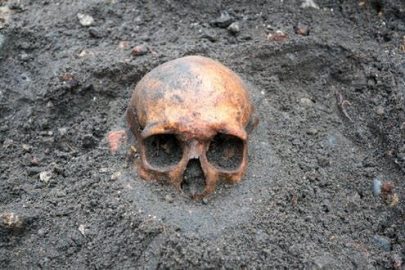
Decomposition starts almost immediately after death, with the end of normal bodily functions and the spread of internal bacteria. These processes cause the tissues of the human body to rupture and break down. Forensic pathologists use these observations to calculate the time since death. Once the soft tissues have fully decomposed, all that remains is the skeleton. The skeleton and teeth are much more robust. Although they undergo a number of subtle changes after death, they can remain intact for many years.

Read more HERE

Ask me anything

Explore related questions

#atrocities#crime#human body#investigation#remains#science#skeleton#skull#world
> More World

Follow en.protothema.gr on Google News and be the first to know all the news

See all the latest News from Greece and the World, the moment they happen, at en.protothema.gr

> Latest Stories

Sophie Turner’s first photo as Lara Croft released for Tomb Raider series

January 15, 2026

Obst sealed the win at the end against Panathinaikos as Bayern defeated them 85–78 in Munich

January 15, 2026

“You think you are descendants of Plato and Aristotle, but you’re not” – Rama’s tirade against Greek journalist, watch video

January 15, 2026

“Aunt Pecu,” who lived outside all protocol: Who the unconventional and eccentric princess Irene was

January 15, 2026

High-tech fraud – SMS blaster attack: Bank data stolen using special equipment installed in a car’s trunk

January 15, 2026

Ballistic missile strike hits pier in Ukraine

January 15, 2026

Ursula von der Leyen from the Green Line: Pushing for a solution to the Cyprus issue is a priority

January 15, 2026

The ordeal of a 28-year-old Greek man in Australia: He went on holiday to visit relatives, was injured at a beach, and is at risk of quadriplegia

January 15, 2026
All News

> Science

How was cancer treated in ancient Greece?

According to Galen, the most common types of cancer were the uterus and breast cancer found in women

July 11, 2018

Reptilian-mammal fossil changes the timeline of supercontinent breakup

May 25, 2018

Russia & US will cooperate to build moon’s first space station

September 28, 2017

Computer solves a major time travel problem

June 15, 2017

Why we can’t trust academic journals to tell the scientific truth

June 6, 2017
Homepage
PERSONAL DATA PROTECTION POLICY COOKIES POLICY TERM OF USE
Powered by Cloudevo
Copyright © 2026 Πρώτο Θέμα