×
GreekEnglish

×
  • Politics
  • Diaspora
  • World
  • Lifestyle
  • Travel
  • Culture
  • Sports
  • Cooking
Wednesday
14
Jan 2026
weather symbol
Athens 10°C
  • Home
  • Politics
  • Economy
  • World
  • Diaspora
  • Lifestyle
  • Travel
  • Culture
  • Sports
  • Mediterranean Cooking
  • Weather
Contact follow Protothema:
Powered by Cloudevo
> World

Voyager spacecraft detects “persistent hum” beyond our solar system

"It's very faint and monotone"

Newsroom May 17 11:04

One of the Earth’s longest-flying spacecraft has detected a “persistent hum” beyond our solar system, according to a new study.

>Related articles

FBI searches the home of a Washington Post journalist who covered the Trump administration’s firing of federal employees

Countdown to a U.S. strike on Iran: Americans and Britons evacuate bases, direct assassination threat against Trump from Tehran – Live

Direct assassination threat against Trump from Iran: “This time the bullet will not miss the target”

NASA’s Voyager 1 launched on September 5 1977, from Cape Canaveral, Florida, aboard a Titan-Centaur rocket, just weeks after its sister craft, Voyager 2. Although they were initially designed to last five years, more than 43 years after they launched, the crafts are still sending back data as they explore interstellar space.
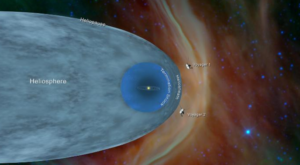
Instruments aboard Voyager 1, which has moved past the edge of the solar system, through the solar system’s border with interstellar space, known as the heliopause, and into the interstellar medium, have detected the sounds of plasma waves, according to research published Monday in the journal Nature Astronomy.

See Also:

Athens: Maintenance works are in progress in the Temple of Olympian Zeus

Bipartisan resolution calls on US President to make Cyprus solution top foreign policy priority

A Cornell University-led team studied data transmitted from the spacecraft, sent from 14 billion miles away and discovered the interstellar gas emissions.
“It’s very faint and monotone, because it is in a narrow frequency bandwidth,” Stella Koch Ocker, a Cornell University doctoral student in astronomy, said in a statement. “We’re detecting the faint, persistent hum of interstellar gas”.
Read more: CNN

Ask me anything

Explore related questions

#Deep Space#discovery#hum#nasa#science#space#technology#Voyager#world
> More World

Follow en.protothema.gr on Google News and be the first to know all the news

See all the latest News from Greece and the World, the moment they happen, at en.protothema.gr

> Latest Stories

FBI searches the home of a Washington Post journalist who covered the Trump administration’s firing of federal employees

January 14, 2026

RealPolls: New Democracy above its European election result, Plefsi returns to second place – With a change of leader ND loses nearly two points, PASOK gains 5.5

January 14, 2026

Countdown to a U.S. strike on Iran: Americans and Britons evacuate bases, direct assassination threat against Trump from Tehran – Live

January 14, 2026

Direct assassination threat against Trump from Iran: “This time the bullet will not miss the target”

January 14, 2026

32 dead after a crane falls on a passenger train in Thailand

January 14, 2026

Meeting between Mitsotakis and the “agro-leaders” of the blockades set for Friday

January 14, 2026

Pierrakakis: We will achieve even more through collective effort

January 14, 2026

“All cash”: Netflix is preparing a strategic move to accelerate its $83 billion deal with Warner Bros.

January 14, 2026
All News

> Greece

Meeting between Mitsotakis and the “agro-leaders” of the blockades set for Friday

Earlier, farmers who held an assembly in Palamas, Karditsa said “yes” to a meeting with the prime minister with roads kept open and decided not to hold a rally in Athens

January 14, 2026

Taxi strike to continue on Thursday, convoy planned toward the Maximos Mansion

January 14, 2026

Armed robbery in Thessaloniki with gunfire at a pawn shop

January 14, 2026

The frigate “Kimon” en route to the Salamis Naval Base – Watch the video

January 14, 2026

Meteo: Forecasts point to a warm February in Greece, with temperatures up to +1.2°C above average

January 14, 2026
Homepage
PERSONAL DATA PROTECTION POLICY COOKIES POLICY TERM OF USE
Powered by Cloudevo
Copyright © 2026 Πρώτο Θέμα