




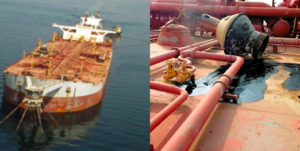
Nobody knows the FSO Safer like Ahmed Kulaib.
The year he joined the Hunt Oil Co. as a loading master back in 1988 was the same year the Dallas-based oil producer installed a former oil tanker it had just converted into a floating oil storage and off-loading vessel (FSO) a few miles off the coast of Yemen. The 3.1 million-barrel-capacity ship received oil pumped from the hydrocarbon-rich fields of the country’s Marib region, storing it at sea before it was off-loaded to export tankers.
The production-sharing agreement the Texans had with Yemen’s government expired in 2005, leaving the Safer Exploration and Production Exploration Company (SEPOC) in control of the ship. For years, Kulaib rose through the ranks working beside the FSO Safer’s 1,188-ft. iron hull. “I know her very well. I know her piece by piece,” Kulaib tells TIME from Cairo, where he now lives. He speaks of the Safer with a paternal nostalgia. “She was a very good vessel at a certain time. But not today.”
Kulaib was general manager at SEPOC in 2014, when members of the Shi‘ite Houthi movement swept across northern Yemen and precipitated a civil war that continues to this day. Exasperated by the corruption and chaos that ensued, Kulaib left the country a few years later. His charge, the Safer, remains in place, umbilically joined to Yemen’s Red Sea coast at the end of 4.8 miles of subsea pipeline.
The giant rusting ship has had virtually no maintenance since Kulaib departed. The sea chest valves that once fed its cooling system have rusted and can’t be completely shut, he says. The ship’s fire-extinguishing system no longer functions. And power comes only from a small generator on deck that provides lighting and heat for a skeleton crew of SEPOC employees.
On May 27, 2020, a ruptured pipe caused seawater to flood the engine room. A repair job that under normal circumstances should have taken four hours ended up taking five days of nonstop work, according to an emergency case report seen by TIME. It took a team of local divers to seal the sea chests’ external openings underwater. Only then could the SEPOC crew onboard patch up the damaged pipe in the sweltering engine room. Their repair job is just about holding, Kulaib says. More dangerous still is the oxygen that could be accumulating in the Safer’s 34 oil tanks and mixing with volatile crude fumes because of inert gases’ seeping out of corroded seals, he says. “Any spark, believe me, will end with a big explosion on that ship.”
Greek Defence Minister: “What is threatened is not demilitarized”
The consequences would be unfathomable. Estimated to hold 1.14 million barrels of crude (47.9 million gal.), the Safer could spill four times the amount of oil the Exxon Valdez leaked into Prince William Sound in 1989. And it would add another dimension of catastrophe to Yemen, a country already enduring the world’s worst humanitarian crisis amid a six-year war that is only becoming more complex.
The precise impact of a disaster would depend on seasonal variations in weather and sea conditions, but the Geneva-based humanitarian agency ACAPS found that if the Safer’s oil leaked between April and June, it would affect 31,500 fishermen and 235,000 workers in fishing-related industries, and would likely shut down the vital port of Hodeida, the main entry point for a nation teetering on famine, for up to three months. Cleanup on such a spill would cost $20 billion, according to ACAPS’s projections, which U.K.-based consultancy RiskAware has modeled for the British government. That’s almost the same as the entire GDP of Yemen in 2019.
A fire on board might be even worse. Up to 5.9 million people in Yemen and 1 million more in Saudi Arabia could be exposed to very high air-pollution levels, completely overwhelming a health care system already on its knees as a result of the COVID-19 crisis. Some 500 sq km of Yemen’s farmland would be covered in soot, causing crop losses for almost 10 million Yemenis and 1.5 million people in Saudi Arabia. If these worst-case scenarios come to pass, says Belal Al Mazwwda, an information analyst at ACAPS who worked on the projections, “it’s going to be the biggest man-made oil-related disaster ever recorded, based on our estimation”.
Read more: Time
Ask me anything
Explore related questions