

×
GreekEnglish

×
  • Politics
  • Diaspora
  • World
  • Lifestyle
  • Travel
  • Culture
  • Sports
  • Cooking
Tuesday
13
Jan 2026
weather symbol
Athens 4°C
  • Home
  • Politics
  • Economy
  • World
  • Diaspora
  • Lifestyle
  • Travel
  • Culture
  • Sports
  • Mediterranean Cooking
  • Weather
Contact follow Protothema:
Powered by Cloudevo
> World

Hubble discovers the most distant star ever detected

The far-away star system takes the official name WHL0137-LS, but the astronomers who found it nicknamed it “Earendel”

Newsroom March 31 04:00

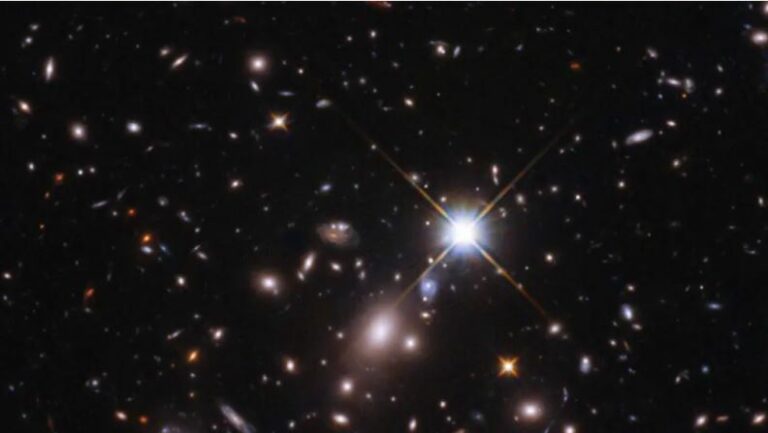
The most distant star — or possibly pair of stars — that astronomers have ever seen was just revealed thanks to the Hubble telescope and a massive cluster of galaxies. Far from Earth, the universe bends around the vast bulk of a galaxy cluster, creating a gravitational lens in spacetime much like the curved lens in a magnifying glass. Like a magnifying glass, it revealed something small and hidden: a star system from the early universe.

The far-away star system takes the official name WHL0137-LS, but the astronomers who found it nicknamed it “Earendel” from the Old English word meaning “morning star” or “rising light.”

>Related articles

Sick astronaut on mission – NASA considers early return of International Space Station crew

NASA published a new map of the universe; the “SPHEREx” space telescope changes the data landscape

Voyager 1 ready to make history again: in 2026 it will reach a distance of “one light-day” from Earth

Earendel system as we’re seeing it today was shining within just 900 million years of the Big Bang, according to the authors of a new paper in the journal Nature describing the discovery. Fully 12.8 billion years passed before that light reached the Hubble Space Telescope, magnified by a lucky trick of gravity to appear as a tiny smudge of photons on Hubble’s image sensor. Earendel is 8.2 billion years older than the Sun and Earth and 12.1 billion years older than our planet’s first animals.

Even by the standards of ancient stars, Earendel stands out: astronomers observed the previous record holder, nicknamed Icarus, as it appeared 9.4 billion years ago — 3.4 billion years more recently than this new record-holder. Even the oldest known supernovas, usually the brightest and most easily-spotted individual objects across the immensity of spacetime, are younger than Earendel.

source theverge.com

Ask me anything

Explore related questions

#galaxy#Hubble#space#stars
> More World

Follow en.protothema.gr on Google News and be the first to know all the news

See all the latest News from Greece and the World, the moment they happen, at en.protothema.gr

> Latest Stories

Motorcycle rider arrested in Thessaloniki for driving 128 km/h in residential area

January 12, 2026

Mattel releases the first Barbie with autism, watch video

January 12, 2026

Farmers’ unions cancel meeting with Mitsotakis, plan escalation with new roadblocks

January 12, 2026

Shark attack on woman in Brazil: ‘I knew it had bitten me’, watch video

January 12, 2026

The 15 Greek islands that stand out for holidays in 2026, according to Conde Nast Traveller

January 12, 2026

Agatha Christie’s 1958 visit to the Acropolis captured in unpublished photo

January 12, 2026

Russia declares war on the Ecumenical Patriarch: “He is dismantling the Body of the Church, has nationalist and neo-nazi allies”

January 12, 2026

Video: The “battle” of the Skopelitis with the waves in the Aegean

January 12, 2026
All News

> World

Shark attack on woman in Brazil: ‘I knew it had bitten me’, watch video

The attack was captured frame by frame by an underwater camera, with the victim ultimately escaping after receiving several stitches

January 12, 2026

Maria Machado at the Vatican, a few days before she meets Trump

January 12, 2026

The local judicial authorities decided to detain the owner of the bar in Crans-Montana for three months

January 12, 2026

Ukraine: 35,000 households in Odessa are without electricity after a Russian drone attack

January 12, 2026

Bloomberg: Britain and Germany discuss the presence of NATO forces in Greenland

January 12, 2026
Homepage
PERSONAL DATA PROTECTION POLICY COOKIES POLICY TERM OF USE
Powered by Cloudevo
Copyright © 2026 Πρώτο Θέμα