





The term “gulag” re-emerged in the news, as a reflexive association, as soon as the death of Alexei Navalny in a Siberian barbarism detention colony was announced.
In one of Russia’s harshest prisons, in one of the most inhospitable regions of the planet.
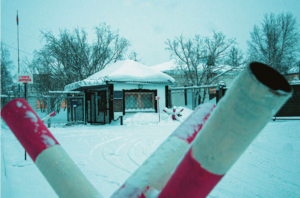
Today, the complex of facilities, code-named FKU IK-3, is considered a modern maximum security prison, where criminals deadly dangerous to society are held.
In reality “gulag” is not a word but an acronym: GULAG (ГУЛАГ) stands for “Гла́вное Управле́ние исправи́тельно-трудовы́х ЛАГере́й” (Main Directorate of Correctional Labour Camps)
However, in many respects FKU IK-3 seems to be just a modern version of the old gulag tradition, a reworking of the archetypal forced labour camp of the Stalinist period, especially of the years 1923-1953.
For a very long time, culminating in the “Great Purges” or the infamous “Great Terror” of 1937, during the obsessive paroxysm that possessed Joseph Stalin to exterminate those he considered a potential threat to the superpowers he had amassed over him as absolute monarch, the territory of the Soviet Union was filled with gulags.
And these were filled with alleged “enemies of the people and the socialist revolution”, i.e. people from every corner of the USSR, including a large part of the then Greek minority.
Stalin, after all, did not limit himself to the targeted displacement of, for example, the Jews, as Hitler did. The communist ruler indiscriminately sent everyone to the gulag (he did not even hesitate to disappear the wife of his most loyal collaborator, Foreign Minister Vyacheslav Molotov).
For the vicious, ruthless and voracious ‘paramilitary’ of the Stalinist secret police – the dreaded NKVD – an anonymous complaint was enough to accuse anyone of being a ‘Trotskyist’ or a ‘cuckold who drinks the blood of the people’.
Where kulaks were the rich peasants, landowners and big landowners.
Regardless of the fact that very few of them were left after the genocide of the Great Famine and the failed experiment of collectivisation, with the violent transformation of Russian peasant society into an industrial one, which Stalin had attempted in the period 1929-1932.
In the years of his rule no one would have wasted time checking the credibility of any complaint, since his orders were perceived as God’s orders.
So, even if the alleged exploiting kulak owned, say, only a goat and a mangy horse, he was considered a brutal capitalist plutocrat and was forcibly led to a gulag to reform his class consciousness.
1.6 million deaths
The insanity of mass deportations to the gulags served Stalin’s plans in many ways.
On the first level, it relieved him of any political opponent.
At the same time, the prospect of deportation discouraged any form of opposition to the will of the ruler, exerting a constant and subconscious terror on the citizens of the USSR.
Apart from this, however, there was the extremely important dimension of forced labour a valuable tool in the hands of Stalin, who relied on endless armies of exiles to construct colossal public works or exploit natural resources, such as the mining of the gold mines of Kolima.
Queen Letizia: With Felipe at the memorial service of the former King Constantine – Photos
Of course, at very little cost to the state, since in the Soviet proletariat paradise, in its Stalinist version, the deportees in the gulags were turned into slaves without the slightest right.
The true number of those who experienced the Stalinist gulag remains impossible to determine with any accuracy. Historians speculate that the number of the deported was 18-20 million people.
The system, or the “Gulag Archipelago” in the words of Aleksandr Solzhenitsyn, was one of the main tools of oppression of the Soviet people, a constant nightmare, as no one could ever feel secure that they would not be arrested by the Stalinist regime’s secret police, that they would not end up an inmate in a gulag.
The victims, either after mock trials or without any, were exiled to nowhere.
Without having the slightest idea whether they would be released and when – or ever, if they would manage to survive in the Siberian hellholes.
Often without even having been informed of the charges against them, of the crimes that justified the brutal sentencing of the perpetrators to a deportation identical to an execution of the ultimate penalty, the death sentence.
The most famous book about the Gulags, the classic text that revealed to humanity in its entirety the horrors of the Stalinist concentration camps, was “The Gulag Archipelago” by the Nobel Prize-winning Russian writer Aleksandr Solzhenitsyn, first published in 1973.
However, even the almost painful realism of the Archipelago, a faithful representation of an earthly hell, falls short of the raw power of Varlaam Salamov’s Tales from Colima.
It is a collection of 145 short stories, in the form of short “short stories”, but altogether a beastly length (1,970 pages in the Greek translation by Indictus).
In Kolima, according to all available descriptions, the most inhumane gulag of the USSR’s and, possibly, the worst forced labour camp ever – after the Nazi crematoria.
Ask me anything
Explore related questions