
×
GreekEnglish

×
  • Politics
  • Diaspora
  • World
  • Lifestyle
  • Travel
  • Culture
  • Sports
  • Cooking
Sunday
18
Jan 2026
weather symbol
Athens 6°C
  • Home
  • Politics
  • Economy
  • World
  • Diaspora
  • Lifestyle
  • Travel
  • Culture
  • Sports
  • Mediterranean Cooking
  • Weather
Contact follow Protothema:
Powered by Cloudevo
> Culture

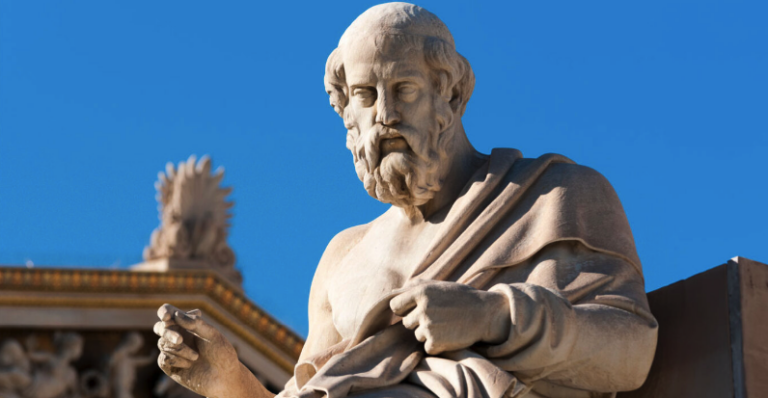
Plato: The papyrus that indicated his burial place revealed and how he spent his last hours

The Greek philosopher allegedly spent his last night listening to music played by a slave girl from Thrace and commenting on her... lack of rhythm

Newsroom April 30 12:15

Recently deciphered passages from papyrus scrolls buried under layers of volcanic ash after the eruption of Mount Vesuvius in 79 AD may shed light on the final hours of Plato, one of the most important figures in Western philosophy.

According to the Guardian, Italian scientists have discovered that the ancient scrolls in question contained a previously unknown narrative describing how the Greek philosopher spent his last night, listening to the music played on the flute by a Thracian slave girl.

Despite the fact that he was roasting in fever and on the verge of death, Plato seems to have possessed considerable intellectual clarity, as he criticised the musician for her lack of rhythm, according to the account.

Recall that decoded passages of the papyrus in question indicated, among other things, the exact location of Plato’s burial in a garden near the ‘Temple of the Muses’, in the Academy that bears his name in Athens. Previously, it was known only in general terms that he was buried within the Academy.

Presenting the findings of the research at the National Library of Naples, Professor Graziano Ranocchia, of the University of Pisa, who led the team responsible for deciphering the scroll, described the discovery as a “great development that helps us to have a deeper understanding of ancient history”.

“Thanks to the most advanced imaging diagnostic techniques, we finally have the ability to read and decipher new passages of texts that were previously considered inaccessible,” the scientist said.

The text also reveals that Plato was sold as a slave on the island of Aegina, possibly as early as 404 BC, when the Spartans conquered the island, or alternatively in 399 BC, shortly after Socrates’ death.

“Until today it was believed that Plato was sold as a slave in 387 BC during his stay in Sicily at the court of Dionysius I of Syracuse,” Ranocchia said. “For the first time, we were able to read sequences of hidden letters from scrolls that were wrapped in multiple layers and had been stuck together over the centuries through an unrolling process using a mechanical technique.”

According to him, the ability of scientists to locate these layers and virtually reposition them in their original position, thus restoring the coherence of a text, represents a major advance that could lead to the future recovery of vast amounts of information. The impact of this development will be fully realised in the coming years, he pointed out.

See Also:

>Related articles

“You think you are descendants of Plato and Aristotle, but you’re not” – Rama’s tirade against Greek journalist, watch video

Crete, Pompeii & Stonehenge: The most important archaeological discoveries of 2025 that overturn what we knew

The imposing Portara of Naxos: The mystery surrounding the monument that spans 26 centuries

Former NASA engineer says he’s invented a thruster that doesn’t require propellant

At the heart of Ranocchia’s team’s work are the scrolls found in the luxurious Roman villa at Ancient Heraklion (Erculaneum) in Campania, also known as the “Villa of the Scrolls”. This villa, which had an impressive library, was registered on earth during the eruption of Vesuvius in 79 AD, which destroyed Herculaneum and Pompeii.

The villa was accidentally found in 1750 and from 1752 to 1754, through the excavation process, numerous scrolls of papyrus came to light. The effort to decipher them continues with modern digital technology methods.

Ask me anything

Explore related questions
#ancient burial sites#Ancient Heraklion#deciphered#Greek philosopher#National Library of Naples#papyrus scrolls#Plato#platon#Pompeii#slave
> More Culture

Follow en.protothema.gr on Google News and be the first to know all the news

See all the latest News from Greece and the World, the moment they happen, at en.protothema.gr

> Latest Stories

Erfan Soltani confirmed alive by Iranian Human Rights Group after days of uncertainty

January 18, 2026

Rescue operation underway for eight hikers on Mount Taygetus; four injured

January 18, 2026

Piers Morgan recovering in hospital after serious fall in London

January 18, 2026

Prime Minister Mitsotakis’ agenda: From talks with farmers’ representatives to Davos for investment outreach

January 18, 2026

Iraq veterans report long-term health concerns after a lack of medical screening for toxic exposure

January 18, 2026

Skirtsos: ‘After years of efforts, the first results on maritime safety are starting to become visible’

January 18, 2026

Politico: Europe for the first time considers tough response to Trump on Greenland tariffs, what is the Anti-Brexit Act

January 18, 2026

The backstory behind Trump’s decision not to attack Iran: The camps in the White House, the SMS from Tehran, and the calls from Arab allies

January 18, 2026
All News

> Culture

The historic cafes of Athens: 12 legendary hangouts lost to time

The café-patisseries that set the rhythm of cosmopolitan Athens – “Flokas,” “Papaspirou,” “Sonia,” “Alaska,” “Lentzos,” “Floral,” “Blue Bell,” “Prapas,” “Pachos,” “Galaxy,” “Caprice,” “Centaur” were the most popular meeting points where modern Greek history was written, became songs and books, and left their mark with their famous culinary creations

January 16, 2026

Actress Melpo Zarokosta dies at 93

January 16, 2026

Cycladic Identity Initiative launches fourth funding phase to preserve the Cultural and Natural Heritage of the Cyclades

January 16, 2026

Grief in Crete for the loss of Yannis Xylouris

January 15, 2026

“A Picasso for 100 euros” — Christie’s for a million-euro painting

January 15, 2026
Homepage
PERSONAL DATA PROTECTION POLICY COOKIES POLICY TERM OF USE
Powered by Cloudevo
Copyright © 2026 Πρώτο Θέμα