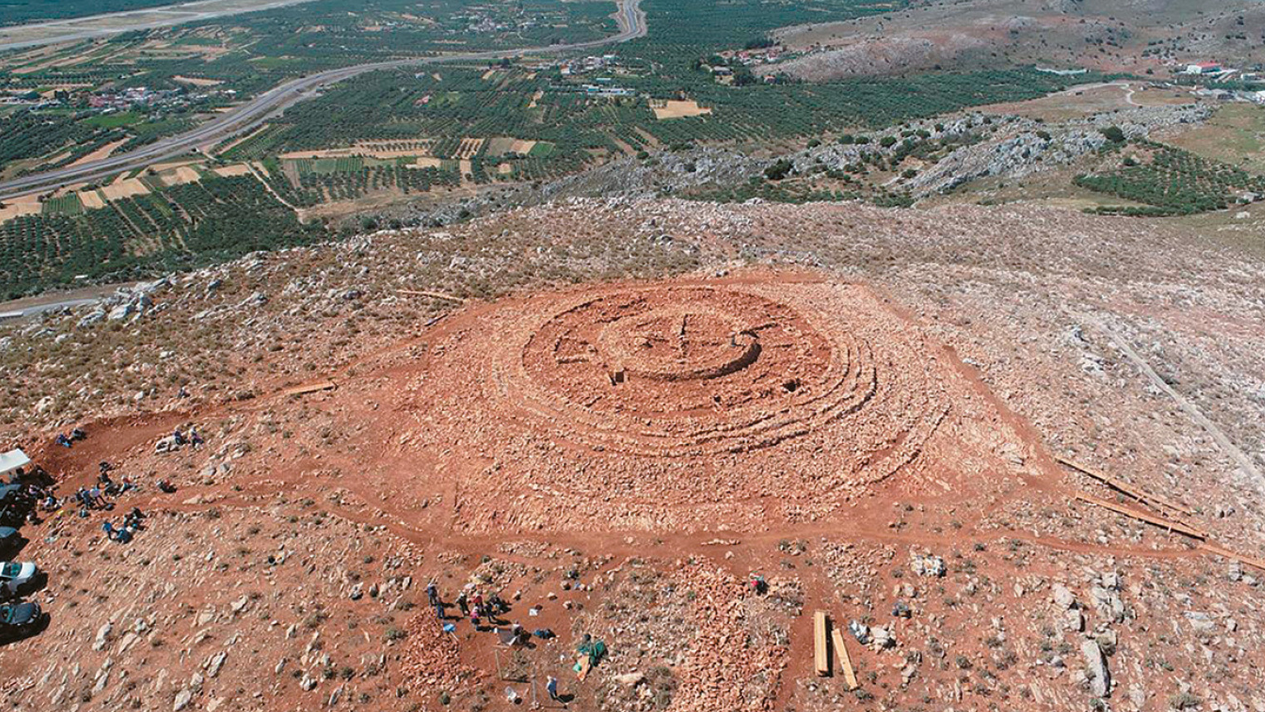
A uniquely significant archaeological find, unmatched within our territory, is the monumental circular structure discovered atop Papoura Hill, near the under-construction Heraklion Airport. This rare architectural treasure of Minoan archaeology spans a diameter of 50 meters and an area of approximately 1,800 square meters. Once analyzed, it is expected to reveal much about the period, as no similar structures have been found in our known archaeological landscape, only in other Near Eastern centers.
This unique archaeological find is circular in shape and located at the highest point of the hill, in an area expropriated for the installation of surveillance systems (radar) for the new airport. The eight concentric rings, developed at different elevations forming a mysterious circle, remind us of similar structures from the Bronze Age in various Near Eastern countries, with which Minoan Crete had close relations, much like with Egypt and the wider Mediterranean region.
From the construction and roofing method, various speculations can be made about its potential function, although these need to be combined with further findings once the processes are complete. Initially, a preliminary conclusion, supported by statements from the head of the Heraklion Antiquities Ephorate, Vasso Sythiakaki, suggests that it is unlikely to be related to beacons—a developed communication method through fires lit by observers, highly advanced among the Minoans in the area. This is not only indicated by its enormous size but also by its unique architectural structure. Although some archaeologists have hastened to associate the structure not only with beacons but also with a worship site related to Zeus, it is known that the Twelve Olympian gods were not worshipped in historical times.
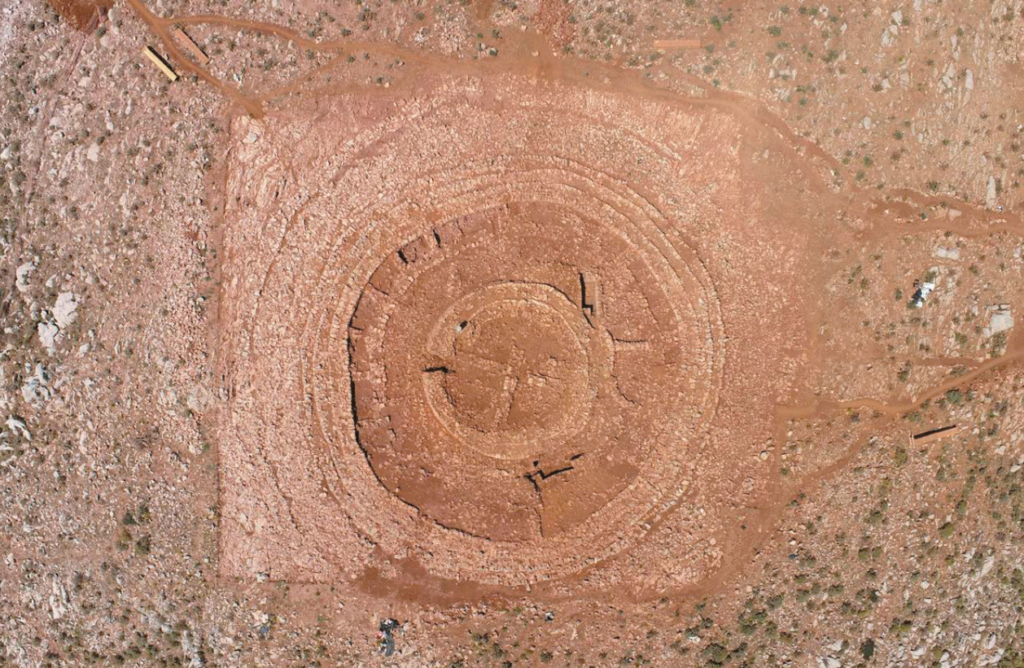
Nevertheless, its construction suggests a religious or ritualistic character, different from those times. Its visibility from all directions may hint at something technologically advanced for its era. The construction with concentric circles and a peculiar cross type in the center suggests astronomical orientation—an existing and developed science in prehistoric times for predicting weather phenomena.
This circular shape may contain various mysterious codes, as seen in ancient texts revealing the deep influence of Mathematics and Eastern scientists on Greek philosophers. According to Platonic tradition and the theories developed by the philosopher in “Meno,” “Timaeus,” and “Phaedo,” Astronomy examines planetary movements and reveals much about the mysterious movements of phenomena. Although these geometric shapes indicate orbits, the theories remain “likely stories,” as Plato says in “Timaeus,” meaning narratives that are good to tell but not exactly to believe.
However, Geometry played a significant role for Plato and his school—in the Academy’s entrance, it famously stated that no one ignorant of Geometry and Mathematics could enter—highlighting the importance placed on Geometry by the Ancients, from temple construction to connecting sacred landmarks. Even in Herodotus, there are revealing accounts of how Egyptians used Geometry precisely to restore property boundaries destroyed by Nile floods. Thus, while the use of radii in this structure cannot be confirmed, one might speculate that it had astronomical significance, identifying significant spatiotemporal reference points, like cereal sowing days, as with the Egyptians.
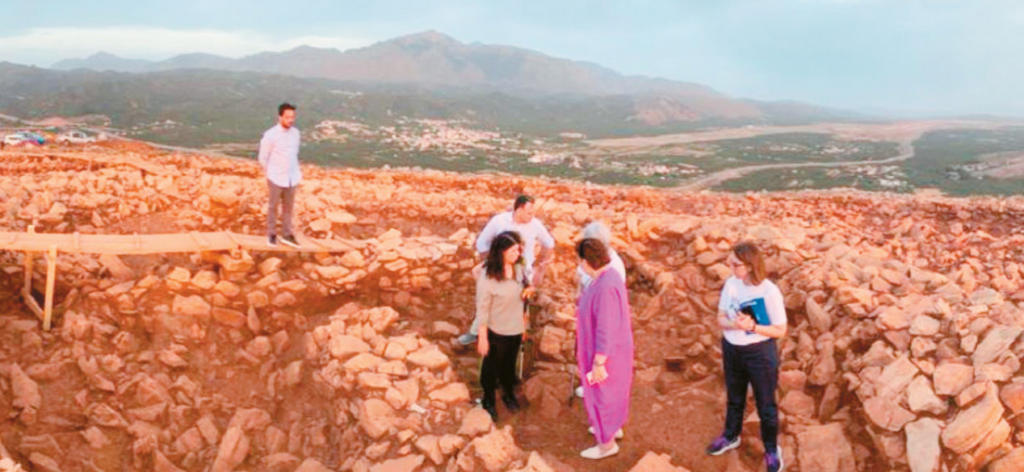
In any case, the impressive size, architectural layout, and meticulously crafted construction of the building indicate its significance and suggest that a central administration likely organized its construction. It is probably a significant communal landmark for the Pediada region if not an astronomical instrument. It’s worth noting that Crete has unique Minoan palaces in Knossos, Phaistos, Malia, and Zakros, with evidence of habitation dating back to 4000 BC.
According to the official excavation announcement, this construction dates between 2000-1700 BC, possibly founded at the beginning of the Protopalatial period (MMI-II), with Neopalatial pottery in the destruction layer indicating continued use. The findings do not suggest residential use but periodic ritual activities, likely involving wine consumption and offerings. The central zone’s roofing, as indicated by its construction system, was probably either a truncated cone shape or domed.
The two zones, A and B, formed by the upper rings, appear to be the main activity centers. Notably, there is no similar find from the same period in Crete for comparison: neither the monument’s floor plan nor the zones’ arrangement and spaces as revealed so far, nor the overall construction, have exact parallels with other buildings of the same period in Crete, although the shape is not unfamiliar from early Bronze Age architectural complexes in the Near East.
It might be compared to the elliptical MM building at Chamaizi and the so-called Cyclopean circular building of Tiryns from the Early Helladic period. Constructive similarities are also found with the so-called tholos tombs of the Prepalatial and Protopalatial periods in southern Crete, where the central space is built similarly, while the overall construction resembles Early Helladic and later tumuli in mainland Greece or later circular sanctuaries, such as the Thesmophoria.
Ask me anything
Explore related questions