






In food packaging, non-stick cookware, waterproof clothing, carpets, mattresses, cosmetics, electronics, even in drinking water, in food, rain, and soil… More than 10,000 are perfluorinated and polyfluorinated alkylated substances (PFAS) – the so-called “permanent chemicals” – which can be found almost everywhere threatening health and the environment.
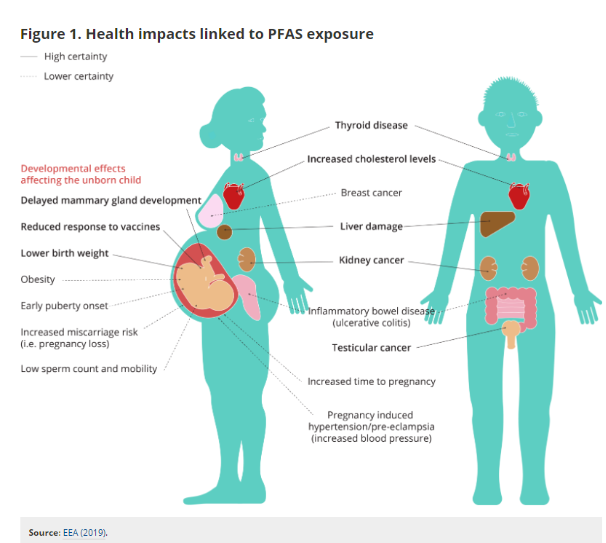
These chemicals are extremely persistent, as a result of which they remain for a long time in the environment, but also in the body when they come into contact with the skin or are consumed by humans. As the European Chemicals Agency (ECHA) explains, many of them “travel”, covering, in fact, long distances from where they were released, contaminating the underground and surface water network, as well as the soil, with their cleaning being a major challenge since it is a demanding and expensive process. As ECHA points out, if they continue to spread in nature, they will continue to accumulate, contaminating drinking water and food even more, leading to serious health problems. These include liver and thyroid diseases, fertility problems, increased cholesterol levels, reduced antibody response to vaccines, reduced ability of the immune system to fight infections, hypertension, low birth weight in infants, hormonal disorders, and even kidney and bladder cancer. testicles.
Where are they found?
The US Environmental Protection Agency (EPA) provides an answer to the question of where exactly “permanent chemicals” are detected, according to which these dangerous substances can be found:
-In the public water supply system and private drinking water wells. That’s why, after conducting research that revealed Americans were drinking water contaminated with PFAS chemicals, the agency decided last April to develop a plan to remove six versions of the chemicals from the water system. . At the same time, local authorities are asked to check water quality every three years and, if harmful levels of chemicals are found, to reduce the amount of PFAS in the drinking water supply. As the BBC points out, common household filters are not designed to remove these substances, unlike reverse osmosis filters which have been shown to reduce – but not eliminate – PFAS levels. However, the EPA stresses that no level of exposure to “permanent chemicals” is safe, with the US government committing at least $9 billion to address the problem and properly treat the water.
-In soil and water near landfills, disposal sites, and hazardous waste sites. At these points, significant amounts of PFAS accumulate and are released, negatively affecting the communities that may develop nearby. Therefore, the necessary settings and appropriate processing are required to address the issue.
-In the fire-extinguishing foam – forming an aqueous film – (AFFF) is applied to fire-extinguishing of flammable liquids. Such foams are used during training and emergency response at airports, shipyards, military bases, fire training facilities, chemical plants, and refineries.
– In facilities where PFASs are produced or used, for example in the chrome plating of products, the production of electronics (e.g. smartphones), and the manufacture of textiles and paper.
-In soil conditioners, for example, fertilizers from sewage treatment plants are used on agricultural land and can affect groundwater and surface water, but also animals during grazing.
-In food, such as fish caught from PFAS-contaminated water and dairy products from animals exposed to PFAS.
-In food packaging such as greaseproof paper, fast food containers or wrappers, microwave popcorn bags, pizza boxes, and candy wrappers.
– In household products, such as those for removing stains, or waterproofing carpets, upholstery, clothing, and other fabrics, as well as in cleaning products, in non-stick cookware.
-In personal care products, such as some shampoos and hair conditioners, dental floss, sunscreens, and cosmetics.
Who is susceptible?
Firefighters, workers in chemical processing facilities, and industries are categories of people who can inhale “permanent chemicals” putting a burden on their health. On the other hand, one only has to consume water and food containing PFAS, breathe air, use products made with them, or packaged in material containing PFAS to be exposed to the harmful chemicals. Among the most vulnerable groups are young children and pregnant women, with fetuses and infants coming into contact with breast milk or even through the placenta.
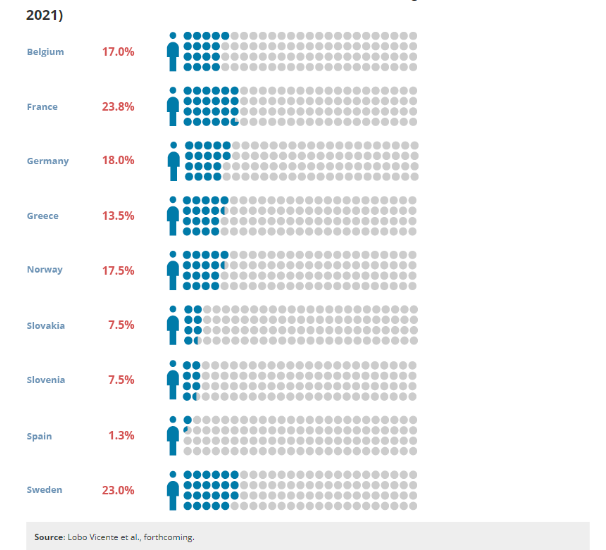
However, experts point out that further research is needed to understand the health effects, especially at lower levels of exposure over long periods. However, a European study revealed that 14.3% of teenagers had PFAS levels in their blood that exceeded the limits. In all of the nine countries, where the research was conducted, increased levels of PFAS were observed in the blood of teenagers in a percentage that exceeded the predetermined value, by 1.3% in Spain, 13.5% in Greece, up to 23.8% in France. Mean blood levels were significantly higher in northern and western Europe than in southern and eastern Europe. As for the US, a report by the Centers for Disease Control and Prevention, taking into account data from the National Health and Nutrition Examination Survey (NHANES), found that there are PFAS in the blood of almost all Americans at an overwhelming rate of 97%!
It’s no coincidence that from next July in Colorado, products that intentionally contain these toxic substances will be banned – as long as they cannot be made safer. These include clothing, cookware, menstrual products, dental floss, and wax. By 2028, Colorado will also ban the sale of all clothing, backpacks, and waterproofs treated with PFAS, and companies selling such items are required to report their presence.
Chemicals with strawberries
A UK survey of PFAS pesticide residues found at least 10 different ‘permanent chemical’ herbicides detected in fruits and vegetables. Among them grapes, cherries, spinach, and tomatoes, with strawberries however taking the lead since, according to the Pesticide Action Network (PAN), 95% of the 120 samples tested contained PFAS pesticides.
Nick Mole, a representative of the organization stressed that given the conditions, British consumers have no choice but to consume the chemicals, “some of which can remain in their bodies for a long time”, explaining that it is not only food that is contaminated but also food packaging, as well as water.
Currently, 25 PFAS pesticides are used in Great Britain, six of which are classified as “high risk”, among them the insecticide lambda-cyhalothrin which, in addition to being a “permanent chemical”, is extremely toxic to both humans and bees. Nevertheless, as PAN reports, in 2022 9,200 kg of this substance was applied to 1.69 million hectares of land in the United Kingdom, an area equivalent to 11 times the size of London. Mole stressed that pesticides are “the only chemicals that are designed to be toxic and then deliberately released into the environment”, yet the British government, he argued, is focusing on industrial chemicals while ignoring pesticides, which he described as “absolutely unnecessary for growing food”.
Greece is at the “toxic” peak
In a European survey of the network, however, Greece ranks second among the European countries with the largest increase in PFAS pesticide residues in fruits and vegetables for the period 2011-2021.
More specifically, the Pesticide Action Network revealed that the number of European fruits and vegetables with detected PFAS pesticide residues almost tripled between 2011 and 2021, with an increase of 220% for fruit and 274% for vegetables.
Among fruit grown in Europe, 37% of the strawberry crop, 35% of peaches and 31% of apricots are contaminated with a cocktail of PFAS pesticide residues – up to four different ones.
Specifically in Greece, an increase of +696% was recorded in fruits and +1974% in vegetables, while Austria, which occupied the first place, “saw” an increase of +698% for fruits and +3277% for vegetables.
More specifically in Greece, in 46% of apricot samples residues of at least one PFAS pesticide were found, in 43% of strawberry samples residues of at least one PFAS pesticide were detected, in 42% of pear samples residues of at least one PFAS pesticide were detected.
Overall, strawberry and grape samples had the highest number of different PFAS pesticides detected in a single sample, while grapes had the highest diversity of different PFAS pesticides.
Ask me anything
Explore related questions