
The long-feared “general war” in the Middle East has now become a reality after the assassination of Hezbollah leader Hassan Nasrallah, Israel’s invasion of Lebanon, and over 200 rockets launched by Iran at Israel.
The New York Times analysis captures this scenario, noting that the situation has become one of the most dangerous moments for the region since the 1967 Arab-Israeli war.
David E. Sanger writes that for the past 360 days, since the world was shocked by the massacre of approximately 1,200 people during the Hamas invasion of Israel on October 7, 2023, U.S. President Joe Biden repeatedly warned against allowing a terrorist attack to escalate into a wider conflict with Hezbollah and, ultimately, Iran. However, Biden’s concerns did not prevent the escalation.
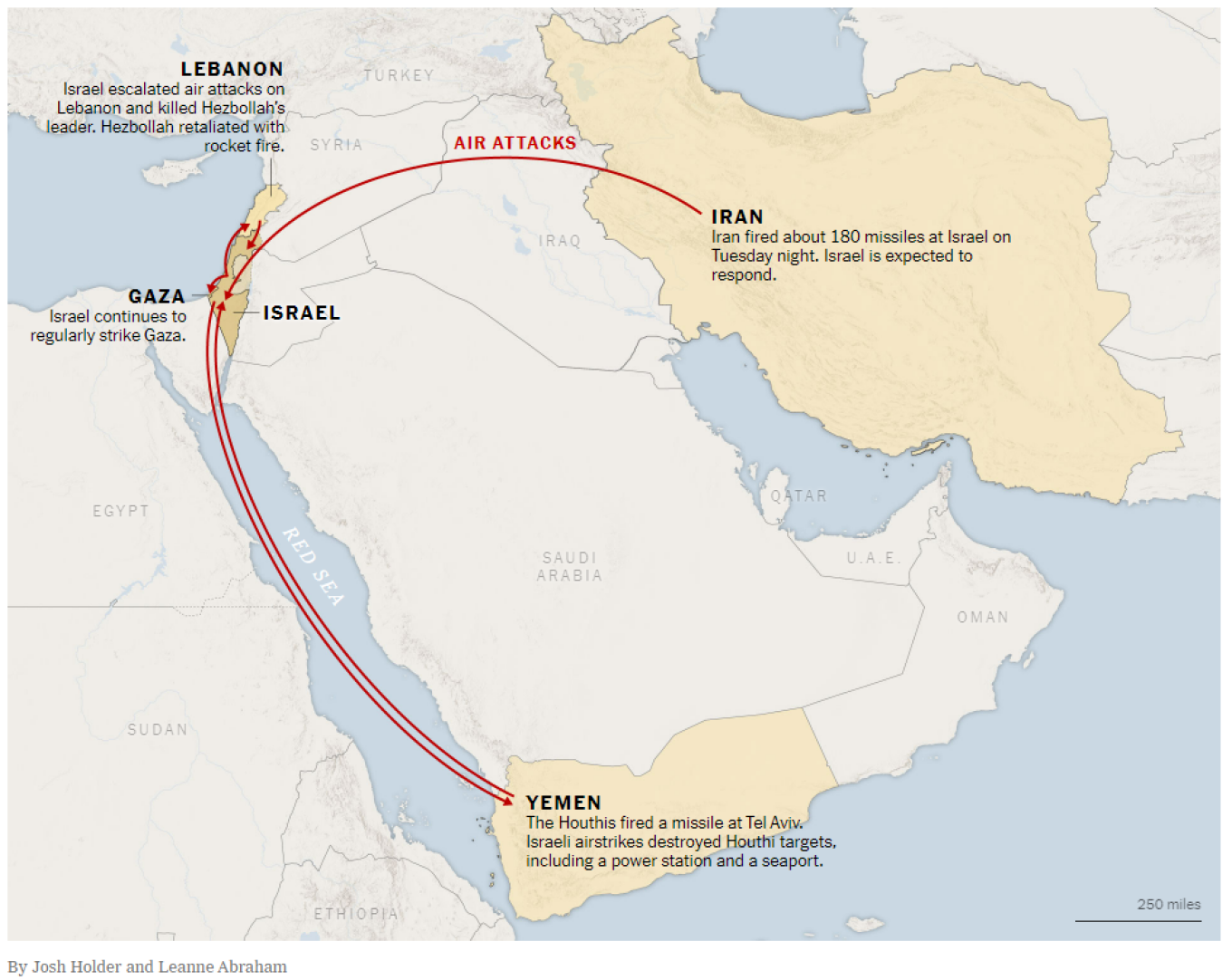
The assassination of Hezbollah leader Hassan Nasrallah by Israel and the ground invasion of Lebanon provoked a fierce response from Iran, which launched approximately 200 missiles toward Israel on Tuesday night. What initially seemed like a limited conflict has now turned into a regional war with unpredictable consequences, presenting one of the greatest challenges for the international community.
EXCLUSIVE: Video from passenger jet en route to Dubai, shows missiles firing out of Iran towards Israel pic.twitter.com/6VUv9OlDUM
— New York Post (@nypost) October 2, 2024
Israel’s Four Enemies
Israel is now fighting four adversaries across the Middle East: Hezbollah in Lebanon, Hamas in Gaza, the Houthis in Yemen, and Iran. According to former Israeli Ambassador to the U.S. Michael Oren, this conflict has taken on the character of a total war, with Oren stating, “This war is a struggle for our national survival,” reflecting the sentiment within Israeli society following Nasrallah’s assassination and the subsequent military operations in Gaza and Lebanon.
Iran’s missile barrage has deeply concerned the White House. National Security Advisor Jake Sullivan stated that the Iranian attack “was defeated and ineffective,” mainly due to coordinated efforts between U.S. and Israeli forces.
The Nuclear Threat
U.S. strategy is now focused on preventing Israel from striking Iran’s nuclear facilities, such as those in Natanz and the holy city of Isfahan, where Iran enriches uranium. A strike on these sites could lead to a broader escalation, something the U.S. wants to avoid as presidential elections approach.
At the center of this crisis is Israeli Prime Minister Benjamin Netanyahu. Despite Biden’s calls for restraint, Netanyahu made decisions that have brought Israel into direct conflict with Hezbollah and Iran. Successive attacks on Gaza, operations in southern Lebanon, and the targeted killing of Nasrallah have created a war climate that is difficult to reverse.
Iran’s Response
Tehran’s missile launch was a response to the assassination of Hezbollah’s leader Hassan Nasrallah and other targeted killings of senior Hezbollah and Hamas figures in recent weeks. Nasrallah, a close ally of Iran’s Supreme Leader Ayatollah Ali Khamenei, was a pivotal figure in Tehran’s “axis of resistance” alliance with Hezbollah and Palestinian groups.
For Iran, the ongoing crisis might push it to accelerate its nuclear program, seeing nuclear weapons as the only way to counter Israel’s military capabilities. Additionally, Iran’s leadership is facing internal pressure from the Islamic Revolutionary Guard Corps, which is pushing for a tougher stance against Israel and the U.S.
For Israel, this conflict is viewed as yet another chapter in its historical struggle for survival. Since the state’s creation in 1948, wars with neighboring countries and armed groups have been frequent, but the current situation seems to be evolving into something far more dangerous.
Iran’s attack signals its intent to show strength, following pressure from the Revolutionary Guard to act decisively after recent Israeli military operations. Iran’s leadership, while wary of a full-blown military conflict with Israel and possibly the U.S., sees this move as necessary to assert its power and influence in the region.
Ask me anything
Explore related questions