




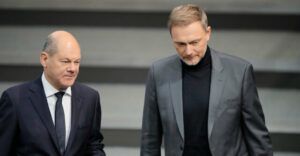
Germany enters a phase of introspection as of today – and officially – following the dissolution of the governing coalition, coinciding with Donald Trump’s electoral triumph in the US presidential election.
According to the timetable announced by Chancellor Olaf Scholz, a vote on whether or not the government will receive a vote of confidence from the Bundestag (lower house of parliament) will be held on January 15.
It is most likely that MPs will pave the way for elections by the end of March.
Until then, the Social Democratic Party (SPD) and the Greens will continue to co-govern as a minority government, possibly with the tolerance of the Christian Democratic Party (CDU), in order to pass crucial pension and industry support bills by the end of the year.
To that end, the chancellor will meet today with the leader of the Christian Union (CDU/CSU) parliamentary group Friedrich Merz, who has so far been careful to avoid commenting publicly on the developments.
At a news conference in Berlin, Germany's Chancellor Scholz said the decision to dismiss Finance Minister Lindner was "necessary to prevent harm to the country." pic.twitter.com/nfopDxzYp3
— DW News (@dwnews) November 6, 2024
Addressing the public, Chancellor Scholz blamed Christian Lindner, the leader of the Free Democratic Party (FDP), for the break-up of the governing coalition, accusing him of “incomprehensible egos” and “petty petty petty party tactics.”
“He broke my trust several times, arbitrarily cancelled the budget agreement (…) There is no basis of trust for further cooperation, therefore serious government work is not possible,” the chancellor said in his highly charged speech.
Earlier in the government committee meeting, the FDP leader suggested calling early elections, which the chancellor rejected. To Mr. Lindner’s accusations of the government partners’ inability to come to an understanding, Olaf Scholz responded with his dismissal from the finance ministry, which apparently implies the FDP’s withdrawal from the government.
A few hours later, the FDP announced a short while ago that the party’s remaining ministers – Falker Wissing from the transport ministry, Marco Bushman from the justice ministry and Bettina Stark-Watzinger from the education ministry – would also be leaving the government.
For his part, Lindner said, among other things, that he had submitted proposals for economic recovery, which, he said, were not even accepted as a basis for consultation by the Social Democratic Party (SPD) and the Greens. “From the chancellor’s carefully prepared statement tonight we understood why,” the FDP leader said, accusing Olaf Scholz of premeditated behaviour.
JUST IN: All of the FDP ministers in Germany's governing coalition government are to quit, the party says.
— DW Politics (@dw_politics) November 6, 2024
After being sacked by Olaf Scholz, former Finance Minister Christian Lindner branded the chancellor's economic plan as "weak."
Live updates ?https://t.co/b2sKmtHvT3 pic.twitter.com/U3d2lDN9Tx
To Mr Scholz’s accusation that Mr Lindner was calling for pension cuts and tax breaks for the rich, the now-deposed finance minister countered that even tonight the chancellor had urgently requested the lifting of the debt brake for “emergency” reasons, something he said he could not agree with. Olaf Scholz was seeking, he said, for continued support for Ukraine, the activation of the “emergency” rule, which justifies additional emergency borrowing by the state. Christian Lindner also claimed that he proposed a coordinated joint early call to the polls, which the chancellor rejected.
“Unfortunately, Olaf Scholz has shown that he does not have the strength to give our country a new start,” Lindner said, adding that this would have to be done by a new government.
Tonight’s outcome had been anticipated by politicians, analysts and the media already in the previous days, as tensions between the government partners escalated until yesterday. The countdown began last week, when Christian Lindner submitted a position paper demanding an immediate suspension of climate policy and an almost fundamental revision of the government’s overall economic strategy, suggesting that the acceptance of his proposals would determine whether the FDP would remain in government.
Media comments
The Frankfurter Allgemeine Zeitung called it a “difficult parting” in a commentary, noting that “at the end of an eventful day, Olaf Scholz is dismissing his finance minister, as his relationship with the FDP chairman is so broken that the joint course is over after almost three years.”
“The end of the governing coalition is good news for Germany,” the Süddeutsche Zeitung opined, noting that “the governing coalition treated each other with contempt.” New elections will be held in the spring and then a reorganization can take place, the paper assured.
Der Spiegel noted the new, “combative” tone adopted by the chancellor, both in his announcements and internally, during his meeting later with his party’s parliamentary group. “Many MPs described him as combative and cool. The chancellor urged MPs to behave with professionalism and discipline,” the magazine explained.
After Germany's coalition collapsed, Vice Chancellor Robert Habeck signaled his Greens would stay on in a minority government.
— DW Politics (@dw_politics) November 6, 2024
Foreign Minister Annalena Baerbock, also from the Greens, reiterated Berlin's commitment to European security.
Live updates ?https://t.co/b2sKmtHvT3 pic.twitter.com/Je6wn9ciCU
“This fall is a logical consequence” of the US election, Focus assessed, in a different tone, explaining that “the message from this double whammy is that the strength of Donald Trump’s electoral victory has carried the German coalition away and the coalition’s failure to deliver is Trump’s first major success.” People in Germany “had long been fed up with the alliance of these inequalities, of those in love with arguments and those obsessed with morality. Never before has a federal chancellor been able to destroy the trust so enduringly placed in him in such a short space of time,” Focus judged, describing Olaf Scholz in terms such as “detached” and “alienated from reality” as he “stubbornly and arrogantly denies personal responsibility for his political failure.”
“Olaf Scholz did not fail because of Christian Lindner, but mainly because of Olaf Scholz,” the magazine judges.
“Scholz ends the government coalition with a bang, followed by lasciviousness,” commented the ntv television network, stressing that the accusations made by the chancellor against Mr. Lindner “are unprecedented, especially for the otherwise rather restrained social democrat, and are likely to mark the beginning of a smear campaign the likes of which Germany has never experienced at the end of a governing coalition.”
Die Ampel ist am Ende – doch was passiert jetzt mit dem Haushalt? https://t.co/xgpUpRxh3G pic.twitter.com/69QJtOU6kp
— WELT (@welt) November 6, 2024
“At last it’s over!” summarizes Bild, recalling that for months Olaf Scholz’s coalition “kept the country in suspense – but only in the sense of bickering and discontent” and noting that the government has in no way lived up to its real task of leading Germany out of the crisis. “On the contrary: the parties in the coalition government have led the country deeper into chaos through whining and constant recriminations.” In the end, Christian Lindner, the tabloid continues, “mustered the necessary courage to end the red-yellow-green drama. He paved the way for a new beginning and did what the majority of citizens have long demanded of the traffic lights: he pulled the plug.” On the one hand, it is understandable that Mr Scholz is now attacking Mr Lindner so strongly. After all, the coalition is history. And Chancellor Schultz too, the newspaper argued.
The Handelsblatt assessed in its commentary that “Lindner’s consistent march towards new elections deserves respect” and that Olaf Scholz and Robert Habeck were not willing to take responsibility for reconstruction or new elections, so Lindner took action by doing the right thing at the right time. “We’d almost like to say, Respect, Mr. Lindner, risking one’s position to stay true to oneself doesn’t happen often in politics,” the financial paper added.
Ask me anything
Explore related questions