





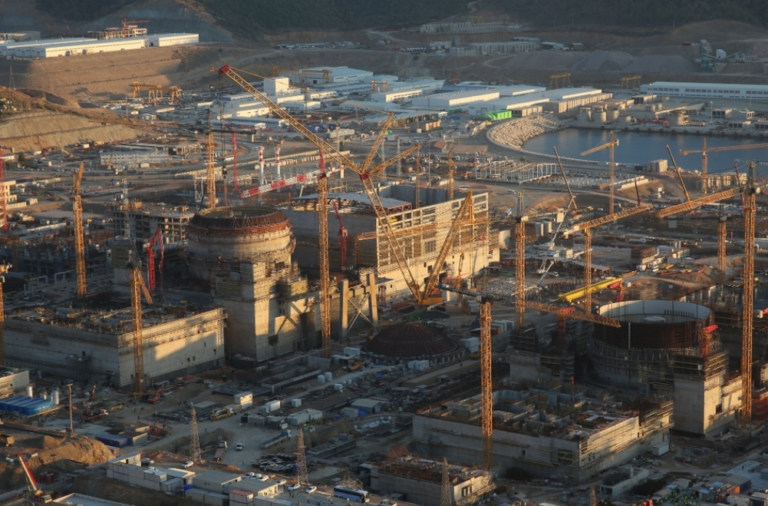
Should Israel knock Turkey’s nuclear plant offline? Turkey’s Akkuyu nuclear plant may begin trial operation in 2025. The move toward operations comes just over 15 years since Turkey signed an agreement with Russia to cooperate on the construction of a nuclear power station near Mersin.
Such a nuclear plant should never be allowed to function.
Turkey is one big seismic zone. Devastating earthquakes strike Turkey every few years. Even discounting corruption in Turkey’s construction sector, the Akkuyu plant poses an untenable risk to all of Europe.
A greater risk is the possibility that Turkey might utilize its nuclear plant to acquire fissile material for a nuclear weapon. Turkish officials—and even American counterparts—might say that the Akkuyu plant is proliferation-proof. Put aside that “proliferation proof” is never absolute. As with the Iranian civilian nuclear reactor at Bushehr, the problem has never been diversion at the civilian energy plant, but rather using the civilian program as cover to acquire and divert goods to a covert program.
A nuclear plant in Turkey will forever change the dynamics of the region. Turkey is both an irredentist power, openly challenging century-old agreements that define its borders and a terror sponsor in all but designation. Erdogan openly supports both Hamas and Hay’at Tahrir al-Sham, and there is ample evidence that he has also assisted both Al Qaeda affiliates in Syria and the Islamic State.
If Turkey gains a nuclear weapon, it might not only make good on its threats against other regional states, but it could also feel itself so immune behind its own nuclear deterrent that it could increase its terror sponsorship without fear of retribution or accountability. Such policy concern mirrors that with which many Western countries consider the possibility of Iranian nuclear acquisition.
From an Israeli point of view, it does not matter if a nuclear weapon originates in Iran or Turkey. Should President Recep Tayyip Erdogan continue to call for attacks on the Jewish state, Israel will have no choice but to respond.
Here, past is precedent. In 1981, Israeli jets attacked the French-built Osirak nuclear reactor shortly before its fueling. Quiet diplomacy had failed, and Western leaders remained mired either in wishful thinking about Iraqi President Saddam Hussein’s supposed moderation or just calculated that the possibility of an Iranian nuclear weapon was not there problem. The same dynamic was true with the Al Kabir plutonium processing plant near Deir ez-Zour in eastern Syria that Israeli jets destroyed in 2007. Israeli jets flew nearly 1,000 miles to destroy Osirak. The distance between Tel Aviv and Deir ez-Zour was just 400 miles, though Israel’s circuitous route made that perhaps double. The straight-line distance between Tel Aviv and the Akkuyu plant is just over 325 miles.
For Israel to attack Turkey’s nuclear reactor may be easier than the Iraq operation in a strictly military sense. Unlike Turkey, Israel has F-35 Joint Strike Fighters and it need not overfly intermediary countries to strike inside Turkey. Turkey’s F-16s are very good at attacking unarmed Kurds and Armenians, but Erdogan’s purge of pilots has left the Turkish Air Force a shell of its former self. Turkey may have anti-aircraft systems, but these may be little better than those upon which Iran relies.
Diplomatically, however, the ramifications of an attack on Turkey would be profound, especially with NATO collective self-defense clauses. Should Israel (or any other country) attack the Akkuyu site clandestinely and not claim credit, it will be possible to bypass such concerns. After voicing so many conspiracy theories and providing allies dossiers filled with poor intelligence, Turkey’s own word is meaningless.
Israel may be the boldest, but it is not the only country not to want to live in a world with a nuclear Turkey. Other NATO countries, including the United States, also have reason to fear Turkey’s nuclear program. Many NATO countries—Sweden and Finland especially—have every reason to rake Turkey over the coals. Israel might be a chief suspect, but in an age of drones and stealth technology, diplomats would refuse to act absent definitive proof that Jerusalem was to blame.
Then, there are other means to knock Turkey’s nuclear reactor offline. The Stuxnet virus set Iran’s nuclear program back years; Turkey is not immune to cyber-attacks. Even if Israel were responsible for inserting a virus into Turkey’s atomic software, it is unclear that NATO would deem this a reason to react.
Turkey, of course, would react with fury. If Turkey understood that NATO or not, it no longer falls under the NATO umbrella, it might be enough to compel the mercurial Erdogan to exit the alliance, effectively killing two birds with one stone.
Turkey may believe Akkuyu will come online in 2025 but, in reality, that may be the year the nuclear site’s lights go out, once and for all.
Source: 19fortyfive
Ask me anything
Explore related questions