





Revealing the Secret Conversation
After the uproar caused by the initial report on the leaked classified details of the recent bombing operation against Houthi positions in Yemen, The Atlantic has returned with a new article, offering further insights into what has been labeled a “blunder” by Donald Trump’s team.
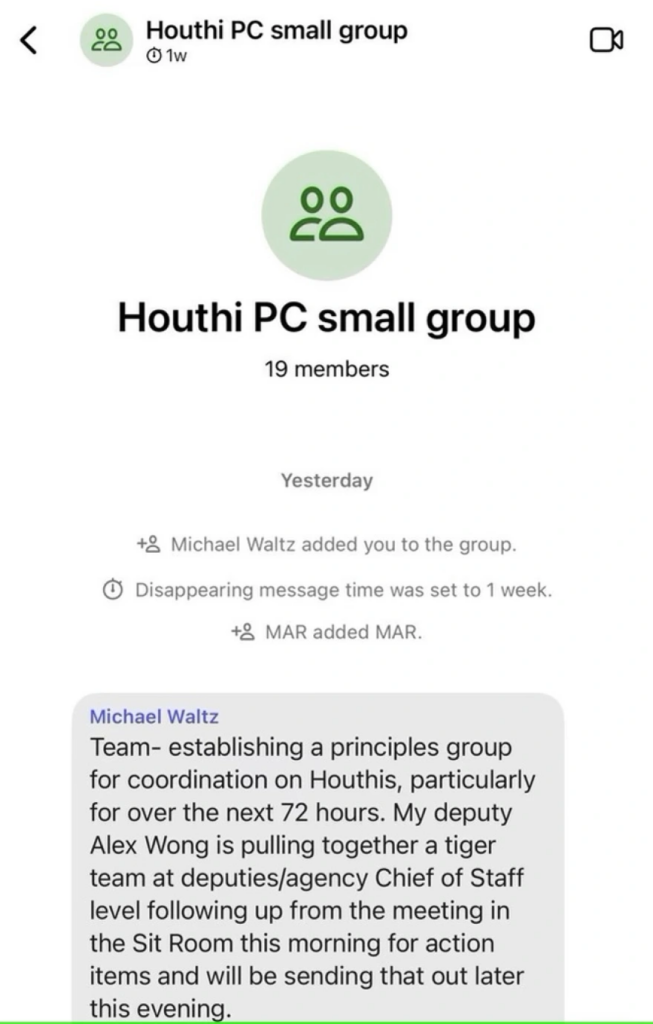
This time, the magazine has published details of the U.S. attack plan, which was accidentally disclosed to its editor-in-chief, Jeffrey Goldberg, when government officials mistakenly included him in a classified Signal group chat titled “Houthi PC small group.” This group was actively discussing the military strategy of the American forces’ operation in Yemen.
Efforts to Downplay the Leak
The article also highlights attempts by senior White House officials, including Trump himself, to downplay the significance of the leaked information, claiming that no “classified war plans” were shared in the chat.
Following the initial article exposing the major security breach, a journalist questioned Secretary of Defense Pete Hegseth, who responded:
“Nobody was sending messages with war plans. That’s all I have to say about it.”
During a Senate hearing yesterday, Director of National Intelligence Tulsi Gabbard and CIA Director John Ratcliffe were also questioned about the Signal conversation, where Goldberg was “accidentally” invited by National Security Advisor Michael Waltz.
“There was no classified material shared in this Signal group,” Gabbard told the Senate Intelligence Committee. Ratcliffe echoed this, stating:
“To be clear, my communications in that Signal chat were completely legal and did not include classified information.”
President Donald Trump also dismissed the issue, stating, “It wasn’t classified information.”
Decision to Publish the Messages
Initially, The Atlantic chose not to publish specific details from the chat—such as attack timing and weapon systems—to protect U.S. personnel involved in the operation. However, given the official denials and accusations that the magazine was lying, The Atlantic decided to release the full messages.
Critical Security Breach
Goldberg reportedly received information about the attack two hours before the bombing began, including precise takeoff times for U.S. aircraft. Had this information fallen into the wrong hands, the consequences for American troops could have been catastrophic.
The Leaked Messages
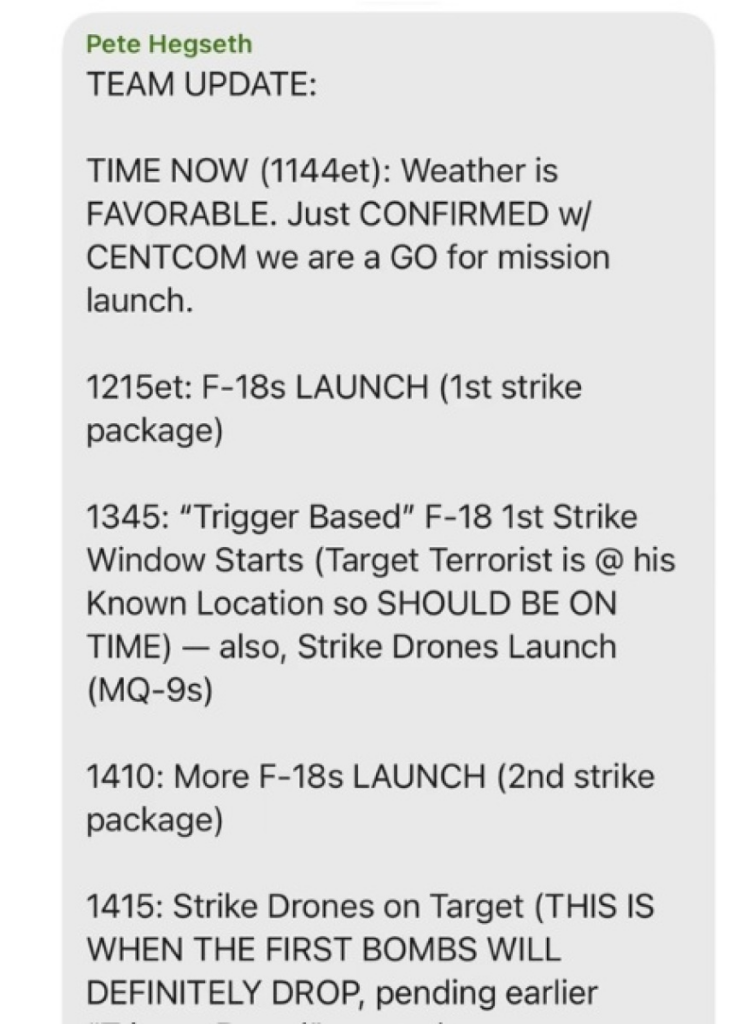
On Saturday, March 15, at 11:44 AM EST, Hegseth wrote on Signal:
“Team update. Weather is favorable. Just confirmed with CENTCOM—we are ready to launch the operation.”
He then provided minute-by-minute operational details:
- 12:15 PM ET: F-18s (1st strike package) take off
- 1:45 PM ET: First strike window opens with F-18s… MQ-9 drones deployed
- 2:10 PM ET: Additional F-18s (2nd strike package) take off
- 2:15 PM ET: Drones hit target (first bomb drop confirmed)
- 3:36 PM ET: 2nd F-18 strike package begins, first Tomahawk missiles launched
“For now, OPSEC (Operational Security) is clear. Good luck to our warriors,” he added.
Shortly after, Vice President J.D. Vance joined the chat, writing:
“Praying for victory.”
At 1:48 PM, Waltz sent real-time updates about the conditions at a targeted location, likely in Sanaa, Yemen:
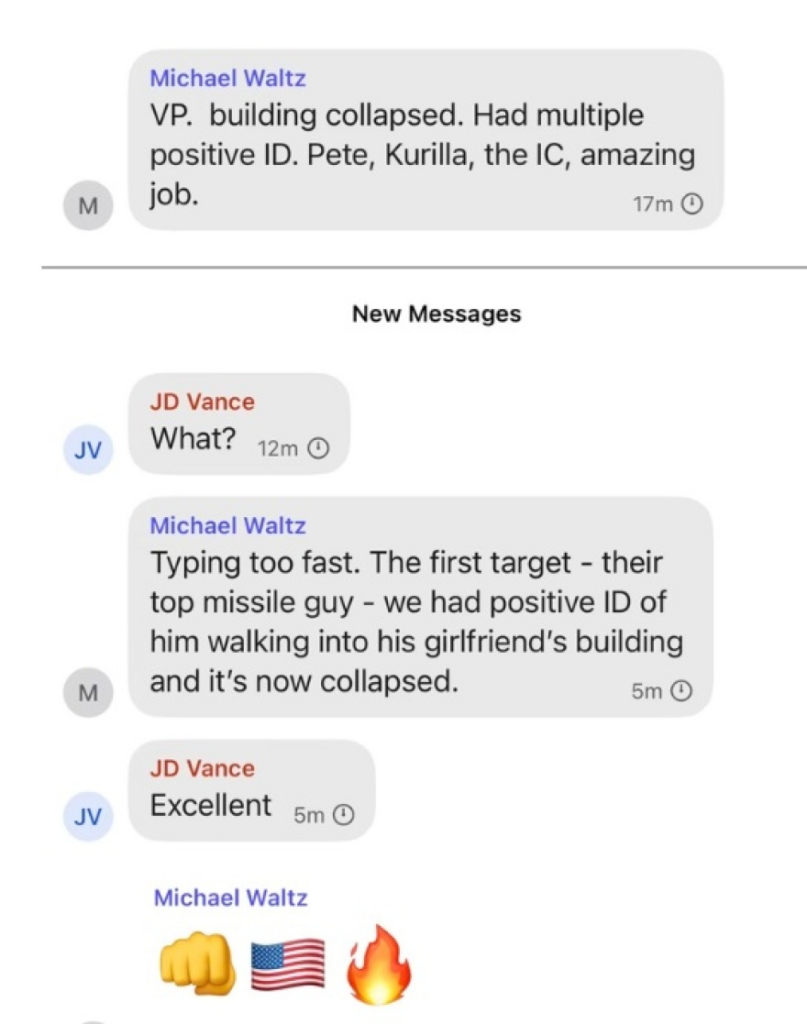
“Building collapsed. Multiple positive IDs. Pete, Kurilla, IC, great job.”
In this case, Waltz was referring to Hegseth, General Michael Kurilla (CENTCOM commander), and intelligence officials. The term “multiple positive IDs” indicated that U.S. intelligence had confirmed the identity of key Houthi targets.
A confused Vice President Vance replied:
“What?”
Waltz clarified:
“Typing too fast. For the first target—their top missile commander—we confirmed he entered his girlfriend’s building, and now it has collapsed.”
Vance responded: “Excellent.”
CIA Director Ratcliffe added: “A good start.”
Waltz followed with American flag and fire emojis.
“Great work, everyone,” Hegseth continued. “More strikes continuing for hours tonight. Full initial report tomorrow. But so far, on time, on target, and strong indicators of success.”
The Houthi-led Yemeni government later reported at least 53 casualties from the strikes—though no independent verification has been provided.
Reactions and White House Resistance
The White House was contacted by The Atlantic regarding the potential publication of these chat messages. Press Secretary Caroline Levitt responded via email hours later:
“There was no classified information, but we do not encourage the publication of this conversation. It was a private discussion among senior officials, and sensitive topics were discussed.”
The administration did not specify what it considered “sensitive,” but maintained its objection to publication, even though the Yemen operation had already taken place.
The CIA specifically requested that The Atlantic withhold the name of Ratcliffe’s chief of staff, who was mentioned in the chat. The magazine complied, but published all other messages without redactions.
Cybersecurity Risks and National Security Concerns
National Security Advisor Michael Waltz stated that he is investigating “how the hell Goldberg ended up in the group.”
The incident raises serious questions about cybersecurity and the management of military intelligence on unofficial platforms—especially when discussions involve critical national security operations.
Ask me anything
Explore related questions


