





The strategic relationship between Greece and Israel is reaching a new level. Beyond their shared understanding of regional issues and security threats in the area, both countries are eager to deepen their defense cooperation—potentially through joint production of advanced weapons systems.
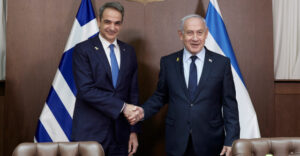
During his brief visit to Israel, Greek Prime Minister Kyriakos Mitsotakis met with Israeli President Isaac Herzog and had a private meeting with his counterpart, Benjamin Netanyahu. What stood out, however, was his meeting with officials from Israel’s Ministry of Defense (SIBAT) and senior executives from the Israeli defense industry. The focus of these talks was “exploring opportunities for collaboration and co-production, with an emphasis on technological innovation, research, and the acquisition of strategic capabilities.”
Prime Minister Benjamin Netanyahu met this evening, in Jerusalem, with Greek Prime Minister Kyriakos Mitsotakis.
— Prime Minister of Israel (@IsraeliPM) March 30, 2025
PM Netanyahu and @PrimeministerGR @kmitsotakis first met privately and then held an expanded meeting.https://t.co/76Mhhc7Fhf pic.twitter.com/gjltZ3OeeT
According to government sources, “the importance of mutually beneficial bilateral cooperation in the continued development of the Greek defense industry ecosystem was emphasized, which now includes companies producing high value-added products.”
Israel’s defense industry plays a key role in Greece’s broader effort to strengthen its deterrent capabilities, including through projects like the development of an “Iron Dome.” Even more important, however, are the new partnerships and joint ventures that could, in turn, boost Greece’s own defense sector.
The Mitsotakis-Netanyahu talks confirmed the high level of bilateral relations—ties that have been carefully maintained even during the Gaza war. Mitsotakis reiterated the need for a ceasefire in Gaza and the release of hostages, while Israel—backed by the United States—continues its military operations and supports Donald Trump’s (controversial) regional plan.
Athens and Tel Aviv share a broad understanding on key regional challenges and security threats in the Eastern Mediterranean, forming the foundation of their strategic alliance.
For Greece, maintaining this relationship is vital, as Israel remains a key regional actor—one that, for the foreseeable future, will serve as a crucial counterbalance to Turkey’s expansionist aims and its ambition to become a leading regional power in the Middle East and Eastern Mediterranean.
New Ankara-Tel Aviv Clash
Yesterday, another severe confrontation occurred between Ankara and Tel Aviv, following Erdoğan’s Ramadan-ending remarks wishing that “Allah destroys Israel.” In response, Israeli Foreign Minister Gideon Sa’ar posted on X (formerly Twitter), stating: “Dictator Erdoğan has revealed his antisemitic face. He is dangerous to the region and his own people, as recent days have shown. Let us hope NATO members recognize this and act swiftly.”
The Turkish Foreign Ministry reacted strongly, and both Erdoğan’s diplomatic advisor T. Kalinç and the AKP spokesperson responded online.
Turkey’s interventionist posture in Syria, along with its ambition to exert influence or even maintain a military presence on Syrian territory, is a “red line” for Israel. Recent Israeli airstrikes on the Palmyra military base were a firm response to reports that the Assad regime in Damascus had agreed to hand the base over to Turkey.
Mediation Role Toward the U.S.
Athens believes that Israel—given its current influence in Washington—will oppose efforts to lift CAATSA sanctions on Turkey, which would allow Ankara to rejoin the F-35 fighter jet program. This would directly affect Greece, as removing the sanctions could undermine the strategic edge Athens expects to gain from combining the F-35s with its already acquired Rafale jets.
Greece’s ability to influence U.S. decisions on this front is limited. Moreover, Athens wants to avoid publicly engaging in this debate, fearing that doing so might provoke another outburst from Erdoğan—as occurred after Mitsotakis’s speech to the U.S. Congress, where he urged lawmakers not to approve the sale of F-16s to Turkey.
Still, Greece’s strategic alliance with Israel provides it with a foothold in the evolving Middle Eastern security architecture being shaped by the United States—with Israel playing a central role. It also opens a valuable communication channel with the new U.S. administration.
Furthermore, the U.S. continues to support the development of the IMEC Corridor, a top-priority strategic, economic, energy, and trade project that will anchor U.S. policy in both the Middle East and the Eastern Mediterranean.
A prerequisite for IMEC’s implementation, of course, is the stabilization of the Gaza situation, which could pave the way for expanding the Abraham Accords and restoring Israel-Saudi relations.
The 3+1 Format and Energy Cooperation
Reviving the 3+1 format (Greece – Cyprus – Israel + USA) is also a top priority and something Israel has taken the lead on for the coming period. This format emphasizes energy cooperation and interconnection projects.
Athens has fully briefed Israel on the problems caused by Turkey regarding the critical Greece-Cyprus power interconnection project, which is planned to ultimately reach Israel—connecting Asia with Europe.
Israel’s political and diplomatic backing is valuable, but the real test will come if exploration activities extend beyond 6 nautical miles in Greece’s declared Exclusive Economic Zone (EEZ). At that point, it will be seen whether support from Israel, France, and the EU is enough to prevent Turkey from attempting to block the operations or assert claims that undermine Greece’s EEZ.
Security Challenges in the Red Sea
During the Jerusalem talks, Mitsotakis and Netanyahu also discussed maritime security threats in the Red Sea, particularly the impact of Houthi attacks on global shipping and trade, as well as developments in Lebanon and Syria.
The Greek prime minister conveyed key messages to Netanyahu, following the recent Five-Party Conference in Paris attended by leaders from France, Cyprus, Lebanon, and Greece, along with a videoconference with Syria’s interim president Al-Saraa.
Ask me anything
Explore related questions