





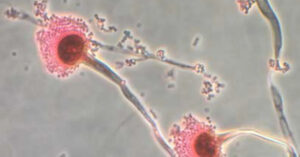
An invisible yet highly dangerous threat is increasingly endangering regions across the planet: fungi. According to a new scientific study published by the University of Manchester and currently under peer review, climate change could dramatically expand the spread of the common fungus Aspergillus, which is responsible for severe infections and millions of deaths annually.
As CNN reports, this species belongs to a vast and still relatively unexplored group of organisms – fungi – that, while vital to ecosystems, can have devastating effects on human health. Fungal infections kill over 2.5 million people worldwide each year, according to the latest estimates.
CNN: Scientists express deep concern over deadly fungi that can “eat us from the inside out”
Aspergillus is a common fungus found in soil, plant debris, water, and air. Humans inhale it daily, but for most people, the immune system is enough to prevent complications. However, for patients with asthma, cystic fibrosis, COPD, cancer, organ transplants, or severe cases of COVID-19 or flu, the fungus can be fatal.
If the immune system fails to neutralize its spores, “the fungus begins to grow and essentially ‘eats you from the inside out,’ to put it bluntly,” explains Norman van Rhijn, researcher at the University of Manchester and lead author of the study. The mortality rate for patients with aspergillosis ranges from 20% to 40%, while diagnosis is particularly difficult, as symptoms – fever, cough, fatigue – are easily confused with other illnesses.
The resilience and spread of Aspergillus species
The study focuses on two key species:
- Aspergillus flavus, which prefers warm, tropical climates, could expand its range by 16% if fossil fuel consumption remains high. It is expected to spread into northern China, Russia, and the U.S. It is particularly drug-resistant and also affects crops, posing a threat to global food security. In 2022, WHO listed it in the “critical” category of fungal pathogens.
- Aspergillus fumigatus, which thrives in temperate climates, is expected to expand by 77.5% by 2100, potentially exposing 9 million people in Europe alone.
Conversely, some regions – such as parts of sub-Saharan Africa – will become so hot that they may no longer support the growth of these fungi. However, this could seriously disrupt local ecosystems, as fungi are essential to soil fertility.
Climate change increases resistance and spread
Another alarming factor is the possibility that fungi may become more heat-tolerant, making it easier for them to survive inside the human body. Additionally, extreme weather events – such as floods, droughts, and heatwaves – facilitate the long-distance spread of their spores. A notable example is the outbreak of fungal infections following the 2011 tornado in Joplin, Missouri.
The global community, according to researchers, remains ill-prepared to tackle the fungal threat. There are only four classes of antifungal drugs, and more and more strains are showing resistance.
Professor Justin Remais from UC Berkeley, who leads a study involving over 100 million U.S. patients, told CNN that over 20,000 cases of aspergillosis were recorded between 2013 and 2023, with an annual increase of 5%. However, the lack of data may be masking much higher numbers.
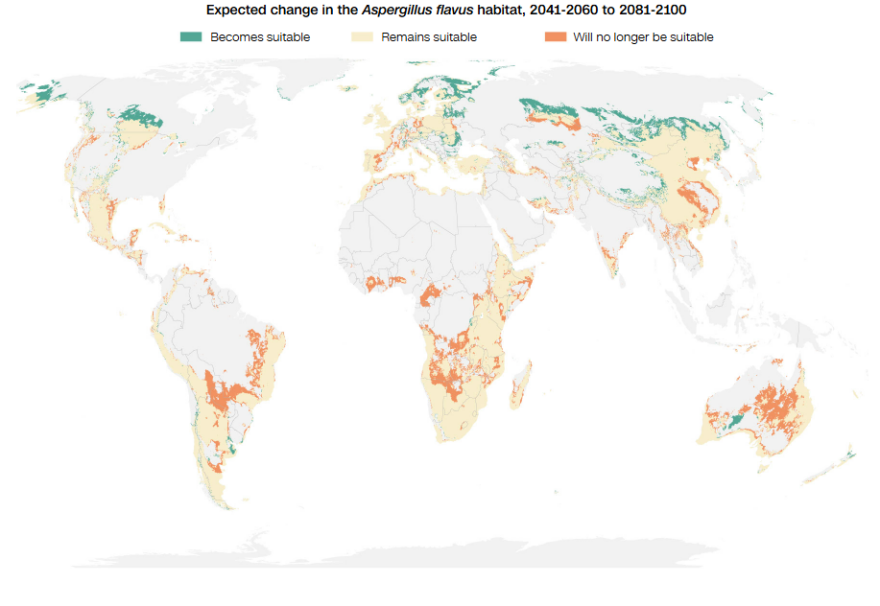
Projected habitat shift of Aspergillus flavus, 2041–2060 to 2081–2100
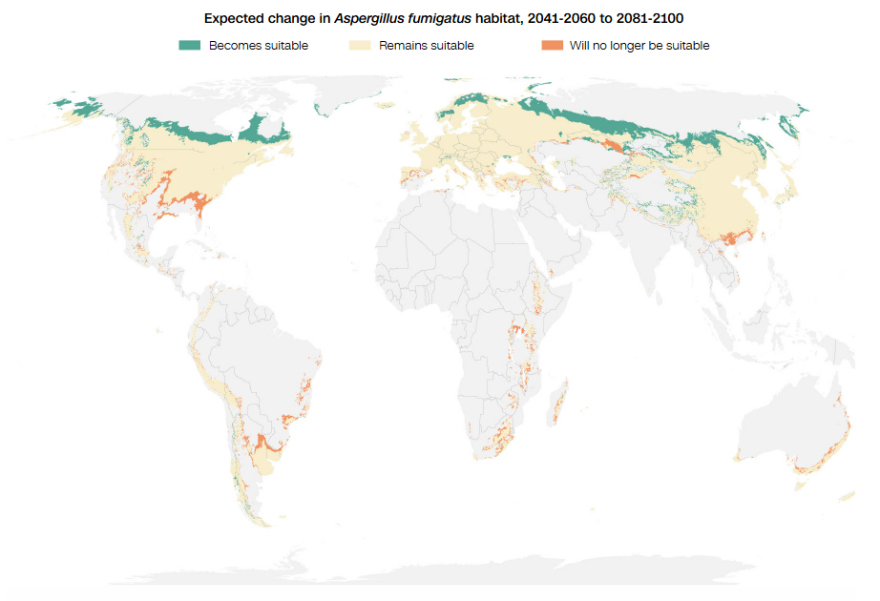
Projected habitat shift of Aspergillus fumigatus, 2041–2060 to 2081–2100
“There is a need for urgent action”
Professor Elaine Bignell, co-director of the MRC Centre for Medical Mycology at the University of Exeter, emphasizes that the new study “rightfully highlights an underappreciated public health threat.” She also calls for increased funding for research and improved epidemiological monitoring.
The scientific community hopes that the success of TV series like The Last of Us will raise public awareness – even through science fiction – about the real threats posed by fungi, which, as Bignell says, “are not just horror stories, but a real danger.”
Ask me anything
Explore related questions


