




When Nicola Procacchini was first elected to the European Parliament six years ago, the New York Times writes today, many of his colleagues would not shake his hand and even avoided sharing an elevator with him.
As a member of a small, far-right party in Italy, his positions on immigration were met with suspicion and disdain. “My hand was in the air because they wouldn’t shake hands with fascists,” he describes sarcastically, referring to the way he was viewed by his political opponents. At the same time, immigrant rights activists were being welcomed into Parliament and cheered.
Today, however, the scene has changed dramatically. Procacchini, a member of the “Sisters of Italy,” sees many of his positions becoming… mainstream. His party dominates Italy politically, with Georgia Meloni in the prime ministry, and he is now chairman of the European Conservatives and Reformists group – a powerful voice in Strasbourg and Brussels.
The new doctrine: Tighter line from right and left
Europe is experiencing a historic turning point. A tough attitude towards illegal immigrants is no longer the exclusive prerogative of the far right. From centrists to traditional leftist leaders, more and more are advocating for restrictions, strict borders and mass deportations. As expert Martin Hoffman says, “there is now a broad consensus in almost all political camps: we will be tougher.”
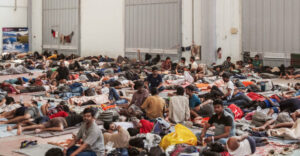
After the great wave of 2015, when more than 1,000,000 refugees – Syrians, Iraqis, Afghans – arrived in Europe, the political agenda shifted. The rise of nationalist and populist parties in many countries pushed even traditional centrists to harden their positions. And although arrivals have fallen – about 20 percent this year, according to Frontex figures – the issue remains explosive.
Today, member states and European officials are seeking new solutions to curb the flows. Denmark, under the center-left Mette Frederiksen, is leading the way with its “zero” refugee policy, now being held up as a model even by German Chancellor Friedrich Murch.
The idea of outsourcing asylum claims to third countries is no longer considered taboo: Meloni’s Italy wants to keep asylum seekers in Albania until their claims are processed, despite being blocked by Italian judges. Even Ursula von der Leyen called this approach “an example of creative thinking.”
At the same time, the EU is stepping up cooperation with countries such as Libya and Tunisia. But rights organisations warn of the price: in 2023, Tunisian authorities abandoned migrants in the desert, highlighting the “huge human rights costs”, as Camille Le Coz of the Migration Policy Institute Europe notes.
Rocks to Europe’s fundamental principles
This change touches even the very basis of the European legal edifice. Recently, Meloni and Frederiksen presented a joint letter, co-signed by leaders from Austria, Belgium, Poland and other countries, calling for a review of the European Convention on Human Rights because, they say, it “excessively restricts” the right of states to decide who to deport.
At the same time, countries such as Poland are suspending the right to asylum at their borders, citing a “hybrid war” by Belarus and Russia that is encouraging migratory flows to destabilize Europe.
The harsh rhetoric is causing concern among local leaders. In Sopot, Poland, Mayor Magdalena Czarzynska-Jahim points out that her city has been supporting Ukrainian workers and war refugees for years. “I agree that the borders need to be protected,” she says, “but we run the risk of collectively portraying migrants as criminals. Legal immigrants are our neighbors – they are not criminals.”
This concern touches even longtime advocates of the harsh measures. Alexander Downer, Australia’s former foreign minister, recalls how the EU criticised Australia for its plan to transfer asylum seekers to detention centres in Papua New Guinea. “I was lectured about how bad we were,” he says. “Today, von der Leyen has adopted it.”
The bet: borders secure or values at risk
Europe is changing. Borders are being secured ever more tightly. Asylum claims are being moved away from European territory. Immigration, for years a flashpoint between right and left, is now becoming common ground for governments of all colours.
The big question is whether the continent will be able to hold on to its core values of an open society and human rights, while putting up fences and closing passages. Perhaps the answer will be seen not at the borders, but in the squares, villages and towns where migrants – legal or not – live, work and raise children. For many Europeans, this dialogue has only just begun.
Ask me anything
Explore related questions