





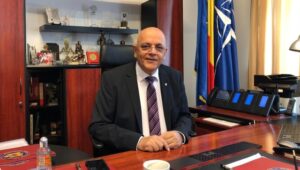
Romanian firefighters will be operating in Greece’s fire fronts again this year until the end of September and protothema.gr was at the “headquarters” of the responsible Deputy Minister, Reid Arafat, who is considered one of the most qualified European politicians and a pioneer in the field of Civil Protection.
He is one of the most prominent figures in the field of human rights protection, a leading expert in the field, and a key figure in the European Union.
Referring to the cooperation between the two countries on firefighting, “we need to think of new means and we need to increase the means at the national level, but also at the European level, in the rescue program, which was finally created by former Commissioner Stylianides and turned out to be one of the beneficial projects”, he stresses new resources and more European solidarity as a counterweight to the escalating climate crisis.
He stresses the importance of evacuation based on prescribed protocols, focuses on good preparation through systematic training, and emphatically underlines the need for enhanced preparedness at the national and European levels to deal with future climate disasters.
In detail, the interview of Raed Arafat with protothema.gr
ER: We are in August. The temperatures are very high even here in Bucharest, and everyone is wondering what the future will be like in the summer.
Arafat: The problem is that we are facing the new normal. Climate change has brought many challenges in many areas, not only in civil protection. But what we see now is that every year we have more and more complex challenges than the year before. I can tell you that in Romania, we had a large number of fires, and one of them, which took about 12-15 days to put out, was in the Delta region, a protected area where we used all the means at our disposal to contain it. But we’re dealing with more forest fires than before. They are different from those in the Mediterranean, but they still require resources. They need air assets, land assets. And in the Delta region, we also used naval resources to put out the fire, using one of our firefighting ships from the Danube, in the area that was close to the Danube, and was affected by the fire. So, this is getting more and more complicated.
ER: Some ships are helping you with the fires, right?
Arafat: Yes, we have our own ships, from Civil Protection, but their use depends a lot on the situation. For example, the fire was very close to the Danube, so the ship’s water cannons were able to get to the fire and limit its spread, which was very good for us.
We have a lot of water cannons.
ER: I asked you because your experience is vast. Everybody knows that. And we see that we have big fires in the Mediterranean. Do you think we need new means, yes, like ships as well?
Arafat: Here, we can see what happened this year, for example, from our side, apart from the fires we had in Romania, we saw what happened in Greece, in Spain, in other countries. We had teams in France in July. Now we have a team in Greece until mid-September, as we do every year, but for the first time, we sent a team of 51 firefighters by air to Spain without vehicles. They asked for teams without vehicles as well. So at the moment we have 51 firefighters in Spain. And for the first time, we sent a helicopter to Bulgaria for firefighting. What we see is that the demands are increasing, and resources are limited. So my answer is yes, we have to think about new methods. We need to think of new means and we need to increase the resources at the national level, but also at the European level, in the rescue programme, which was finally created by former Commissioner Stylianides and proved to be one of the beneficial projects. And now we know that some Canadairs have been ordered through the bailout programme, but they will be delivered near the end of this decade, between 2028-2030 and so on. Also, some helicopters have been purchased. Romania is now waiting for the rescue helicopter that will be under the EU mechanism, and we hope that it will be delivered by the end of the year, which will be the eighth helicopter of the Civil Protection. Eighth, yes, but that will be dedicated to the EU response, to the rescue response.
ER: In the past, we have not had training for Civil Protection, and you have worked for many years training the citizens, the schools, and everyone involved. Do you now believe that training is the key to Civil Protection?
Now you believe that training is the key to Civil Protection?
Arafat: Well, it’s one of the pillars. Civil Protection is not a solitary thing; it’s a team effort. And of course, the basis for Civil Protection is usually the fire and rescue services. But they are not the only ones. You have to bring the medical system, the doctors, the emergency response, under our department. We have all of that under one department. We have the fire department, we have the medical emergencies, and we have the air ambulance. We also have, right now, a water rescue component, as well as a mountain rescue. All of that is now under one umbrella. The population is the basis of preparedness and response, and we keep telling our population that they are the basis, because if you have a disaster, if you have a major emergency, the population has to be the first responders. You can’t expect the government or the state to be able to respond immediately to everything that comes up after an earthquake or after a major disaster. You need the population to be educated, to know what to do, to know how to avoid exposure, to know how to respond and help neighbors until the authorities arrive. One of the things we use a lot, beyond going to schools and so forth, is our web portal.
You can find it in Romanian. It’s called figatite.ro, but it also has a full English version, called be prepared. ro, so if you type be prepared with the same word, you can access the portal in English. If you get to the Romanian site, you can select English, and you’ll see the recommendations and the population guidelines there. You will see that the big situations that we can face, for example, strong storms, how to behave before, how to prepare, what to do during the storm, what to do after, all these things you will find in this portal. What happened with the earthquake, fires and so on? Recently, we’ve started adding some short films for children, short films for children, yes, and we’re creating them with UNICEF of the United Nations, so the first six will be published this year. The first one is already here and we might have one more published. But these short films show children from four to seven and from seven to fourteen, let’s say, how to behave and how to prepare for disasters.
So the culture of preparedness needs to be built. And it needs to be built from the moment you are a child, not just when you are an adult. And it needs to be built in schools as well. And before schools, we know today, all kids are on devices like tablets, cell phones and so on. So at least here, we’re trying to reach out to them and show them how to be prepared and make them understand that they’re first responders, and they’re the first level that’s part of Civil Defense. If they’re prepared, our job becomes less difficult or less heavy for emergency services, because a prepared population means that when you get a warning, you do what the warning says. If you’re told to evacuate, you evacuate. If we tell you not to expose, you know where not to expose. This makes it much easier for emergency services because you will have fewer emergencies per phase. If the population knows how to be…
ER: When I came here a few days ago, my cell phone received a 112 warning because of the high winds. And there’s a big debate these days in Greece, whether we should evacuate when we get a warning on our cell phone because of the fires. And I would like you to share with us your opinion on this, because some people say, okay, I’ll stay behind and save my house, my car, my property.
Arafat: The most important thing is to save your life, your family’s life, and your animals’ life, if you have pets, animals and so on. That’s the most important thing. If you get left behind and the fire gets out of control, you become a liability to the emergency services, and the emergency services have to try to save you, but trying to save you can even mean firefighters getting injured or getting lost in rescue operations. So, when the decision is made to evacuate, the best thing to do is to evacuate, and that means there’s a reason for it, because the people who decided to evacuate know full well that if you don’t, you can be in a very, very difficult situation, and your life may be in danger. We’ve seen big fires. You’ve experienced this before. Portugal has had it in the past, they’ve had it in the United States, in Hawaii, where we’ve had a lot of fire deaths, and that’s because sometimes people don’t want to evacuate, the fire changes direction, and you think you’re safe, and then you’re in the middle of the fire. We saw that in Israel, on Mount Carmel a few years ago, also where they lost, I understand, some firefighters. So evacuation, when it’s decided by the authorities, by the Civil Protection, is usually a decision that is made based on the information that they have, and it’s also based on the idea that we want to avoid tragedies. Tragedies usually mean that lives are lost. If you lose houses, you can rebuild them. If you lose property, you can find a way, especially if you are insured, to recover it. But loss of life is never recoverable. So yes, evacuation, in my opinion, when it’s decided by the authorities, we hope and pray that the population will listen to us right away, and start moving and evacuating as recommended. I can tell you that this year we evacuated for flooding. It’s true, not for fires. We evacuated some areas, a few hundred people and so on in the middle of the night. Fortunately, it wasn’t that serious in that area, but the evacuation prevented people from being in the middle of the water, but in another area where we gave a message because it was an immediate warning. Three elderly people were unable to evacuate. They didn’t know how to avoid the situation, and they died. So in that respect, evacuation is a very important decision, and it’s a very wise decision if it’s made in time, and if it’s implemented, and if the population listens to the authorities.
ER: One last thing, we’re talking about large fires. Romania helps us every summer, and we feel very grateful for that. But I would like to ask you what do you predict that we have these fires, and what is the future? Because climate change is very serious.
Arafat: The future is that we see more and more that there are some situations that a country alone cannot deal with, and needs help. I cannot tell you that in the future we will not ask for help. Sometimes this year we have not needed it. We could manage on our own, but you don’t know what will happen. No one can say I’m 100% resilient. I’m 100% ready. I don’t know that in an earthquake, I am sure that Romania, if we have an earthquake in Bucharest, we will ask for help. And that’s for sure, as it happened in Turkey, as it happened in many other regions. So the future, we have to prepare better for that. And the preparedness has to be at two levels, the national level, which includes the local level, the regional level, the national level, but the national level means that every country has to prepare more and more. And of course, at the European level, solidarity has to become stronger, and we have to understand that when somebody needs help, we are there to help, and we know that when we need help, others will come to help. It is a matter of solidarity, and that is how we are building the whole civil protection system in the EU. It is based on solidarity, and it has proven to work very well. Look now, the Romanian firefighters in Greece are working together with the French firefighters, but the Romanian firefighters were in France before, in July, and they worked with the French firefighters there, along with other countries that are now in Spain. The Romanian firefighters are working with the Finnish firefighters in that area, and in another area, there are French, Germans, and so on, who are supporting Spain. It becomes something that we have to look at, we have to reinforce. It is a very positive way of working together. We learn from each other. That is what we have to understand, that there is also a learning experience. There is the support you give to the country you go to, but there is also a lot to learn from that country. So you become better in your own country. When you go to forest fires and so on.
In my opinion, the future means better prepared people, better prepared personnel, firefighters, and so on, a better prepared population, and more capabilities and more means to intervene to meet the challenges we will face in the future. We have to understand that the future will not be better than today. I am very sorry to say this, but we are not that optimistic about the future. We believe that with this climate change, which you cannot reverse overnight, it takes a long time to reverse. You’re going to need better preparedness. You’re going to need more resources. You’re going to need more resources to be able to meet the challenges that we’re going to face in the future.
Ask me anything
Explore related questions


