




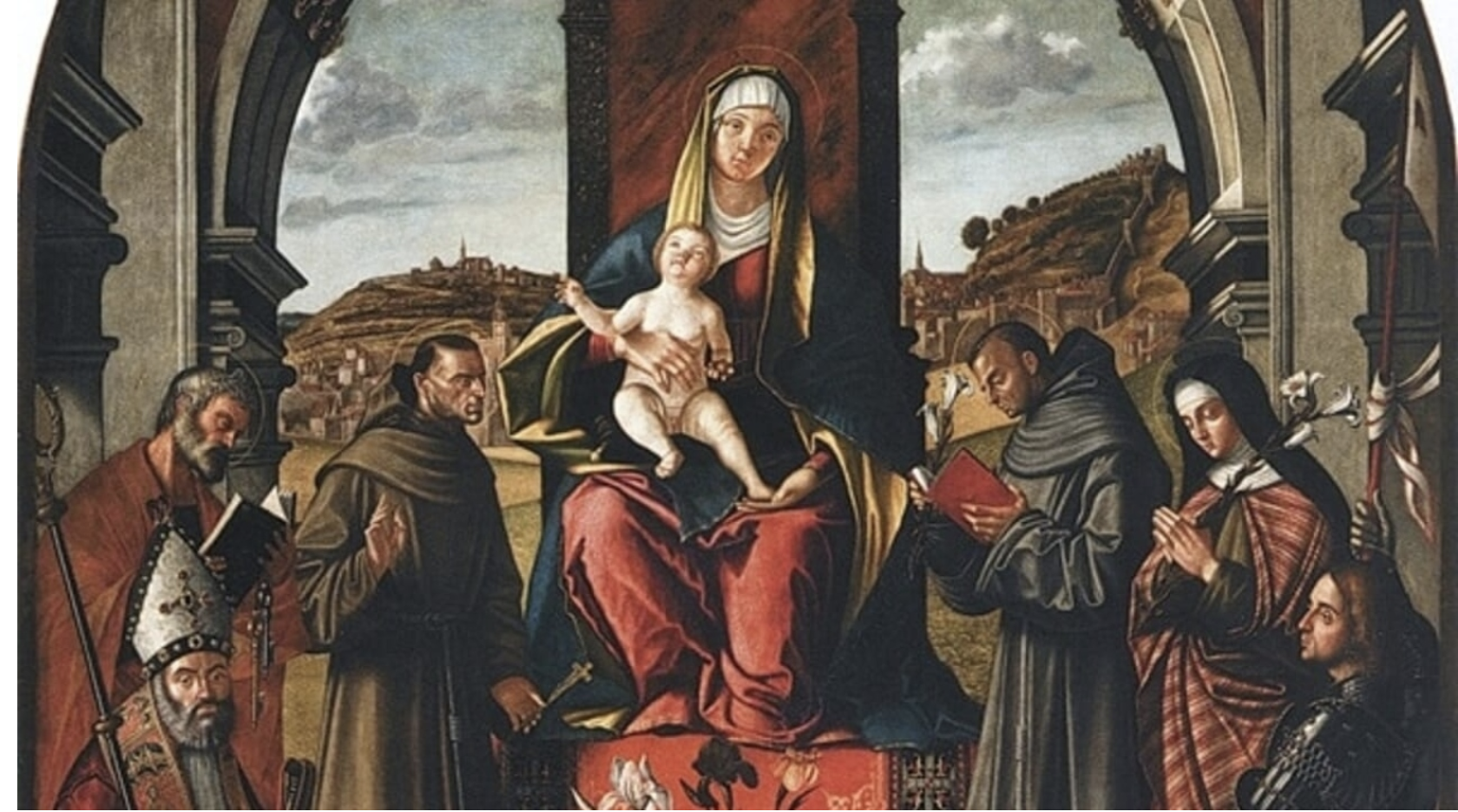
A row has broken out between Italy and Slovenia over the return of a 16th-century altarpiece by painter Vittore Carpaccio from Padua to the Slovenian town of Piran, where it was originally installed.
Italian politicians argue that the artwork remains part of their country’s cultural heritage.
The work, titled “The Virgin and Child Enthroned with Six Saints” (1518), an ecclesiastical decoration placed behind the altar, was painted for the Church and Monastery of St. Francis of Assisi in Piran, Istria — a region of the Adriatic once under Italian control but now divided between Slovenia, Croatia, and Italy. The painting was removed in 1940, when Istria was entirely within Italian borders, and transferred to Padua for safekeeping during World War II. It adorned the Basilica of St. Anthony there for decades.
On September 4, following pressure from Franciscan monks in Padua, the work was quietly returned to Piran, just days before Italian President Sergio Mattarella’s official visit to Slovenia. Slovenia’s Culture Minister Asta Vrečko hailed the return as “the result of long-standing efforts” and announced that the painting would soon be exhibited “in its authentic setting.”
The painting’s return after 85 years is a sign of good cooperation, said Janez Šaber, guardian of the Monastery of St. Francis, according to the Slovenian news agency STA.
When first removed from the church in Piran, the painting was stored for three years in Villa Manin, a mansion about 20 km southwest of the Italian city of Udine, which served as a depot for artworks from Friuli Venezia Giulia and Istria, according to the online art magazine Finestre sull’Arte.
How the painting ended up in Padua
After Italy’s armistice in the autumn of 1943, Villa Manin was no longer secure and artworks were returned to their owners, the magazine notes. However, communication with the church and monastery in Piran was impossible at the time, as the monks had been imprisoned by Nazi forces occupying the Slovenian territories formerly held by Italy.
The painting was moved to Padua, where it remained in the Basilica of St. Anthony.
Slovenian Ambassador Tomaž Kunstelj told STA that the “key” to Carpaccio’s painting being returned was “quiet diplomacy.” He emphasized that this is the first of several dozen artworks removed during World War II for protection that are expected to be repatriated.
Outcry from Meloni’s party MPs
In Italy, however, the handover has been denounced as capitulation. Roberto Menia, senator for Giorgia Meloni’s Brothers of Italy party and a descendant of exiled Istrians, said the work “remains part of Italian heritage,” stressing Carpaccio’s Venetian roots. Another Brothers of Italy MP, Alessandro Urzì, called the transfer of the painting to Slovenia “fundamentally wrong.”
The debate is highly sensitive, as about 350,000 Italians left Istria and Dalmatia after World War II amid intimidation and reprisals in Tito’s Yugoslavia.
The painting will be placed in Piran’s Church of St. Francis on December 27, following restoration work on the high altar.
Ask me anything
Explore related questions