




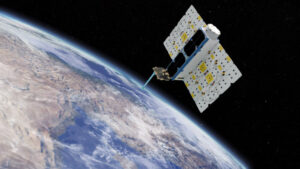
The National Space Program is entering the full implementation phase. In November 2025, the launch of two operational Radar (SAR) technology satellites, built by ICEYE, as well as three experimental microsatellites, is planned, which will enhance the national capability in advanced technologies and enable the development of new applications. This will be followed by the launches of seven optical satellites and four thermal satellites, which will provide full daily coverage of Greek space.
The programme, designed and implemented by the Ministry of Digital Governance, the General Secretariat of Telecommunications and Post, and the Hellenic Space Centre, with the technical supervision of the European Space Agency (ESA), is funded by the National Recovery and Resilience Plan” Greece 2.0″.
“When we decided to invest as a country in space with microsatellites that would provide 24/7 critical data for civil protection, urban planning, and the environment, many people thought it was science fiction. But in cooperation with ESA, we ran all the procedures very quickly, we signed the relevant agreements, and within just one year, the first microsatellite will be put into orbit under the “National Microsatellite Programme”. Within November, the launch will take place,” Minister of Digital Governance Dimitris Papastergios stresses to APE-MPE.
The objectives of the National Space Programme
The aim is for Greece to acquire immediate operational capability in satellite data and services that will contribute to environmental protection, the response to natural disasters and climate change, as well as applications related to national security and defence, while at the same time strengthening the domestic space industry with satellite and subsystem production lines.
The aim of the programme is twofold: on the one hand, immediate access to satellite data that will enhance civil protection, environmental monitoring, climate change analysis, and national security, and on the other hand, the gradual development of autonomy in the production of satellites, subsystems, and advanced cutting-edge technologies.
Investments in production lines, test infrastructure and ground stations have already been launched, such as the creation of a 350 sq.m. clean AIT Facility (Assembly, Integration & Testing) in Tanagra for testing microsatellites up to 500 kg, as well as the upgrade of three telescopes (Helmos, Skinakas, Cholomontas) into optical ground stations for optical and quantum communications.
“Even more crucially, we are already planning our next step, which envisages integrated satellite production in Greece to serve the global market. The company’s next goal is to produce primary technology through R&D activities in Greece, as we aspire to contribute to the development of the country’s technological base, which is the key component for Greece’s technological autonomys,” ICEYE’s head Vassilis Haloulakos told APE-MPA, adding: “Regarding the usefulness of ICEYE’s satellites, the SAR system carried by the company’s satellites produces satellite data that help the relevant authorities respond faster and more effectively to a wide range of operational needs and challenges. More specifically, ICEYE’s satellite data helps to respond to natural disasters such as floods and fires to provide critical and readily usable information for the security and defence of the country. This makes ICEYE satellites an excellent tool for Greece, which has significant needs in these areas.”
The operational capabilities of the National Space Programme cover an extremely wide range of uses
Thermal satellites will support forest fire management, temperature monitoring in sea, land, and urban centres, contributing to the early detection of marine burns and the protection of the blue economy (e.g. aquaculture). SAR data will enable accurate mapping of floods, tracking of vessels and vehicles at sea and on land, as well as surveillance of marine areas, critical infrastructure, and pollution incidents.
Optical satellites will enable the production of highly accurate national cartographic backgrounds, enhance the monitoring of ecosystems, Natura sites, and biodiversity, as well as agricultural production through crop mapping, yield assessment, and soil moisture monitoring. In addition, the data will be used to monitor urban heat islands, air quality, and soil deformation, providing valuable tools for public agencies, research institutions, and civil protection services.
“At ICEYE, we are very proud to have built and will be launching the first Greek satellites, ahead of the original schedule. Our collaboration with the Ministry of Digital Governance and the European Space Agency on this critical project has been exemplary and has shown the added value that investments funded by the recovery fund can bring. At the same time, we are particularly pleased with the rapid establishment of our Greek offices in Athens, which include a production facility where Greek engineers and craftsmen are building important subsystems for our global satellite constellation.”
Finally, the development of the Government Geo-Information Node will allow the unified collection, processing, and dissemination of data, both from Greek satellites and from European and international programmes such as Copernicus and Landsat, enhancing the use of satellite information for civil protection, research, security, and industrial development.
“With resources from the Recovery Fund, Greece is for the first time acquiring its own satellite in space, enabling public and private entities to formulate effective policies and produce smart solutions. And this is just the beginning. From 2026, the country will have a full production line capable of manufacturing high-tech satellites entirely “made in Greece”, from the first component to the final assembly. This development marks not only our technological upgrade, but also a great opportunity for brain gain. Greek scientists and engineers are returning home to contribute to the creation of a strong domestic space ecosystem that will place Greece on the European space map with claims”, concludes the Minister of Digital Governance, Dimitris Papastergiou, speaking to APE-MPE.
Ask me anything
Explore related questions