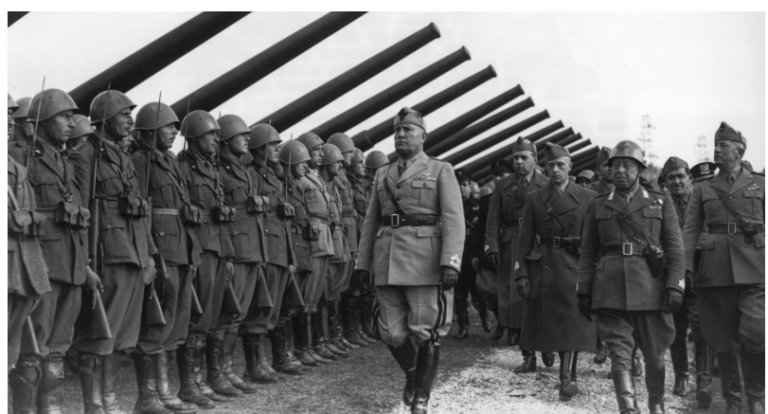
The choice of October 28th as the date for Fascist Italy’s attack on Greece was far from coincidental. Beyond Mussolini’s desire to boost his international profile with a decisive European victory and compete with his ally Adolf Hitler, he also wanted to celebrate an important anniversary for the Fascist Party. He chose Greece, but history would show it did not go as planned.
The March on Rome
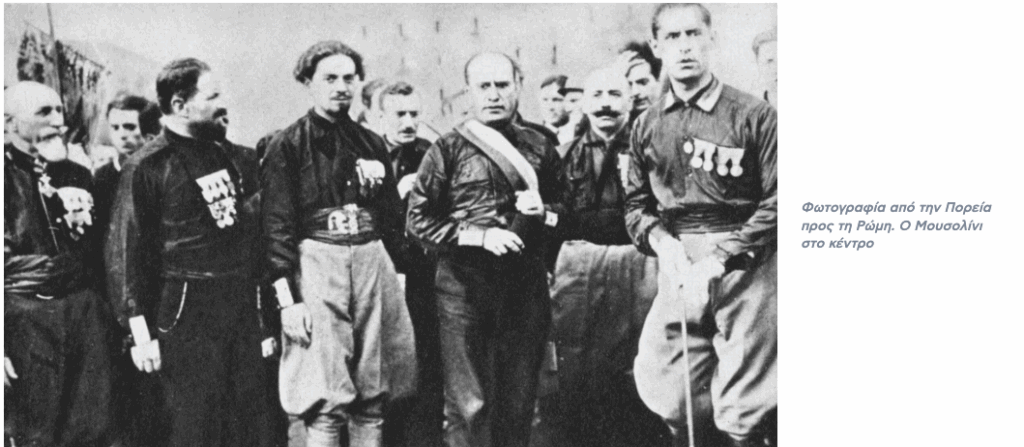
On October 28, 1922, Benito Mussolini and his Fascist squads carried out the infamous “March on Rome.” This event, later described as a “pseudo-coup,” became the historic path by which Mussolini rose to power.
Over three days (October 27–29, 1922), the Blackshirts gathered outside Rome, pressuring the fragile Italian government. On October 29th, King Victor Emmanuel III decided not to resist. Instead of declaring a state of emergency, he invited Mussolini to form a government. About 25,000 Fascists paraded through Rome, transferring power virtually without a fight. Fascist propaganda later portrayed it as a dramatic seizure of the capital.
Mussolini became prime minister and gradually consolidated his regime. Initially ruling under a parliamentary façade, by the end of 1926, he had eliminated all democratic freedoms and imposed a single-party dictatorship that lasted until 1943. In Fascist Italy, October 28th became a symbolic anniversary of the March on Rome, the “birthdate” of Mussolini’s regime.
The Irony of History
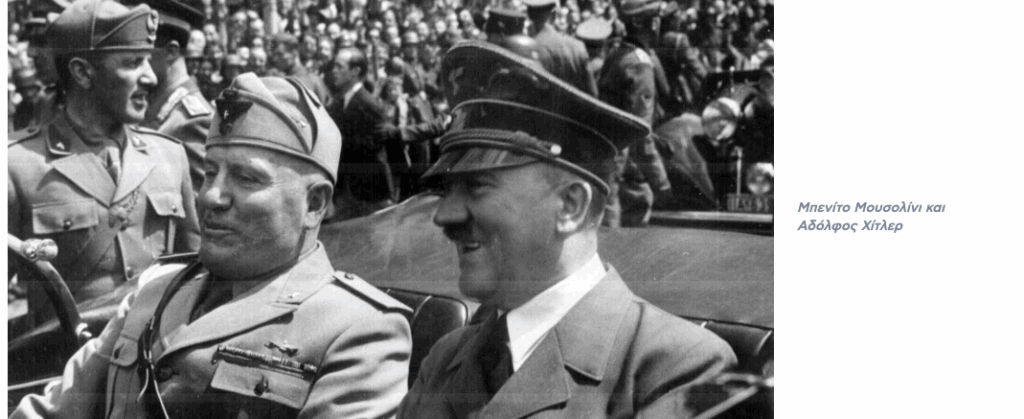
Mussolini’s decision to attack Greece on this symbolic day backfired. The same evening of the invasion, he met Hitler in Florence, proudly announcing that he had started a war against Greece. However, instead of a quick triumph, the campaign marked the beginning of Fascism’s decline.
As one historian vividly noted:
“The fascist ambitions sank into the snow of Pindus, and the ‘march to glory’ became a march to defeat.”
The symbolic date of the Fascist regime thus became a commemoration of failure.
The Attack on Greece and the “Lightning War” Fiasco
In the early hours of October 28, 1940, Fascist Italy issued an ultimatum to Athens, demanding free passage of Italian troops and essentially Greek surrender. Prime Minister Ioannis Metaxas’s response was firm:
“Then we are at war” – the historic “OXI”, reflecting the will of all Greeks not to surrender.
At 5:30 a.m., Italian divisions stationed in Albania launched an attack along the Greek-Albanian border. Mussolini had gathered roughly 135,000 troops against just 35,000 Greek soldiers. Fascist Italy and the Roman press had portrayed the campaign as an easy, three-day victory. The day before the invasion, Italian newspapers celebrated the expansion of the “New Roman Empire,” with headlines like:
- “Italy Breaks the Chains of the British in the Balkans”
- “Greece Will Embrace Italian Culture”
Reality, however, shattered these expectations. Instead of a swift collapse, Greece mounted a strong resistance in the mountains of Epirus and Pindus. Within weeks, the Italian advance stalled. By November 14th, the Greek army counterattacked, pushing deep into Albanian territory and liberating key towns of Northern Epirus, including Korçë, Gjirokastër, and Himara.
This Greek success marked the first defeat of the Axis in World War II and the first Allied victory, boosting the morale of European nations. Mussolini, far from celebrating, faced a military fiasco. In March 1941, Italy launched a final “Spring Offensive” to reverse the situation but failed again. Ultimately, Nazi Germany intervened in April 1941 to subdue Greek resistance, highlighting Mussolini’s inability to defeat the smaller opponent he had initially underestimated.
Ask me anything
Explore related questions