





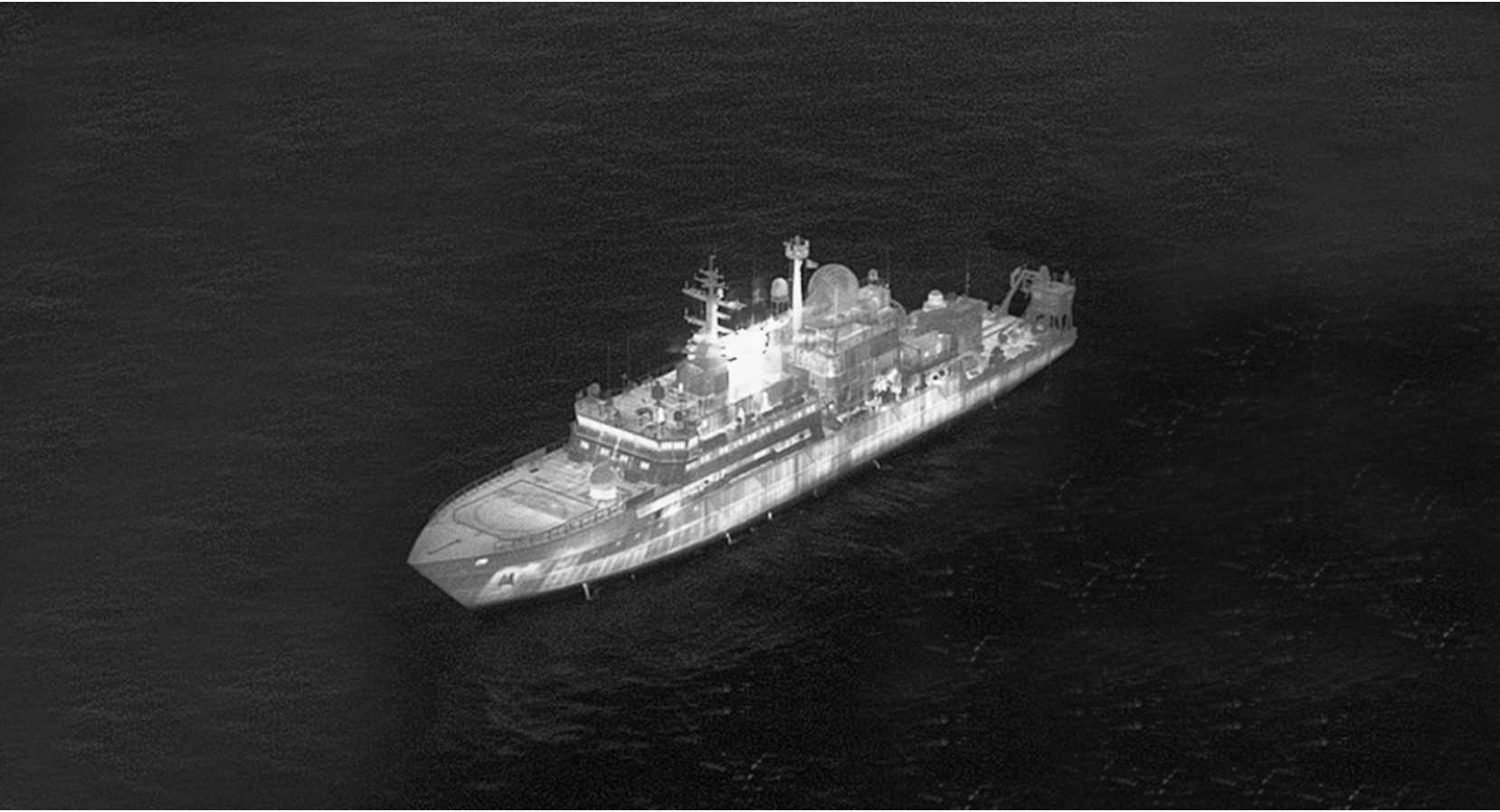
A Russian spy ship just a few nautical miles north of Scotland, and a message that reaches far beyond geography and today’s diplomatic balance.
The Russian intelligence-gathering vessel Yantar (its name meaning Amber) was once again found at the limit – and according to some sources, inside – British territorial waters north of Scotland. During a surveillance mission, British Royal Air Force aircraft were targeted with a laser from the vessel, according to the country’s Ministry of Defence.
Defence Secretary John Healey called the action “deeply dangerous,” making it clear that Britain has “military options ready” should the Yantar move further south or be considered an immediate threat. The ship has been spotted repeatedly in the area this year, with London explicitly describing this as its second entry into British waters.
On the surface, this looks like yet another episode of “harassment.” In essence, it is a controlled crisis around questions of sovereignty, deterrence, and infrastructure.
The subsea “nervous system” of the West
The Yantar is not a conventional warship. It operates under Russia’s secretive deep-sea directorate, carries advanced submersible vehicles, and is designed to map — and, in wartime, to sabotage — undersea cables and energy infrastructure.
The cables the vessel is approaching carry data, financial flows, and military communications — not only for Britain. They form the true nervous system of the West. The possibility that a ship like the Yantar might cut or tamper with cables in the North Sea could cause damage wildly disproportionate to its size.
By positioning the ship at — or inside — British waters, Russia is reminding — for some, loudly signalling — that Moscow has the technical ability to reach this system that is vital for the entire West. Moscow is also testing whether Britain will treat the threat as a “technical detail” or a strategic challenge. The Kremlin is building its own map of “red lines” — probing and wanting to learn — at any cost — where the limits truly are.
Legal boundaries — “innocent passage” and grey zones
Under the Law of the Sea, foreign vessels have the right of “innocent passage” through a state’s territorial waters as long as they do not endanger its security. Moscow will invoke this argument — and may even accuse British authorities if the situation escalates.
But when a specialized intelligence vessel:
- repeatedly moves in the same sensitive area,
- follows routes near known cables,
- targets military crews with lasers,
…the grey zone narrows — and dangerously so. London can argue that this is no longer “innocent passage,” but hostile, low-intensity activity. This does not automatically mean the use of force — but it does justify far more aggressive surveillance and obstruction.
A key point for decision-makers: whether the ship is two miles inside or two miles outside the 12-mile limit matters less strategically than the nature of its behaviour.
Moscow’s message — pressure without Article 5
From the Russian perspective, the Yantar functions as a pressure tool on multiple levels.
First, it tests Britain’s resolve. How far will London go to protect invisible yet critical infrastructure?
Second, it sends a message to NATO. Russia can provoke without clearly violating Article 5. Lasers aimed at pilots are serious harassment — but not an unmistakable armed attack.
Third, it targets weak links. Its track near Scotland and possible movement toward Ireland and the North Sea shows interest in states and maritime zones dependent on a few, vulnerable cables and offshore platforms.
Russia is operating in a field where escalation is gradual, hard to detect, and hard to present as casus belli to Western publics.
London’s response
Britain’s response appears to have three layers.
First, operational.
A Royal Navy frigate and surveillance aircraft are shadowing the Yantar. Rules of engagement are loosening so British assets can approach more closely, record everything, and send the signal: “We see everything you’re doing.”
Second, industrial.
Healey directly links the incident to the need for increased defence spending, new ammunition factories, and investment in infrastructure protection. The crisis becomes an argument for turning toward stronger “hard power.”
Third, political.
The government is tying the Russian ship into a broader narrative: Ukraine, Chinese cyberattacks, Middle Eastern instability, increased Russian manoeuvres around European airspace. Thus, the Yantar is framed not as an isolated episode, but as part of a “new era of threats.”
The NATO context — low-intensity escalation at sea
Since 2022, NATO countries have reported increased Russian naval and submarine activity in northern maritime approaches, with systematic monitoring by the Royal Navy and allies. The Yantar is the clearest — most visible — indication of a shift: from conventional, continental war in Ukraine to undersea and hybrid warfare targeting cables, platforms, and networks.
For NATO, the question is whether to respond to these incidents with fragmented national actions or with a unified deterrence strategy for subsea threats. Russia has chosen critical infrastructure as a primary arena of pressure. The Yantar is a tool of strategic intimidation — not a simple intelligence platform.
Britain is testing a new deterrence model: lowering engagement thresholds, sending public messages to Vladimir Putin, while avoiding a clear line that would lead to military confrontation. Every future “entry” into territorial waters will act as a stress test for NATO, forcing the Alliance to decide whether to respond with warning shots, physical obstruction, cyber retaliation — or a mix.
For international observers, the essential angle is not whether the ship crossed a few hundred metres into the 12-mile line, but how the West’s understanding of security is shifting in the era of critical undersea infrastructure.
The Yantar off Scotland is, in truth, a mirror of a new era — one in which war is not visible on maps with arrows and divisions, but in subtle vessel movements, lasers that blind pilots, and cables that could be cut one night with asymmetrical consequences.
Ask me anything
Explore related questions