




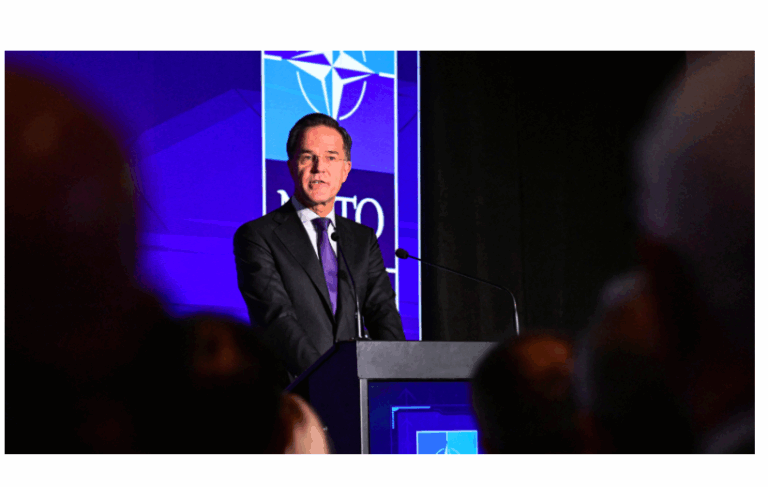
At the meeting of NATO foreign ministers in Brussels, Secretary General Mark Rutte warned that Russia “continues to test our deterrence” and is preparing for a prolonged conflict, describing an increasingly unstable environment around the war in Ukraine.
Rutte accused Moscow of violating allied airspace “with fighter jets and drones,” carrying out acts of sabotage, and deploying “spy ships in our waters.” These actions, he said, are “reckless and dangerous.”
He also emphasized that Russia is working “closely” with China, North Korea, and Iran “to destabilize our societies and dismantle global rules,” noting that these countries are preparing for a long-term confrontation.
Addressing the ministers, the NATO chief stressed that allies “are increasing defense investments, but everyone must contribute their fair share.” As for Ukraine, he said it “needs our support more than ever,” with winter approaching and “Russian attacks continuing.”
The Foreign Ministers’ meeting, which has just begun, is expected to focus on emerging peace initiatives for the war in Ukraine as well as NATO’s deterrence and defense posture.
Before the session opened, Rutte stated upon arrival at NATO headquarters that while it is positive that discussions about ending the war continue, the Alliance must ensure that Ukraine is placed in “the strongest possible position.”
He said allies will discuss “keeping Ukraine as strong as possible on the battlefield today,” and ensuring it is “in the strongest possible position when peace talks genuinely begin—talks that could actually lead to results.”
Rutte added that the best way to pressure Russia is “to keep weapons flowing to Ukraine” and ensure Moscow feels the “bite” of “effective economic sanctions.”
Talks Overshadowed by Failed Moscow Negotiations
This new round of NATO consultations comes after yesterday’s meetings in Moscow between U.S. and Russian officials, which—according to initial indications—did not result in meaningful progress toward a possible agreement to end the war.
A Kremlin spokesperson described President Vladimir Putin’s meeting with U.S. President Donald Trump’s special envoy, Steve Witkoff, as “constructive,” while Washington offered no comment.
The talks revolved around a 28-point peace plan drafted by the U.S. and seen as broadly favorable to Russia, reportedly prepared in coordination with Moscow. The leak of the plan two weeks ago triggered intense political movement in Washington, Kyiv, and European capitals.
The initial U.S. plan reportedly included:
- Recognition of Crimea and the Donetsk & Luhansk regions as Russian territory
- Acknowledgment of Ukrainian sovereignty, while transferring Kyiv-held areas in those regions to Russia
- No prospect of NATO membership for Ukraine, but potential EU membership with “short-term privileged access” to the European market
- Limiting Ukraine’s armed forces to 600,000 personnel
- “Reintegrating Russia into the global economy”
These provisions sparked backlash, seen as aligning too closely with Russian demands. Ukraine and several European countries requested changes, prompting new negotiations in Geneva.
A revised draft reportedly agreed between the U.S. and Ukraine included:
- Ukraine pledging not to retake occupied sovereign territory by military means, but through negotiations
- Increasing Ukraine’s military force limit to 800,000
- Ukraine’s NATO membership depending on unanimous consent of allies—“which currently does not exist”
- A commitment from NATO not to station forces in Ukraine
- Security guarantees for Ukraine mirroring NATO’s Article 5: any attack on Ukraine would be treated as an attack on the Alliance’s members
Despite revisions, the framework remains unsettled. Another round of U.S.–Ukraine talks was held this week in Florida, and details of what Witkoff and Jared Kushner discussed with Putin remain unclear.
In Moscow, Russia rejected the Ukrainian and European amendments. Putin called the changes “unacceptable,” warning:
“If Europe wants to go to war and start one, we are ready now.”
Ask me anything
Explore related questions