
×
GreekEnglish

×
  • Politics
  • Diaspora
  • World
  • Lifestyle
  • Travel
  • Culture
  • Sports
  • Cooking
Saturday
17
Jan 2026
weather symbol
Athens 10°C
  • Home
  • Politics
  • Economy
  • World
  • Diaspora
  • Lifestyle
  • Travel
  • Culture
  • Sports
  • Mediterranean Cooking
  • Weather
Contact follow Protothema:
Powered by Cloudevo
> World

Voyager 1 ready to make history again: in 2026 it will reach a distance of “one light-day” from Earth

Voyager 1, together with its twin spacecraft Voyager 2, will celebrate their 50th “birthdays” in 2027, having made history in space exploration

Newsroom December 10 03:12

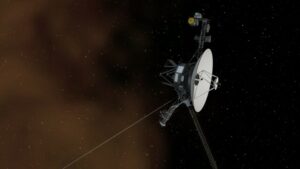
NASA’s Voyager 1 spacecraft is expected to reach another historic milestone in November 2026: it will be at a distance of one “light-day” from Earth.

This distance, approximately 26 billion kilometers, means that light — and any signal traveling at the same speed — will take 24 hours to reach the spacecraft and another 24 hours for a response to be sent back.

This delay illustrates the enormous distance Voyager 1 has now traveled.

Launched in 1977, the spacecraft continues to move away from Earth at a speed of over 61,000 km/h. Without any orbital adjustments since then, it has entered interstellar space, beyond the heliosphere — the Sun’s magnetic “bubble.”

Together with its twin, Voyager 2, it is the only operational spacecraft exploring this region, using its remaining instruments to collect primary scientific data.

Maintaining communication with such distant spacecraft is a challenging task. Voyager 1 transmits data at a rate of only 160 bits per second — comparable to old dial-up internet — as the distance greatly weakens its signal.

Receiving this data requires multiple deep-space antennas, and NASA’s team is updated only intermittently on the spacecraft’s condition.

>Related articles

Sick astronaut on mission – NASA considers early return of International Space Station crew

NASA published a new map of the universe; the “SPHEREx” space telescope changes the data landscape

Research: The BBC’s “first Black Briton” from the Roman era was ultimately…white and originated from southern England

Continuing the mission requires difficult choices. NASA has shut down several systems and instruments to conserve power, keep the spacecraft warm, and ensure the antennas remain aligned and pointed toward Earth.

Despite these limitations, the two Voyagers continue to surprise. Voyager 2 will not reach a distance of one light-day until 2035, likely beyond its operational lifetime. Nevertheless, both spacecraft continue to operate daily, breaking every longevity record.

NASA’s team is working to ensure both spacecraft reach their 50th “birthdays” in 2027 — a remarkable achievement for the oldest functioning spacecraft in the history of space exploration.

Ask me anything

Explore related questions
#science#space#Voyager 1
> More World

Follow en.protothema.gr on Google News and be the first to know all the news

See all the latest News from Greece and the World, the moment they happen, at en.protothema.gr

> Latest Stories

The horror of the “Tariff of the Dead”: how the Iranian regime prices the bodies of protesters

January 17, 2026

Mitsotakis on the Karystianou party: “There is a long distance between being the parent of a tragedy victim and being the leader of a political party”

January 17, 2026

Patras in carnival mode – This evening, the city’s official opening ceremony

January 17, 2026

Greenland as the first line ofdefense for the U.S. and NATO:

January 17, 2026

Changes at top universities: Oxford abolishes the term ‘doctores’ for inclusion reasons

January 17, 2026

Where affordable housing falls short in Greece: IOBE proposes a cap on rent increases

January 17, 2026

Weather: Noticeable drop in temperature from today – Where it will snow and at which altitudes

January 17, 2026

One dead after train–bus collision at the Port of Hamburg – see photos

January 16, 2026
All News

> technology

From Tesla to Disney, 4 companies are preparing humanoid robots for the market: What they can do, how much they will cost

They fold clothes, serve coffee, work in factories and are getting ready to enter our homes — the four most advanced robots moving closer to everyday life

January 4, 2026

iPhone 17: Slimmer, better, but not much more expensive despite Trump’s tariffs

September 10, 2025

Voice Cloning: A new form of AI-assisted fraud sweeps the US and is coming to Europe

October 20, 2024

Instagram: Changes for minors – Introducing ‘teen accounts’ with parental supervision, countries affected

September 17, 2024

Europe at the forefront of artificial intelligence: The first AI law

August 30, 2024
Homepage
PERSONAL DATA PROTECTION POLICY COOKIES POLICY TERM OF USE
Powered by Cloudevo
Copyright © 2026 Πρώτο Θέμα