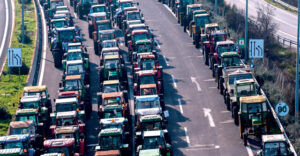
The farmers’ mobilizations are evolving into an equation with multiple variables, while in the coming days a repeat of what happened during the Christmas exodus is expected: from tomorrow, tractors will remain on the sides of the roads to facilitate holiday travelers. Farmers, however, who in the previous period saw public opinion stand by them, know that the balance is fragile. Already today, bypass roads began to be closed as well, subjecting both those returning to urban centers and those traveling toward the countryside to severe hardship.
In the coming days, the situation is expected to be reviewed at a nationwide meeting in order to decide the future of the mobilizations. The prevailing mood is for them to continue and intensify, while fuel was added to the fire by the initiative of representatives from eighteen roadblocks and farmers’ associations to speak of dialogue with the government. Several roadblocks denied that the announcement reflected their decisions, while agricultural unionists even ended up arguing on television. One side speaks of a crack that could lead to dialogue; the other speaks of “decoys” and “bogeymen.”
For now, farmers are not under time pressure, since for most there is little work at this time of year; for many, the countdown to returning to the fields for the new cultivation season begins toward the end of January.
In any case, significant developments—and especially the withdrawal of thousands of tractors from the roads—are not expected during the holidays, barring unforeseen circumstances.
Dialogue and the extremes
Open channels with the Ministry of Rural Development do exist and are functioning informally. In this context, farmers have received the message that efforts are being made to further specify the government measures already announced with the passage of the Budget. On one of their key demands—the reduction of agricultural electricity prices—where farmers are asking for 0.7 euro cents and the government had responded with 0.9, informal discussions have conveyed the possibility of reducing it to around 8.5 cents for two years.
Speaking on Monday morning on SKAI, Minister of Rural Development Kostas Tsiaras said regarding agricultural electricity that “we are extending the low price and lowering it even further,” while on agricultural diesel he stressed that “farmers are asking for the special consumption tax not to be withheld at the pump, and we are satisfying this.” Mr. Tsiaras also stated that consumption of diesel needs to be reassessed and that the refund of the special consumption tax will be without a cap.
“The government has taken bold steps to resolve the problem,” the minister added, recalling that “the Prime Minister himself has made himself available for dialogue.” He also said that “if 18 roadblocks have taken a decision for dialogue, they should not be subjected to pressure and ridicule.”
The new faces: an unknown X
However, the participation in the roadblocks of younger farmers—both in terms of age and experience with mobilizations—new faces seeking a role and a leading say in decision-making, is blurring the landscape of any negotiations. As people with excellent knowledge of the situation over the past month point out, the agricultural union leaders “who know the game of negotiation, the rules and the limits, do not control these younger people, who largely operate with the logic of the square and confrontation.”
Consequently, it is particularly difficult to define the situation and make reliable predictions about what comes next. The extremists, as the same sources say, come from across the spectrum—from the Right to the Left.
Restructuring in theory
While the government maintains that it has exhausted its limits in terms of benefits to farmers, having publicly addressed all of the agricultural sector’s demands, it continues to declare its willingness to meet with representatives of the farming community in a spirit of rapprochement and joint problem-solving.
After all, both the government and farmers who have not adopted the logic of extreme reactions know well that the primary sector is facing a Europe-wide survival problem. This is precisely what is bringing farmers and livestock breeders onto the streets in many countries, even in the heart of Brussels.
On this basis, it is acknowledged that the discussion cannot be based on benefits, but rather on planning, reconstruction, and restructuring of the primary sector so that it can once again gain prospects for the future.
So far, discussions about restructuring—of crops, for example—have largely remained theoretical, with few bright exceptions, since it is extremely difficult for an aging farming population (nine out of ten full-time farmers are over 50 years old) to be trained in new crops and at the same time invest in the machinery and infrastructure required.
The problem with subsidies
Thus, Thessaly continues to plant cotton, even though it is well known that the product is not viable. This year its price is significantly below production cost, while its cultivation is water-intensive at a time when drought is a real threat.
Cotton is a characteristic example of the distorted subsidy model, as in the past income from the product consisted of 90% subsidies and only the remainder from its market price. Moreover, the logic of subsidies tied to production led farmers to cultivate in ways that increased output, but resulted in a qualitatively downgraded product.
The data changed a decade ago; nevertheless, the slogan “all the kilos, all the money” seems to resurface whenever the discussion is framed around subsidies and income replacement rather than production. “This is the discussion that needs to take place, if both farmers and the government decide that the primary sector should have a future,” says a livestock breeder with a large production and genetic improvement unit.
He notes that regardless of how this year’s mobilizations develop, if farmers and the state continue to look only at the present and how much money can be allocated from European or national resources, then in the coming years there will be no reason for roadblocks—because there will be no primary sector left.
Photo: EUROKINISSI
Ask me anything
Explore related questions