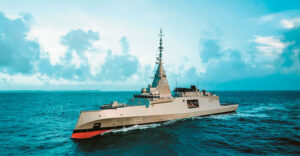
Sailing toward the Salamis Naval Base, the new flagship of the Hellenic Navy is expected to arrive on January 15 – What the armament loaded in Brest includes and what the first trials showed – An impressive welcome is being prepared by a naval convoy featuring the battleship Averof and the trireme Olympias.
Any unlawful use or appropriation of this content is prohibited under Intellectual Property Law and carries severe civil and criminal penalties for the offender.
The first Greek FDI frigate, Kimon, departed from the city of Lorient in France and set course for Greece. The new pride of the Hellenic Navy is en route to the Aegean, with its final destination being the Salamis Naval Base. Upon entering the Saronic Gulf on January 15, in a move rich in symbolism, it will be welcomed by a flotilla of Hellenic Navy vessels, most notably two ships of immense historical significance: the battleship Georgios Averof and the trireme Olympias.
The fleet’s new flagship departed from the shipyard facilities of its manufacturer, Naval Group, and headed to Brest. There, at the Marine Nationale naval base, it received its weapons load, while the first connectivity tests of its armament and electronic systems were also carried out before sailing for Greek waters. The arrival of the frigate Kimon in the Saronic Gulf, from where it will proceed under escort to the Salamis Naval Base, is expected on January 15.
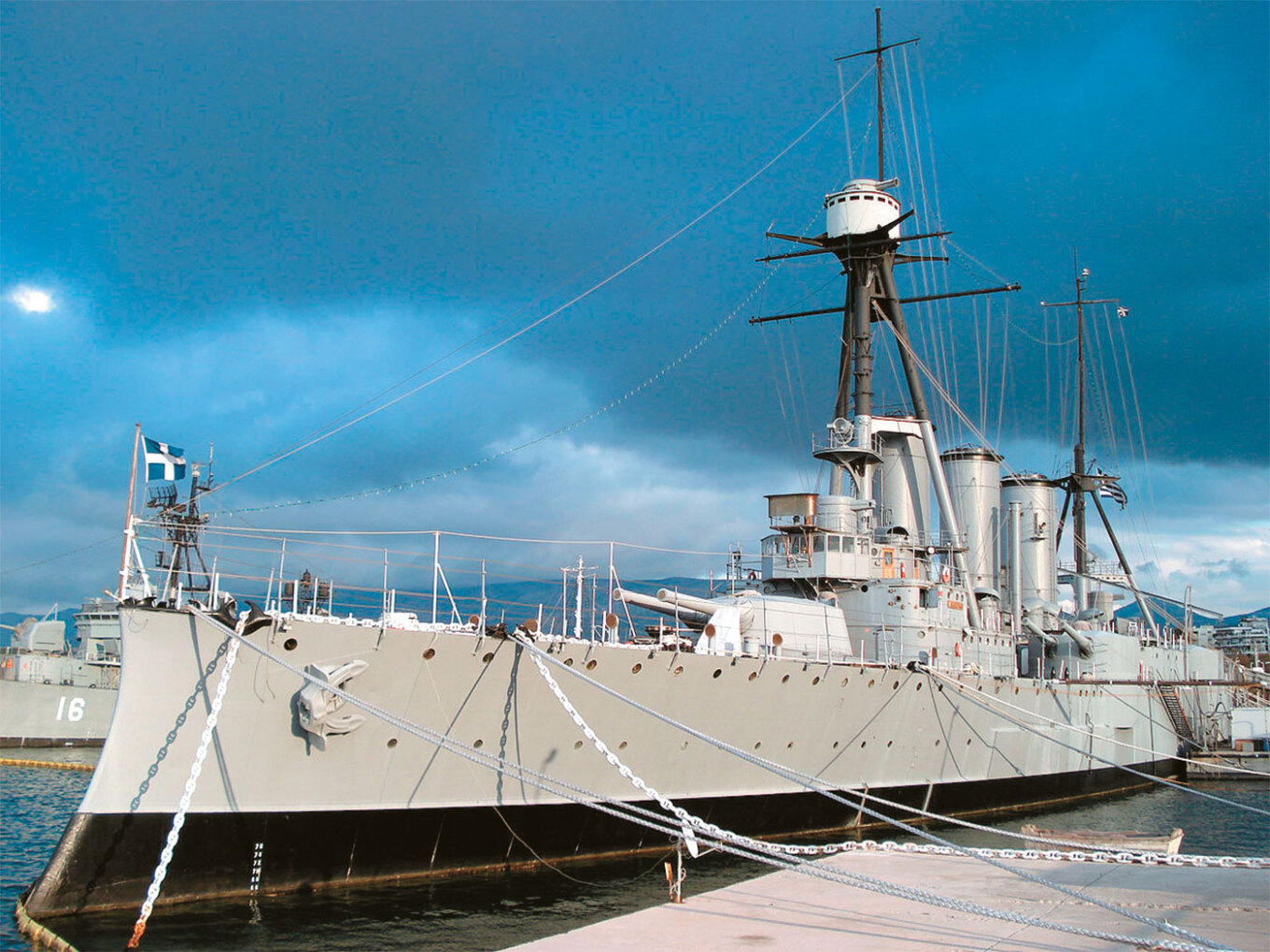
In a scene unprecedented for peacetime, a convoy of six Hellenic Navy vessels—comprising frigates, gunboats, and missile boats—will be waiting in the Saronic Gulf to welcome the state-of-the-art frigate. Alongside them, the legendary battleship Averof and the trireme Olympias will also sail out to greet it and, depending on weather and other conditions, are planned to escort the frigate all the way to the entrance of the naval base.
The choice of Averof and Olympias to escort the frigate Kimon during its ceremonial entry into the naval base is far from coincidental. The three ships share a common feature: from the “wooden walls” of antiquity to the “Sheitan Papor” and today’s fully armed Belharra, the inverted bow—common to all three types—has long been associated with Greek naval power and serves as an aesthetic and symbolic link between ancient seamanship, the aura of the legendary Averof, and modern technology: the greatness of a maritime nation.
Symbolically, the battleship—or more precisely, the heavily armored cruiser, which was ultra-modern for its time and remains the only surviving vessel of its class worldwide—Averof was greeted with enthusiasm by Greeks at Faliro, as it symbolized the transition of the Hellenic Navy (then possessing only a few outdated surface units) into a modern era combining speed and unprecedented firepower. The same applies today to the frigate Kimon, which marks the transition to an era of digital innovation and naval supremacy.
The First Trials
The new naval vessel departed from Lorient and arrived at the naval base in Brest (northern France) on Tuesday afternoon. There, amid polar cold conditions, the critical process of loading its weapons began. Due to the nature and volume of the munitions, as well as the extremely strict protocols followed by the French navy (for example, loading operations halt if lightning is forecast, are carried out only during daylight, and weapon certifications can take up to 16 hours each), the process requires exceptionally careful, time-consuming, and precise handling.
At the same time, the procedure provides valuable training for the crew in the resupply of the frigate’s weapons systems—not only for Kimon’s crew, but also for members of the crews of the other two Greek Belharra frigates (Formion and Nearchos), which are to be delivered by the end of the year. A fourth frigate, Themistocles, with an HN++ configuration, is expected in 2028. Each weapon loaded undergoes a separate, lengthy procedure that includes safety restrictions, acceptance checks, and crew training.
During its brief stay in Brest, the frigate Kimon was fully equipped with the planned load for all its weapons systems. This includes Aster-30 surface-to-air missiles for the A50 launchers installed at the bow, Exocet MM40 Block 3C anti-surface missiles, MU90 torpedoes for anti-submarine warfare, RAM missiles for the close-in defense system at the stern, as well as ammunition for the 76mm Oto Melara gun and the two remotely operated 20mm Lionfish cannons.
The loading and certification process by the French Naval Weapons Directorate was completed shortly before sunset on Wednesday, after which the first acceptance trials began. In practice, Kimon weighed anchor, sailed into open waters, and its crew tested weapon connectivity, communication with control consoles, and the flawless operation of its cutting-edge systems.
After spending several hours off the coast of Brest, the frigate began its first mission—its voyage to the Salamis Naval Base—closing its transponders on Wednesday night and setting course for the Aegean.
Inverted Bow
Seventy-four years have passed since the last time Greek seamanship employed a vessel with an inverted bow to assert dominance in the Aegean and the Eastern Mediterranean. That was in 1952, the year the legendary battleship Averof was decommissioned—the ship of victory that won battles single-handedly, chased fleets, humbled empires, and emerged victorious from two World Wars. It is therefore natural that the similarly inverted bow of the Belharra frigate evokes memories of the Hellenic Navy’s glorious past.
The inverted bow of the frigate Kimon, like that of the battleship Averof, may appear striking, but it is not an aesthetic choice. It is the product of advanced naval engineering with deep roots in maritime history.
In the case of the Belharra, the inverted—or wave-piercing—bow represents the convergence of modern digital technology with ancient naval wisdom. Rather than riding over waves like a conventional bow, it cuts through them, resulting in reduced pitching, greater stability, higher sustained speeds in rough seas, and more predictable vessel behavior.
This concept is not new. Ancient Greeks understood the value of a bow that pierces the waves. Their triremes featured a low, sharp forward section designed to minimize hydrodynamic resistance while maintaining speed and maneuverability even in rough conditions—crucial qualities for operations in the Aegean.
A similar principle, inspired by ancient Greek naval knowledge, was embodied in the battleship Georgios Averof, which provided the stability required for accurate gunnery. Known by the Turks as the “Sheitan Papor” (“devil ship”), it became a symbol of Greek naval dominance and victory.
Today, this naval philosophy returns in the FDI frigates, adapted to the demands of the 21st century—precision sensors, missile systems, interoperability, and stealth design. The inverted bow enhances stability, improves crew comfort, and reduces radar signature, making the ship harder to detect at long range.
In the case of the FDI frigates and Kimon in particular, the inverted bow is not merely a technical feature but a strategic advantage in the modern maritime operational environment.
Ask me anything
Explore related questions