




What constitutes art in cinema — and what does not — may well be open to debate. Historical truth, however, is self-evident. Ioannis Kapodistrias is indisputably the national leader of the Greeks and the statesman who changed the course of European history. The film by Yiannis Smaragdis has shattered box-office records, surpassing both Greek and international productions — a fact that is itself historic.
For the creation of the film and the portrayal of the Governor’s personality, the director drew inspiration from actress and close collaborator Natalia Kapodistrias, the last living descendant to bear the family name.
“In her gaze, I saw the eyes of the Governor,” Smaragdis has said. He cast her in the role of the divine force in which the protagonist believes — a presence that appears, like the deus ex machina of ancient tragedy, at the most critical moments of his life.
I remembered Natalia from years ago as the stage actress who dared to introduce herself to television audiences through the provocative character of Annita Rassia — the minister’s mistress in the 1990s series The Evil Vizier. Her line, “Bow before the idol,” became a powerful mantra of self-confidence long before the era of affirmations like “I deserve it.”
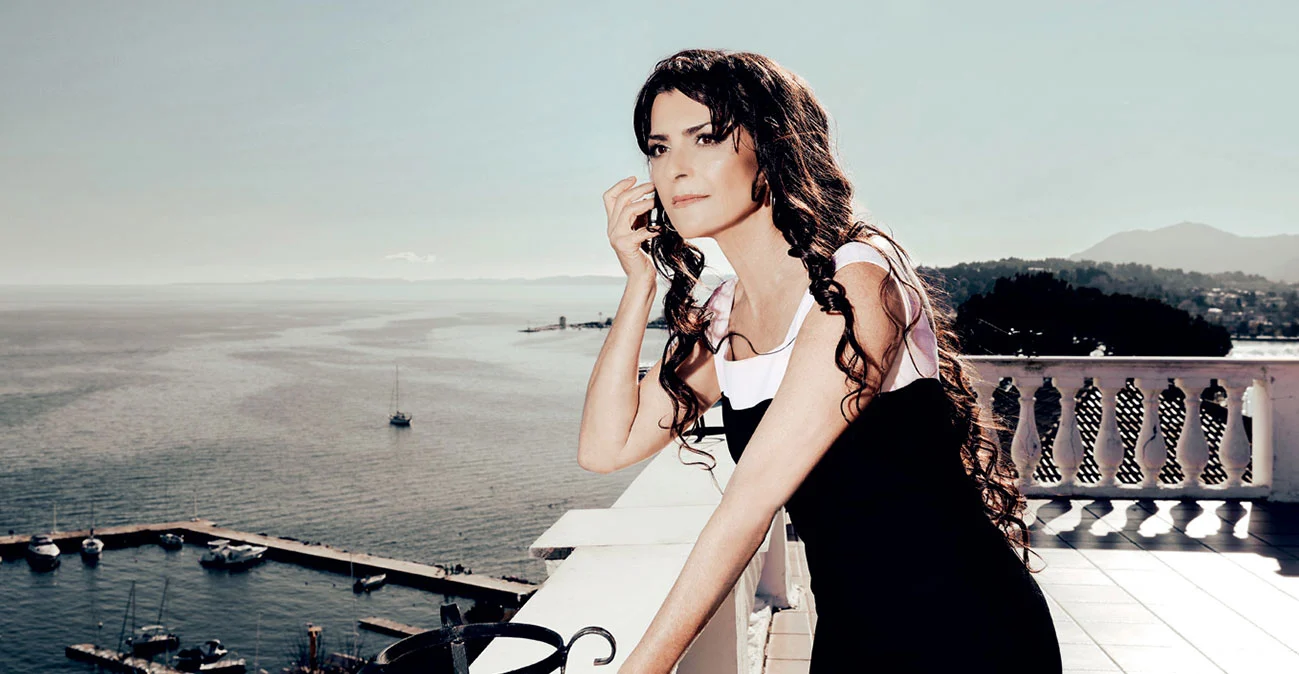
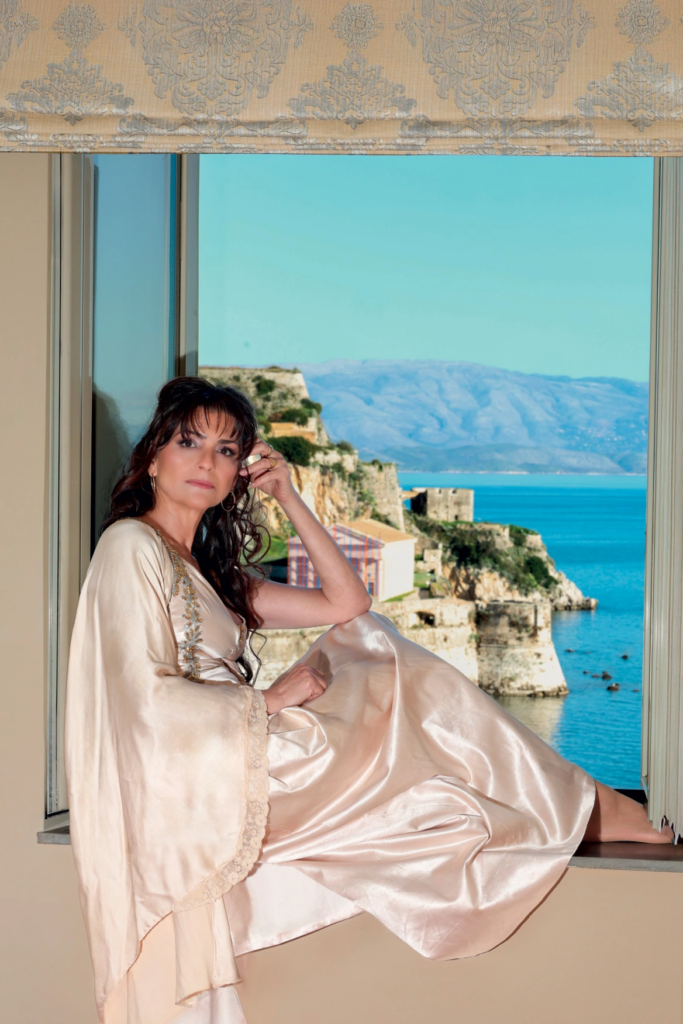
Today, I meet her in Corfu, on the 120-acre ancestral estate in Moraitika — the only property Kapodistrias did not sacrifice for the Greek War of Independence. For the past 15 years, she has lived there, tending the land while actively participating in the island’s cultural life.
Gala: What connects you to this land?
Natalia Kapodistrias:
It was the Governor’s favorite estate. In fact, in his correspondence with his father from Russia, he gave detailed instructions on what to plant and how to care for it. He dreamed of returning and closing his eyes here. Until 2010, my father looked after the estate, but his health deteriorated, so I learned to drive and came to take it over myself so he wouldn’t worry. Maintaining it is a constant struggle — things break, responsibilities are great, and at this stage, I have to rise to the challenge.
G.: Just as the estate influences your decisions, would you say your surname is also a heavy legacy that has shaped your life?
N.K.:
Yes, it has shaped me in a certain way. Especially since moving to Corfu, I feel an even greater responsibility to live up to the name. My two sisters and I were raised to keep a low profile and never boast about our ancestry. Besides, it is only in recent years that Kapodistrias’ memory has been fully restored and his work properly honored. Growing up, I only knew what we were taught at school — that he was a good man who helped Greece. After my studies, when I began researching on my own, I realized the true magnitude of his personality.
Historian Eleni Koukkou played an important role; she wrote the book on Kapodistrias and Roxandra Sturdza. She was a family friend and often took me with her to archival presentations and events. Gradually, I delved deeper. Along the way, I met many remarkable people who have studied Kapodistrias extensively, which strengthened my need to learn more.
G.: How exactly are you related to Greece’s first Governor?
N.K.:
There were ten children in his family. Of the five sons, only Georgios married. He had a son, Antonios-Maria; Antonios-Maria had my grandfather, Giannis; my grandfather had my father, Viaro-Augustinos. Through this direct male lineage, we are the closest descendants of the Governor. There are many cousins through the daughters, but they did not inherit the name. My father was the last male descendant, and I am the last person to carry the surname.
G.: Did his estate pass down through this line as well?
N.K.:
Kapodistrias himself left no personal wealth. He gave everything to the national cause. He lived so modestly that Kolokotronis once urged him to wear his uniform so people wouldn’t mistake him for a clerk. All he owned were gifts he had received, his clothes, writing tools, and his snuffbox.
Before the war, my grandfather made a tremendous effort to gather all the heirlooms and archival material in a three-story house in central Corfu. According to my father, papyri and parchments dated back to the 9th century, and even manuscripts attributed to Charlemagne. It was a true museum. Sadly, the building was destroyed during the Nazi bombing of Corfu in 1943. When the fire broke out at three in the morning, and everyone fled into the streets, my father and his mother managed to save only two diplomas awarded to the Governor for his work in Switzerland.
G.: Were you involved in the film’s script?
N.K.:
No, the screenplay is entirely Mr. Smaragdis’s work. However, at every stage of its development, whenever he revised it, he sent it to me. I read it, and we discussed it. Writing a script about Kapodistrias is extremely difficult — you don’t know what to include and what to leave out. His life unfolded with such speed and complexity that it requires mastery and strict focus to tell a coherent story. That is one of the many reasons I deeply respect Mr. Smaragdis.
G.: How did you feel watching Kapodistrias on the big screen?
N.K.:
I was deeply moved — I felt uplifted and proud. A great, collective effort spanning many years was finally vindicated. In the final quarter, as we moved toward the tragic end, I could hardly breathe, and by the end, I was in tears. Many people cried at the New York premiere, and the same happened in Athens. Even though the film runs over 120 minutes, I didn’t feel the time pass. I wanted more.
I believe it is a complete work that fulfills its purpose. Such a rich production is an achievement by Greek standards. Given the subject matter and the outstanding performance of Antonis Myriagkos, who truly convinces you he is Kapodistrias, I cannot see it as just a film. For me, it is something far greater.
G.: How do you respond to the negative reviews?
N.K.:
I expected them. For eight years, while the film was being fought for, there was a fierce wave of opposition. Naturally, that hostility continues after its release. The person who should respond has already done so — Mr. Smaragdis himself. Personally, I am not influenced by critics. My own judgment and the audience’s reaction are enough for me. The film was made for them, and they are the ones who rise to their feet, applauding at the end.
I also choose to focus on the positive rather than the negative. Beyond the fact that this is an important work for many reasons, what matters most is that, at last, a historically accurate production about Ioannis Kapodistrias exists — and that the average Greek will learn the truth during two emotionally rich hours at the cinema. That is enough for me.
G.: How have the Governor’s political virtues — selflessness and devotion to the common good — influenced you personally?
N.K.:
His presence was always felt in our home. These values have always been my measure in life. I was shaped by these references. If a child grows up in a home where drugs are used, they are more likely to learn that behavior. Likewise, we grew up with Kapodistrias.
G.: Could you ever enter politics yourself?
N.K.:
I follow public affairs and have political views, but I do not have the necessary expertise. I fear that if I ever entered politics, the responsibility attached to my surname would be overwhelming and would require double the caution. For now, I choose to stay away from such a risk.
G.: How did you decide to become an actress?
N.K.:
There wasn’t a single defining moment. It came naturally through the theatre program at school. I loved the concentration required during theatrical exercises — it felt like a form of creative isolation. The idea of drama school came from my mother. I was accepted into the National Theatre School and stayed on after graduating as a top student.
It’s a profession full of risk, disappointment, and insecurity, but if the goal is to preserve one’s soul, it is a beautiful path. Of course, I have many questions about how jobs are secured and how networks operate. For women, the challenges are even greater — at every age, we must redefine and reintroduce ourselves. Every decade, we become different people. What matters most is not losing the way we want to practice this craft.
G.: What have been the best moments of your career?
N.K.:
All of them. But perhaps the three performances I did with Alexis Minotis stand out as the most important experience of my life. Being 21 and sharing the stage with him as equals exceeded every dream I had. I also experienced great moments at the Amore Theatre, and I’m glad I’ve done many different things.
When I appeared in The Evil Vizier, I heard criticism that I had become “commercial.” I loved that role — especially because Anna and Haris wrote it specifically for me. I haven’t withdrawn, though. Over the past 15 years in Corfu, I’ve been far more active artistically than I was in Athens: teaching, cultural events, festivals, and touring performances abroad. There is vibrant artistic activity in the regions.
Television is difficult due to distance, but I hope one day to spend more time in Athens. What I truly miss is cinema. I would love to have more experiences like the one I had in A Touch of Spice.
Ask me anything
Explore related questions