
Efforts by Greece’s Ministry of Health to improve access to surgery and reduce waiting times are continuing at full pace, with public hospitals recording a sharp rise in operations and a dramatic drop in delays.
Surgical care is one of the most demanding areas of the National Health System (ESY), where the resilience of hospitals, staffing levels, and patients’ access to treatment are tested daily. Often described as the “heavy industry” of public healthcare, surgery saw major gains in 2025.
According to official data, the number of non-urgent (“cold”) scheduled surgeries with waiting times longer than four months fell by 80% compared to 2024, while the total number of operations increased significantly. A key role was played by free afternoon surgeries and the single national surgical waiting list, introduced in 2024 by Health Minister Adonis Georgiadis.
A Six-Year Record in Surgical Activity
Data obtained by Proto Thema show that 519,366 surgical procedures were performed in public hospitals in 2025 — the highest figure in six years.
The most common procedures reflect the everyday healthcare needs of the population. At the top of the list are ophthalmology, general surgery, and orthopaedic operations, followed by:
- Ophthalmology
- General surgery
- Orthopaedics
- Urology
- Obstetrics–gynecology
- ENT (ear, nose and throat)
- Neurosurgery
- Microsurgery
- Vascular surgery
- Dermatology
Free Afternoon Surgeries and the Recovery Fund
2025 was also the first year in which free afternoon surgeries were fully implemented nationwide, funded by Greece’s Recovery and Resilience Fund. Around 20,000 free operations were carried out within the ESY, easing pressure on surgical waiting lists that had stretched for months.
Hospital administrators, however, raise concerns about whether these improvements can be sustained once Recovery Fund financing comes to an end. Paid afternoon surgeries, which were piloted earlier, are expected to continue beyond the programme.
From Pandemic Collapse to Strong Recovery
The figures highlight a dramatic journey for Greek public hospitals:
- 2019 (pre-pandemic): 498,507 surgeries
- 2020: 383,113 surgeries
- 2021: 360,393 surgeries
During the pandemic, routine operations were largely suspended as hospitals focused on COVID-19 patients.
Recovery began in 2022 (420,953 surgeries), continued in 2023 (473,772), and accelerated in 2024, when 489,039 surgeries were performed — a 32% increase compared to the previous year.
In 2025, with the addition of afternoon surgery sessions, total procedures climbed to 519,366. The Ministry of Health attributes this growth to reforms introduced over the past two years, while acknowledging that shortages of nurses and anaesthesiologists remain a major challenge.
Regional Disparities
The increase was not evenly distributed across the country. The 1st Health Region (YPE), covering Athens and the largest hospitals, recorded the highest number of surgeries (148,460). It was followed by the 6th Health Region (Peloponnese, Epirus, Ionian Islands, and Western Greece), with 96,773 procedures — a 20% rise compared to 2019.
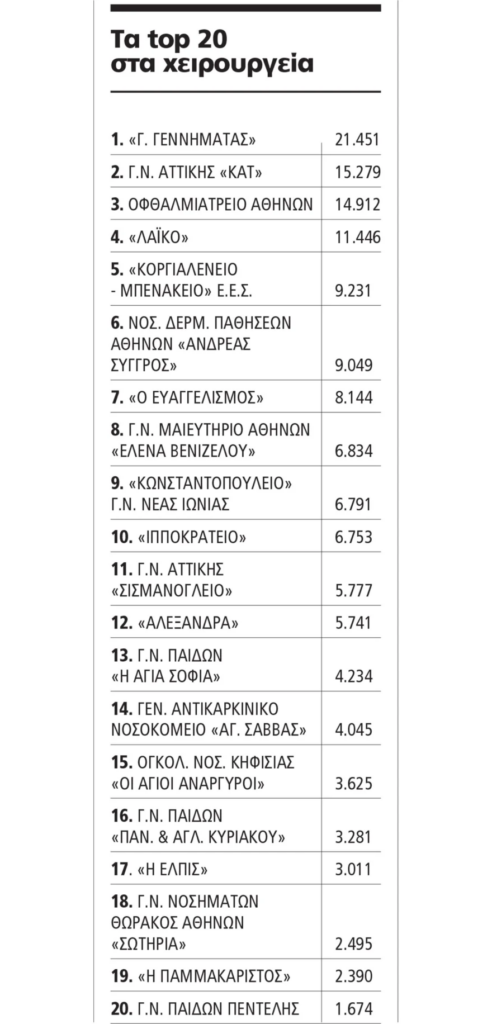
Lower figures were recorded in other regions, particularly where patients often travel to Athens for treatment. Crete (7th Health Region) showed stable surgical activity over the six years, returning in 2025 to almost the same levels as before the pandemic.
Ask me anything
Explore related questions