





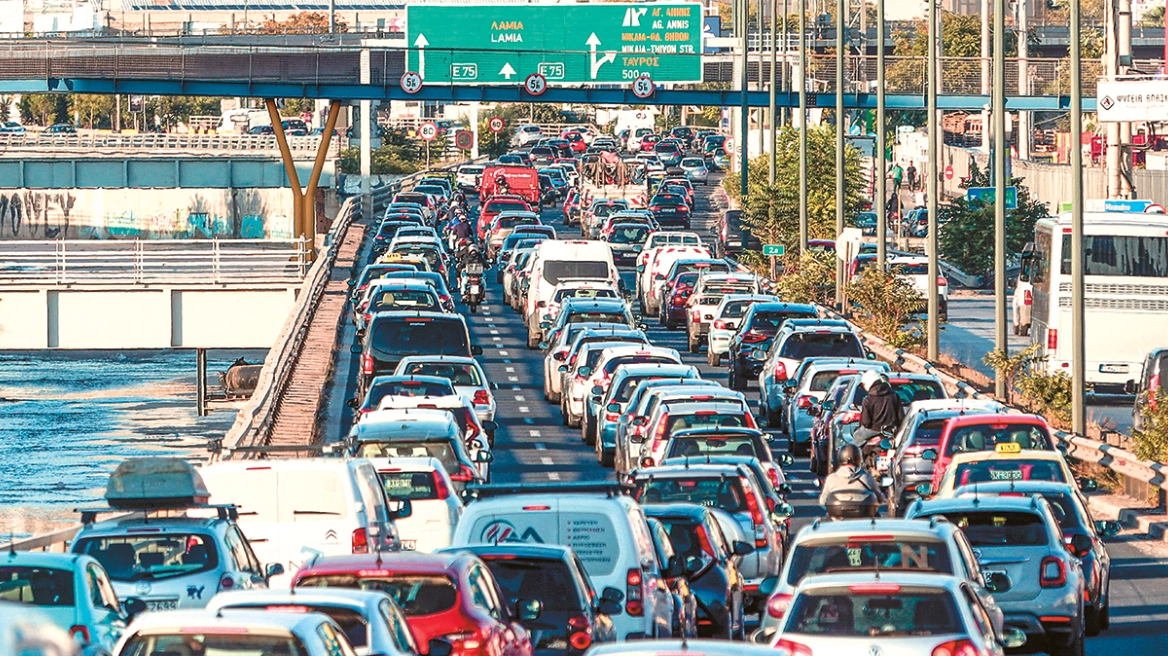
The government is planning a series of interventions to address traffic congestion in the Attica basin, as the concept of “rush hour” has essentially disappeared. In addition to long-term measures – for example, the Ymittos tunnel, discussed since the Souflias era, and new metro extensions – ideas already applied in other European countries are being considered, such as carsharing for taxis and private cars. There is also significant discussion about Kyriakakis’ proposal to change market delivery hours and “displace” trucks from major roads during the 7–10 a.m. period.
Major roads operate at 200% of their capacity from morning until at least 8 p.m. Kifisos, in particular, emerges as the weakest link in traffic, as any accident (which happen daily) turns it into an endless ordeal for trapped drivers. This is reflected in today’s Monday morning traffic in the capital.
Traffic congestion has long been a persistent problem for governments, and it was believed that increasing public transport use would partly solve it. Unfortunately, this has not happened. Urban interventions were implemented over the years, with the most recent addition being the Attiki Odos, fully operational since 2004. Today, however, the situation is suffocating. Metro and ISAP stations have reached 66 after recent network expansions, and trains operate at full capacity during peak hours, yet this does not change the overall problem.
Transport experts note that urban infrastructure was designed for 2–2.5 million vehicles, while now around 6 million cars move monthly in Attica—almost three times the intended capacity. This situation is a thorn in the government’s side, which has previously attempted stopgap measures but now plans more targeted action.
The logistics challenge
The Deputy Minister of Transport, Konstantinos Kyriakakis, who is collecting data, has developed some basic ideas for short- and medium- to long-term solutions. These are expected to be presented at a special meeting chaired by the Prime Minister at the end of January. Traffic issues were included in the December cabinet agenda but were ultimately postponed to January.
According to reports from Proto Thema, Prime Minister Mitsotakis has decided to discuss the matter at an inter-ministerial meeting with the relevant ministers on January 28, aiming for the government to make decisions and launch initiatives.
Proto Thema previously reported the Ministry of Transport’s plan to reduce travel time on metro lines 1, 2, and 3 from this year by adding new trains. Additionally, the aim is to ease truck transport congestion.
A tender is underway for a new 450-acre logistics hub at “Spilies” in the Municipality of Fyli, replacing Elaionas. Currently, the overcrowded Elaionas area hosts 350 transport companies, operating 4,000 trucks daily, worsening Kifisos traffic.
Three consortia are competing, following the withdrawal of Orfeus Veinoglou this summer. One consortium includes the Melissanidis Group with Goldair and Aktor, another is FINCOP INFRASTRUCTURE LTD. of the Kopelouzos Group, and a third is the duo Giorgos Theodosis – Stratis Apergis of Newsphone, which has expanded into transport after ferry and call center operations.
Once the tender is complete and the project proceeds, significant relief is expected, as Elaionas will be relieved—a critical junction near Kifisos.
In general, a “big bang” of investments in new logistics centers is currently underway in Western Attica, beyond this tender. A new Logistics Park in Aspropyrgos is being implemented on the old premises of the Hellenic Steelworks within the Industrial Area of Refineries, at the 17th km of the Athens-Corinth National Road—a €300 million investment from the U.S. fund HIG Capital.
Additionally, the Hellenic Train-Damco consortium is progressing with the Thriasio II tender, although the project has faced delays due to pending legal pre-contract checks by the Court of Audit. Once resolved, the concession contract can be signed.
The Ministry of Transport is also considering a different logic for logistics centers: regional transshipment hubs could receive cargo from multiple suppliers, consolidating loads into a single vehicle. Currently, each supplier operates individually, leading to many trucks moving in urban areas nearly empty.
The Skaramangas junction
Plans also include projects not immediately operational but in the pipeline, such as Metro Line 4 and extensions of Line 2 toward Ilion and Glyfada. The Triple Skaramangas Junction, where METKA-Domiki won the tender just before Christmas, is also planned, along with other interventions in urban infrastructure heavily burdened daily.
The Triple Skaramangas Junction is a major Western Attica infrastructure project including three new grade-separated junctions (Skaramangas, Schisto, and the Shipyards) and the connection of the Aigaleo Ring Road to the Old Athens-Corinth National Road.
Carsharing incentives
A solution widely used in European countries is carsharing—sharing a vehicle among people traveling at the same time in the same direction. One idea is to provide incentives for existing transport operators and private platforms to expand carsharing in Greece.
For example, taxi drivers could carry more than one passenger going in the same direction, moving away from the “one passenger per taxi” model. Incentives are still being developed, but the Ministry is observing best practices abroad. In several European countries, apps connect people seeking transport for work, allowing them to share a car and travel costs. Pilot measures, like allowing carsharing vehicles to use the left lane on the Paris ring road, already exist.
Truck restrictions
Another key proposal is banning truck traffic in urban areas during peak hours, from 7 a.m. to 10 a.m. Initially, this targeted only Kifisos, but the Ministry is considering a broader pilot across the basin. This requires a complex adjustment to supply chain operations, including changing delivery and loading schedules and logistics hub and factory operations, which also affects employee shifts.
Compensatory measures are also needed—for example, opening the Old National Road at Kaza, a narrow mountain pass in Western Attica linking Boeotia with Western Attica through a gorge between Mounts Kithaironas and Pastra.
All of these challenges explain the composition of the inter-ministerial committee invitation from the Prime Minister’s office. Attendees include Deputy Prime Minister Kostis Hatzidakis, Ministers Michalis Chrysochoidis, Christos Dimas, Takis Theodorikakos, Niki Kerameus, Vasilis Kikilias, Deputy Minister Nikos Takhiaos, Attica Governor Nikos Hardalias, and the President of the National Logistics Council Thanasis Ziliaskopoulos. Meetings with the Athens Chamber of Commerce and Attica trade associations are also planned for alignment.
According to sources, inter-ministerial cooperation is essential, as precise mapping of the problem is required, including the number of vehicles at peak hours, a qualitative analysis of vehicles in the basin, and identifying the main factors worsening traffic.
Ask me anything
Explore related questions


