




The US president is currently announcing the ‘Peace Council.’ This involves the creation of a new international body called the ‘Board/Peace Council’ (in public discourse it has become known as the ‘Peace Council’ or ‘Board of Peace’), which is presented as a tool for peacemaking—initially focusing on Gaza—but will gradually expand as a ‘crisis management’ forum for other conflicts as well.
What the ‘Peace Council’ is – and why it raises suspicion
According to Reuters, Trump has sent invitations to around 60 countries, aiming for a body that ‘starts with Gaza’ and ‘expands’ to other fronts, while the same report mentions that permanent participation is expected for those who pay $1 billion and that Trump will be chairman for life.
The existence of a ‘ticket’ for a permanent seat (and at an amount that functions as a power filter rather than an equal contribution) is the first major source of European distrust: it turns the body into a closed club, favoring the ‘willing’ and the financially powerful, rather than a process of legitimacy through international treaties.
The second source of distrust is the political structure: in a Reuters report about Italy, it is mentioned that Rome considers participation in an organization ‘led solely by the U.S. president’ to be in conflict with the Italian constitutional principle requiring equal participation in international organizations. Italy’s argument encapsulates European concern: the ‘Council’ does not resemble a multilateral institution but rather a mechanism of American hegemony, where access, duration, and renewal of tenure (according to what has leaked about the draft charter) are directly linked to the central will of the U.S. president.
The third problem is institutional overlap. In a television excerpt/transcript from CNN (Situation Room), the ‘peace council’ already appears as a point of tension between Trump and Macron, with Trump escalating rhetoric and using trade threats in a domain that would ‘normally’ belong to diplomacy and collective security. This combination of ‘hard power’ (tariffs) with ‘peacemaking architecture’ (board) is the main warning sign for Brussels: it turns peacemaking into a tool of coercion.
Greece absent, as is the rest of the EU, except Hungary and Bulgaria
In Greek reporting, Athens appears aligned with general European reluctance. This is a strategic choice: due to geography and sovereignty issues, Greece has historically invested in strict adherence to International Law and the UN institutional framework.
This logic also underpins the statement by government spokesperson Pavlos Marinakis regarding Greenland—that ‘we cannot play with issues of International Law.’
At the same time, Prime Minister Kyriakos Mitsotakis ultimately misses Davos because his flight to Zurich was canceled due to severe weather, resulting in a cut program since he had to immediately travel to Brussels for the EU emergency summit.
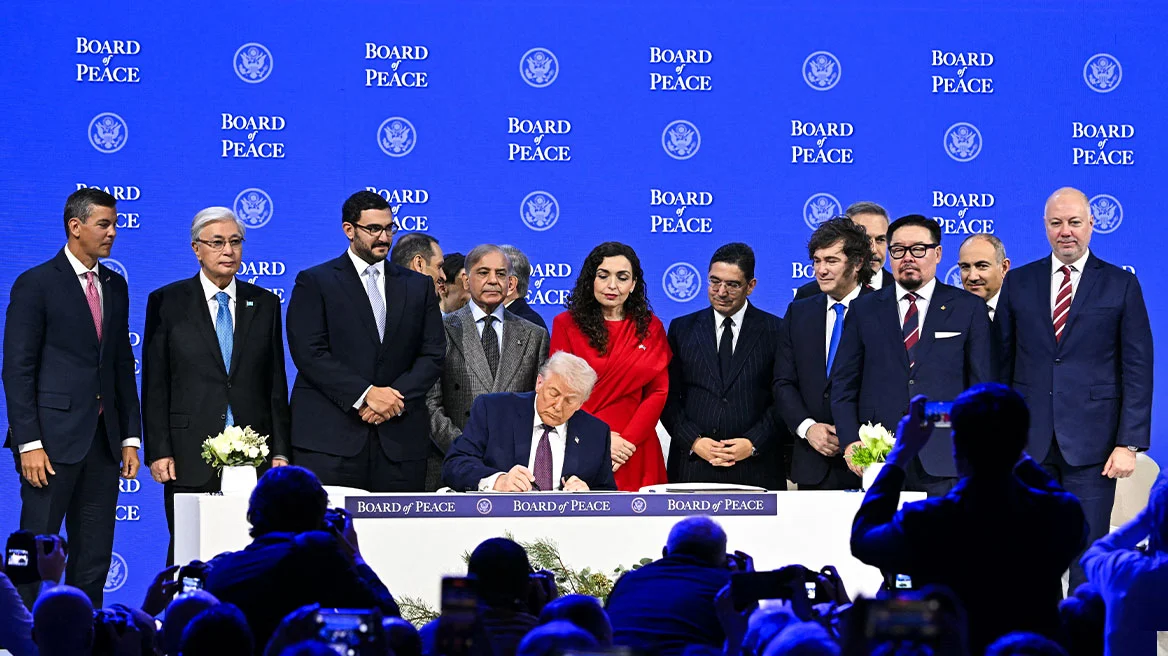
On stage are:
- A representative from Bahrain
- A representative from Morocco
- The President of Argentina
- The Prime Minister of Armenia
- The President of Azerbaijan
- The Prime Minister of Bulgaria
- The Prime Minister of Hungary
- The President of Indonesia
- The Deputy Prime Minister of Jordan
- The President of Kosovo
- The Prime Minister of Pakistan
- The President of Paraguay
- The Prime Minister of Qatar
- The Foreign Minister of Saudi Arabia
- The Foreign Minister of Turkey
- A representative of the United Arab Emirates
- The President of Uzbekistan
- The Prime Minister of Mongolia
‘I thought solving the war in Ukraine would be an easy task.’
Trump thanked Blair.
‘Today, the world is richer, safer, and much more peaceful than it was a year ago,’ Trump said. ‘We extinguished all those fires that many people didn’t even know about, including myself.’
Illegal maritime drug shipments to the U.S. reduced by 98.1%
Donald Trump stated that U.S. strikes against alleged drug trafficking vessels in the Caribbean and surrounding waters have reduced maritime drug shipments to the United States by 98.1%. He said this figure had increased by about one percentage point compared to data he had received just the previous day.
Trump also reiterated his commitment to shift U.S. offensive operations against Latin American drug cartels from sea to land, without specifying the countries where he intends to order strikes. As he had stated on Wednesday, he claimed that land operations would be easier compared to attacks on vessels at sea.
Hakan Fidan endorsed Turkey’s participation in the ‘Board of Peace.’
Ask me anything
Explore related questions