




The continuing upward trend in temperatures in recent years, particularly hot summers, and fewer days of snow cover are the main characteristics of Greece’s climate profile as it took shape in 2025, according to data from Climatebook.gr.
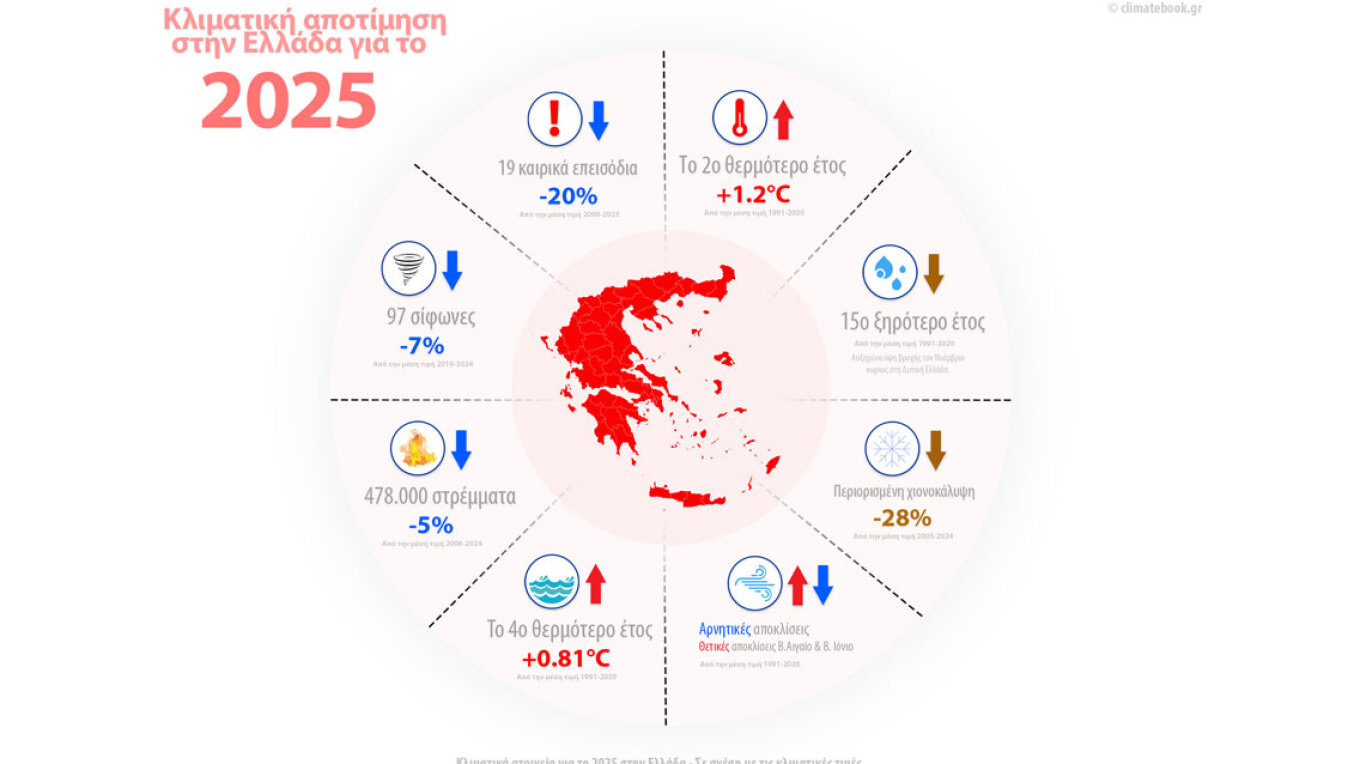
More specifically, as noted by the Director of Research at the Institute for Environmental Research and Sustainable Development of the National Observatory of Athens and head of the METEO unit, Dr. Kostas Lagouvardos, 2025 was the second warmest year in Greece over the past 30 years, with an average annual temperature of 15.3°C. He added that the average maximum temperature in Greece in 2025 was higher in all regions than the mean value of the 1991–2020 climate reference period.
Indicative of the continuous upward temperature trend is the fact that 6 of the 7 warmest years in Greece have been recorded over the past 7 years, with the 3 warmest occurring in just the last 3 years.
At the same time, it is noted that in 2025, 72% of the days of the year were above the average temperature of the 1991–2020 period.
“2024 remains by far the warmest year we have ever recorded; however, 2025 was also the second warmest year. The biggest problem is observed in summer, when temperatures rise extremely high.
Seventy-two percent of the days in 2025 recorded temperatures above normal levels. March saw very high temperatures, as did June and July.
By contrast, October was cold, while November was very warm and humid. The trend clearly shows that temperatures are rising.
An important point, however, is that not all regions are warming at the same rate. Areas farther from the sea—for example Western Macedonia, Kastoria, Florina, and Grevena—are experiencing a greater and faster increase compared to other regions,” Mr. Lagouvardos noted.
It is also worth noting that 2025 was the third warmest year globally, with the average temperature exceeding the pre-industrial average (1850–1900) by +1.47°C.
Rainfall and precipitation levels
As regards rainfall, total precipitation in 2025 was close to the 30-year average (ranked 15th). However, this was not the case for all regions of Greece, as eastern and southern parts of the country experienced one of the driest years of the past 30 years.
Regions that recorded lower-than-average rainfall included Eastern Macedonia and Thrace, many parts of eastern mainland Greece, most Aegean islands and Crete, as well as areas of western Central Greece, such as the Mornos region.
Regions that recorded the highest rainfall compared to normal values were Thessaly, Central Macedonia, the Ionian islands, and some areas of Epirus.
Referring to the recent severe weather event that particularly affected Attica, Mr. Lagouvardos pointed out that “when rain falls in such a short period of time, the water does not have time to be absorbed and is therefore lost. We need slower, longer-lasting rainfall—and we also need snow.”
Fewer days of snow cover
Special emphasis was placed on days with snow cover. According to the data, snow-cover days in Northern Greece and the Pindus mountain range were 25–30% below the average for the period 2005–2024.
Only in a few locations were total snow-cover days equal to or above the 2025 average, such as in parts of Pelion, Kissavos, Samothrace, and Mount Olympus.
“While rainfall shows a relatively stable trend, snowfall is steadily declining. This did not happen only in 2025. Observing a longer period, it becomes clear that snow cover is continuously decreasing. For example, there are 30–40 fewer days of snow cover in northern parts of the Pindus range, something also confirmed by the past year,” Mr. Lagouvardos emphasized.
Sea temperature
Regarding sea temperature, 2025 was the 4th warmest year in Greek seas since 1991, when systematic monitoring in the Mediterranean began.
Sea temperatures were higher in all basins than the 1991–2020 climatic average. Locally, the positive deviation reached +1.4 to +1.6°C.
A monthly overview shows that sea temperatures exceeded 28–29°C in July and August 2025 in the sea area between Rhodes and Kastellorizo, as well as in parts of the Ionian Sea, while the lowest temperature—11°C—was recorded in the Thracian Sea and the northern Aegean in March 2025.
Wildfires
As for wildfires, the total burned area amounted to 478,000 acres, very close to the average for the period 2006–2025 (503,000 acres).
The largest fire by area occurred in Volissos, Chios, and is estimated to have burned about 66,000 acres. Chios, in particular, was the region that recorded significant environmental losses that scarred its natural landscape.
Of the two major fires that broke out during the summer of 2025—specifically in June and August—114,600 acres were burned, corresponding to 13.6% of the island’s total area.
More specifically, the fire that broke out in mid-August in northwestern Chios was recorded as the largest wildfire in Greece for the entire fire season, destroying 66,600 acres. Earlier, the June fire had already burned 48,000 acres.
Increased drought levels
With regard to drought, data presented by Climatebook show that in 2025 increased drought levels were observed in eastern Central Greece, Crete and the rest of the Aegean islands, Thrace, and much of the Peloponnese.
By contrast, slightly positive soil-moisture deviations were observed in Macedonia and Thessaly. On a monthly basis, March, July, August, and September were particularly dry across most of the country.
During the April–June period, soil moisture was particularly high in Macedonia, Thessaly, and central Central Greece.
In the final three months of the year, soil moisture returned to normal or positive levels across much of the country, with the exception of Crete.
Drought monitoring is based on estimates of soil water content using specialized models.
First year since 2000 with no fatalities from extreme weather
Regarding extreme weather events, data show that 19 weather incidents with significant social and economic impacts were recorded in Greece in 2025.
This number is lower than the annual average for the 2000–2025 period (approximately 24 events). The 19 incidents were directly related to flooding, of which 7 were accompanied by strong winds and 2 by land tornadoes.
The year 2025 is the first since 2000 with no human fatalities. The annual average for the 2000–2025 period is about 11 deaths (excluding fatalities attributed to heatwaves—due to limited availability of directly comparable data—and wildfires).
Shrinkage of the Mornos artificial lake
Particular emphasis was placed on the shrinkage of the Mornos artificial lake. During 2025, the lake’s reduction peaked, with its surface area on 09/10/2025 shrinking to 8.3 km²—representing a decrease of approximately 49% compared to October 2022 and, as noted, the smallest recorded area of the past four years.
Extensive drying of fir and pine forests
Finally, reference was made to the “extensive” drying observed in recent years in Greece’s fir and pine forests, with researchers noting a clear link to climate change.
“The drying phenomenon in fir trees is a multifactorial process that depends on prolonged water scarcity, local climatic conditions, species physiology, soil conditions, tree age, genetic composition, and secondary infestation by bark-eating insects.
Immediate response requires rational forest management: removal of dead or infested trees and monitoring of natural regeneration, which is a key indicator of resilience.
In the long term, close cooperation between scientific institutions and forest services is necessary, along with long-term planning, due to the slow pace of forest ecosystem development.
Greece, with its significant genetic diversity, has the potential to lead efforts in the selection and preservation of drought-resistant genotypes, contributing not only to its own forest protection but also to Europe’s.
Research, the creation and maintenance of genetic resource banks, and the link between research and application are critical steps for future reforestation and the development of resilient seedlings.
Protecting fir forests and forest ecosystems in general is a long-term endeavor that requires scientific knowledge, responsible management, and trust in the forces of nature.
Our goal should be to pass on forests in the coming years that are more resilient than those we inherited,” the Climatebook report concludes.
Ask me anything
Explore related questions