

Greetings. Yesterday was overshadowed by the tragic accident that resulted in the loss of five women who were working the night shift at a factory in Trikala. Whatever one may say falls short, and there is no other event that can compare to such an “unjust thing” in life. All one can do is hope that, once responsibility is apportioned, it never happens again. Beyond that, the government is still being battered by the Kefalogianni affair, which since Friday has become the topic of discussion and criticism from mouth to mouth, from home to home. Rarely have I seen such social intensity, because the truth is that the issue is genuinely very sensitive and touches the very core of the family—separated mothers as well as fathers.
What the M.M. says
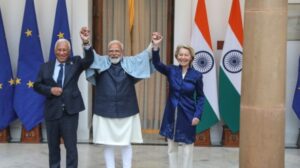
- At the M.M. they are following developments; Mitsotakis had a brief meeting yesterday with the minister, while Giorgos Mylonakis is also handling the matter. I’m told that at the M.M. they say the issue is delicate; the dividing line between a mother with problems and a minister is likewise blurred, and they continue to support the legislative provision submitted by Floridis. What no one hides, however, is that there is great displeasure because the minister herself was the first to make use of this provision, making it look like a “sur mesure” arrangement. What the minister herself—perhaps even amid her heightened emotions—has not yet grasped is that the greatest damage from this very difficult case is being done to her personally. Everyone understands that joint custody does not mean that two four-year-old children can be tossed around like a “ball” from parent to parent and from house to house every other day. But on the other hand, when you are a public figure—and indeed a serving minister—you must weigh everything, personal and family matters included. So if there’s no other way, you set aside either the personal and family life or politics. For now, Olga has gone on a professional trip as far as India, and we’ll see…
The outburst in the Cabinet
- The tragedy at the “Violanta” factory cast a shadow over yesterday’s Cabinet meeting. When the cameras were switched off and discussion began, Adonis and Kerameos gave an initial briefing both on the condition of the injured and on the inspections carried out by the Labour Inspectorate during 2025. Last year, four visits were made with remarks regarding heat stress among workers, but the facilities apparently did not present problems. Clearly, it is far too early for conclusions, which will of course emerge from the authorities and above all from the judiciary.
Postal voting
- There was also quite a bit of discussion following Livanios’ presentation on extending the right to postal voting to expatriates for national elections as well. I’m told that several ministers said the other parties—especially PASOK—must be put before their responsibilities, given the good precedent set during the European elections. Ministers even believe that interest among expatriates will be greater this time, due to the higher stakes. Let me tell you that, based on Livanios’ idea—which will be presented in greater detail on Thursday at an informal Interparty meeting—each party will have one ballot with up to five candidates, and voters abroad will mark a preference cross. Given that this constituency will function like three-seat districts, the central scenario is that the top three parties will each gain one extra nationwide MP.
Milos – ecological disaster – strange things…
- A year ago we revealed that on Milos, at Sarakiniko, an unbelievable character—a tourism “entrepreneur”—opened, with a permit from the Planning Authority, a hole to start a hotel in an area and landscape of exceptional natural beauty. Back then the government stopped it. Until yesterday, however, less than 2 km away in a straight line and right on the sea, a large real-estate company was almost finishing a brand-new ecological, environmental, and aesthetic crime. It was building (via an extension) a concrete mountain of a hotel with dozens of swimming pools, as if we have water to spare. The mayor says, “I did everything I could—appeals, protests, etc.” but, as is now revealed, the suspension of the permit—despite the monster hotel having been expanding for ten months—was issued on New Year’s Eve 2026, yet was not even communicated to his own Service (YDOM), so the suspension was never activated! Strange things, right? In any case, the issue gained major publicity starting the day before yesterday, and K.M. requested briefings from Papastavrou and from his own office (Mylonakis). And of course, once they understood what was happening (it wasn’t exactly hard—watching a single video was enough), they did what needed to be done. They suspended the permit and sent in the authorities. And clearly, their immediate reaction also shows their intent. The problem is that, unfortunately, in the Cyclades—and almost all over Greece—you just can’t keep up. The media write about one and it stops… ten more pop up.
A united media reaction…
- And since we constantly accuse the… bought-off media, let’s also acknowledge the good they sometimes do. The reporting on Milos was aired and highlighted—besides us—by Kathimerini, Mega, SKAI, ieidiseis, and obviously other outlets I’m forgetting. Have no doubt that they helped the M.M. and Papastavrou act instantly.
Something more radical?
- Still, at some point—even now, toward the end of its second term—the government will have to decide what kind of tourism development it wants, what units and where. Behemoths don’t fit in the Cyclades. Had this been clarified and precisely defined, we wouldn’t be seeing such monstrosities.
The accountant godfather…
- Having married someone—especially when they’re a politician and, I say this with absolute sincerity, from Crete—may not mean anything at all. In the sense that godparent ties, even among ordinary mortals, often reflect situational friendships and nothing more. In that sense, the accountant-godfather of Androulakis—who has been remanded in custody for OPEKEPE frauds and was found to be gambling €700,000, possibly to launder money—would not constitute any issue for Androulakis. Except that he himself… kept harping on it and made statements because the late Konstantinos Mitsotakis “had married off Frapes’ brother in 2004.” That Frapes, as far as I know, has not been charged by the competent authorities. I’m just leaving this here so it doesn’t get dropped.
Papademos at the Presidential Mansion
- The cycle of meetings between President Tasoulas and former prime ministers continues in the coming days. Thus, after Karamanlis and GAP, it will be Lucas Papademos’ turn this Friday. With the new month, meetings will also be scheduled with Alexis Tsipras and Antonis Samaras, who have in principle accepted the invitations extended to them.
The regional governors at Maximos
- K.M. continues his… bucolic meetings, this time on the issue of smallpox, with four regional governors invited from the regions where the problem is mainly identified. Participating will be Kouretas of Thessaly, Aidona of Central Macedonia, Topsidis of Eastern Macedonia–Thrace, and Farmakis of Western Greece, while Kachrimanis of Epirus will also attend as a good example of a livestock region that brought cases down to zero through proper application of measures. I should tell you, however, that the… big match is between Kouretas and the rector of the University of Thessaly, Charalambos Billinis, who is president of the Ministry’s Scientific Committee on smallpox. Next week there will also be a special meeting between K.M. and livestock breeders.
Kepler Cheuvreux against Coca-Cola HBC over the Africa deal – Destroys shareholder value
- A week ago, the general meeting of Coca-Cola HBC shareholders approved by a large majority the acquisition agreement for 75% of Coca-Cola Beverages Africa (CCBA), which management presented as a €2.2 billion strategic move that changes both the scale and the “geographical map” of the listed company. Since then, Coca-Cola’s share has been desperately trying to reconnect with the €45 level, without much success. The “culprit” seems to be coming from France. Investment house Kepler Cheuvreux downgraded Coca-Cola’s stock to “Reduce” because—put simply—it believes that behind the shine of the CCBA acquisition lies a transaction that destroys shareholder value from day one. With a return on invested capital of 5.7%, HBC will be paying a cost of capital of 12%. Management is betting on a doubling of operating margins, which, however, would require years of flawless execution on inhospitable ground. Kepler Cheuvreux believes the African reality is harsh. Organic growth of 7% shrinks to 3%–4% after currency adjustments; local competitors will cause market-share losses in South Africa; constant blackouts will derail the supply chain; and African consumers show zero tolerance for premium pricing. The promise becomes hard to believe when consumers’ disposable income is falling and price sensitivity is skyrocketing. Kepler Cheuvreux appears rather angry about Coca-Cola HBC’s cash returns. Share buybacks have been frozen in favor of “gradual deleveraging,” which Kepler sees as a mere euphemism for limited shareholder returns. The balance sheet remains strong, but flexibility is constrained. According to Kepler Cheuvreux analysts, the CCBA acquisition may prove strategically right in a decade. The question is whether shareholders have the patience to wait.
The Bakos–Kaimenakis plan for Douros
- The plan to relaunch and develop “Douros” by the Bakos–Kaimenakis families has entered its next phase. The entry of new investors into the well-known Patras-based company—specifically Nikos Bakos and Alexandra Kaimenaki, children of Dimitris Bakos and Giannis Kaimenakis (Credia Bank, Aktor, etc.)—was carried out through the issuance of a €2.1 million convertible bond loan via private placement, alongside the abolition of existing shareholders’ pre-emption rights. The new shareholders, through COSMOS DEVELOPMENTS S.A. (where N. Bakos is President and CEO and A. Kaimenaki Vice-President), acquired approximately 64% of Douros, and processes have already begun for restructuring and the immediate repayment of the company’s bank debt. This step is absolutely necessary to make possible the settlement and repayment of obligations to the Independent Authority for Public Revenue (AADE) and EFKA as well, and there is already relevant activity at GEMI. Based on the latest figures (April 2025), at the end of 2024 Douros had short-term bank loans exceeding €6 million, tax liabilities of €2.1 million, and obligations to social security institutions of over €1.28 million. The investment plan, grounded in Douros’ rehabilitation, was drawn up and completed by “Sioufas & Partners,” and the market considers it certain that Douros will serve as a vehicle for adding and developing new activities by its new shareholders, with an emphasis on real estate, while retaining its traditional apparel line. It remains to be seen whether this new course will ultimately include the company’s return to the Stock Exchange, as Douros is no longer traded on the ASE.
New extension for the land registry
- One might say that four months compared to entire decades is nothing. However, the new extension for completing the land registry and fully operating all cadastral offices simply confirms that this is the most complex project ever undertaken by the public administration. By decision of Deputy Minister of National Economy and Finance Nikos Papathanasis, completion of the “pharaonic” project funded by the Recovery Fund is postponed to April 30, 2026, instead of December 31, 2025. At the same time, milestone RRF_345, which concerns the land registry, is removed from the next European assessment and shifted to a later stage, without jeopardising the flow of disbursements. In any case, the quantitative aspects of cadastral mapping appear to be essentially completed. What remains is the difficult last mile of the administrative transition: the full operation of the remaining cadastral offices, the opening of all branches, and, above all, the permanent closure of 223 old mortgage offices.
The “cost” of the shutdown
- The real cost of the “shutdown” of Tupperware Hellas is beginning to surface, as the Greek subsidiary is in the final stage of liquidation following the collapse of the parent company and its filing for Chapter 11 in the US. In the first phase, which concerned the shutdown of the factory in Thebes in 2023, the cost of ceasing operations—including severance payments to 134 employees—amounted to €7.3 million. In addition, the liquidator estimates approximately €1.2 million more for final compensation to the limited core staff retained for commercial operations and liquidation management. It is recalled that about a year earlier, the dissolution and liquidation of the company had been decided, paving the way for the definitive end of Tupperware’s presence in the Greek market. Meanwhile, fiscal year 2024 was deeply loss-making, mainly due to extensive impairments of fixed assets, receivables, and inventories. After-tax losses surged to €5.68 million, compared to an almost break-even result in 2023. Turnover was nearly halved, falling to €9.97 million from €18.45 million.
Oikonomou as an early validator and the turn toward China
- Giorgos Oikonomou’s appearance at an LNG carrier shipbuilding signing ceremony in China is not a communication detail. It is a move with a clear reading of cycle and cost. For a shipowner who built TMS Cardiff Gas on the Korean shipbuilding industry, the opening toward Hudong-Zhonghua is not a coincidence but a choice. The order for up to six 174,000 cbm LNG carriers, with deliveries from 2028, comes at a time when Korean shipyards are essentially closed and prices have stabilised above $250 million. China offers the same size, similar technical specifications, and significantly lower cost. In Wall Street terms: margin protection before the next cycle. It ensures a low acquisition cost, meaning potential profit margins from charters or future resale remain high even if market prices later move differently. Timing is key. Oikonomou is not chasing today’s tight market. He is positioning for 2028, when new capacity will have been absorbed by long-term LNG projects and the market will demand modern, efficient vessels. The bet is not on the next two years’ charter rates, but on the asset’s value at the end of the decade. There is also a message to the market: Chinese shipyards are entering the “premium” LNG game. Ice-class, GTT containment, and long-term deliveries form a package that until recently was considered Korea’s exclusive privilege. Oikonomou acts as an early validator of this transition.
D.F. Sarakakis and timing that pays off
- On Wall Street they put it simply: sell into strength. That is how the move by Ionic Tankers of Dimitris-Frank Sarakakis, with the sale of the Ionic Artemis, can be read. A pure asset play, well-balanced and noise-free. The sale of the 15-year-old aframax for $35.6 million does not change the market map, but it says a lot about how the company thinks. D.F.S. is not among the Greek shipowners who unload en masse when prices rise. On the contrary, he waited—and waited correctly. Second-hand aframax prices are moving higher, as sanctions tighten the market and available tonnage shrinks. When more than a quarter of the global fleet is effectively outside the Western game, older ships with a “clean” history regain value. That is exactly what Ionic read. The Ionic Artemis was the oldest piece of a package acquired from Mitsubishi in 2018. Back then, it was the “ballast” of the quartet. Today, it became an opportunity. With a valuation close to market benchmarks, the company locked in capital gains without changing strategy. Ionic plays a long-term game. It renews its fleet, adds modern vessels, and sells only when timing is ideal—not when sentiment demands it. For market analysts, this translates into capital discipline.
Antonis Papadimitriou and the enduring Greek maritime intelligence
- At a recent event at the Eugenides Foundation, Antonis Papadimitriou, President of the Onassis Foundation, highlighted the enduring imprint of the Greek maritime entrepreneur, shaped by knowledge, information control, and unmatched adaptability. As he noted, Greek shipping has built its competitive advantage for centuries on understanding every factor affecting the commercial exploitation of a vessel. From the pre-revolutionary era to modern times, the ability of Greek shipowners to control information and make strategic decisions remains unchanged. He also stressed adaptability to technological change, citing examples such as the transition from sail to steam and the acquisition of the first American Liberty ships. History shows that Greek shipping does not fear change—it embraces and exploits it. He also made special reference to the geographical intelligence of Greek shipping: from maritime hubs in London and New York to the rise of Piraeus as a management center, Greek presence is now global, across all seas.
The new era of Nammos in Dubai, with London coming next
- From big business in shipping to big business in clubs, specifically Nammos, which after seven years of operation in Dubai—and following a few months’ closure for necessary renovation—reopened its doors. The two parties held on New Year’s Eve with Latin star Maluma and on New Year’s Day with DJ Pawsa packed the outdoor spaces (helped by the weather), while total revenues for the two days reached €5,000,000. In three months, Nammos will open in London, in a building in Mayfair.
Aretsou Marina, the mayor, and the Salt Pans…
- The mayor of Kalamaria took to the streets distributing “informational leaflets” to citizens, calling on them to “mobilise” against the development of Aretsou Marina. The mayor’s sudden reversal causes discomfort among those familiar with the background discussions and negotiations. Reliable sources report that very recently, the same mayor met with the Ministry of Finance and submitted three specific requests regarding the marina development tender. The Hellenic Corporation of Assets and Participations accepted all of them, with the mayor herself expressing “surprise” at how easily her positions were satisfied. The sudden change of stance that followed, with leaflet distribution to mobilise residents, may serve other purposes or suggest that something intervened to change her mind, which we do not know. Information from the Thessaloniki market suggests that noise is being created—not about the marina—but about the… privatisation of the Salt Pans, which is also underway. Note that Aretsou Marina has been in a state of neglect and degradation for many years. The Asset Fund undertook its upgrade and launched a tender to pull it out of stagnation.
Our… good weather brings cheap electricity
- Wholesale electricity prices in Greece recorded an impressive drop during the first half of January, falling to €97.98 per MWh. The -11% decline compared to the corresponding period in December accurately reflects how weather conditions (and investments in RES) directly affect the country’s energy equation. Today’s price, however, rose again to €137.69 (+32% in two days) for two reasons: first, winds weakened, and second, temperatures fell, increasing electricity consumption not only in Greece but across Europe. The strong winds that swept Greece earlier this month have made wind farms protagonists of power generation. At the same time, recent rainfall has boosted reservoir levels, allowing increased contribution from hydroelectric units. The result? Renewable Energy Sources exceeded 50% of total production, with wind alone reaching 58% on certain days. When weather conditions are favourable, participation of natural gas units drops sharply. Conversely, when temperatures fall and demand rises for stable, continuous power, gas units immediately fill the gap. The good news is that the contribution of now extremely expensive lignite has been limited to 5.63%.
Cenergy Holdings heading full speed toward €4 billion
- One month ago, on December 17, the Viohalco Group announced a mini placement of shares in its subsidiary Cenergy Holdings. A 1.72% stake was placed at €15.8 per share. The US-based buyer had no difficulty paying €6.8 per share above the 2024 capital increase price and €14 per share above the price five years ago. That small transaction showed that as Cenergy advances with its production unit project in Maryland, USA, it becomes increasingly attractive to American funds. Yesterday, Cenergy (+4.94% at €18.68) reached a market capitalisation of €3.963 billion. Proud “parent” Viohalco now holds 69.71% of Cenergy Holdings. This means that if it chose to sell an additional 5% to yield-hungry US funds, it could easily raise around €200 million for investments and/or debt reduction. It is also clear that the Group’s new (younger) leadership aims to further reduce the net debt to adjusted EBITDA ratio, currently at 2.4. The next move by the Stassinopoulos brothers will be the “simplification” of the Group to make it more readable, understandable, and clear to foreign asset managers.
Industrial stocks “on the run” on the Athens Exchange
- Riding momentum from the planned issuance of a €350 million five-year bond, Titan recorded a rise of more than 3% and climbed above €57 for the first time. Within this context, the cement group is preparing a series of presentations to European investors, further expanding its footprint in Europe. At the same time, Viohalco group stocks returned to the spotlight, with the parent company’s share surging 5.7% to €12.6, a new all-time high. The group’s other stock, ElvalHalcor, also benefited, rising +2.2% and approaching €4.2 again. Pharmaceutical company Lavipharm also hit the psychological €1 level, as after last Friday’s +5.7%, the stock surged 14.5%, reaching nearly €1.2 and a new 3.5-year high.
The Greek banking exception
- Since the beginning of the year, the Eurostoxx Banks index is up +1.51%. By contrast, the Greek banking index has surged +15.5%, with all four systemic banks posting impressive performances. National Bank offers a return of +7.12%, Alpha Bank +7.16%, Piraeus Bank +19.30%, and Eurobank +15.10%. These are not bad returns for a three-week period, nor for the General Index (+6.8%), which is 35% weighted toward the four systemic banks. Clearly, the narrative of a “return to normality” for the banking sector has replaced the previous “Greek risk” narrative, while the upgrade of the Athens Exchange to developed market status by MSCI is expected to attract additional liquidity. International houses—UBS, Goldman Sachs, Bank of America—are revising price targets upward, acknowledging that valuations remain attractive despite the rally. By contrast, European banks face different challenges: slowdown in German industry, real estate uncertainties, and increased regulatory pressure. For now, Greek banks are the success story of the European financial landscape.
New York calls Tokyo
- Their problems are not the same. Their objectives, however, coincide. That is why they joined forces. The sharp appreciation of the Japanese yen by +1% to around 154 per dollar reveals a significant shift in monetary policy. For the first time since 2011, the US appears willing to coordinate currency market actions with Tokyo, signalling more than a technical intervention. The Bank of Japan has repeatedly tried to halt yen weakness. Interventions in 2022 (140–145 levels) and 2024 (153–160 zone) had temporary effects. Now, however, possible Fed involvement changes the landscape. New York is not merely defending the yen—it is managing dollar weakness. This strategy is linked to the Trump administration’s effort to facilitate US exports without triggering abrupt turmoil. Risks remain. A stronger yen threatens to unwind carry trades built on low Japanese bond yields. The sudden liquidation of these positions in July–August 2024 caused market panic. The 150 yen per dollar level is critical. Below it, many funds will be forced to adjust exposure, while Japanese institutional investors will discover that their foreign portfolios have lost significant value in yen terms. Coordinated intervention is not just a monetary tactic—it is a political statement for a new phase in managing the international financial system, where Tokyo regains bargaining power and Washington accepts a weaker dollar as a growth tool.
Ask me anything
Explore related questions