




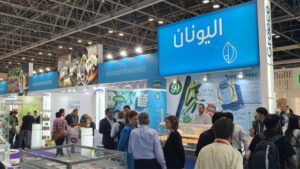
With around 75 Greek companies participating in this year’s Gulfood in Dubai—one of the world’s largest food and beverage exhibitions—the Greek food industry is emerging more organised and determined than ever to claim a share of the Persian Gulf markets. These are high-consumption markets with strong dependence on imports, where the presence of Greek products remains relatively limited but is steadily growing, supported by strong bilateral state relations, particularly with the United Arab Emirates and Saudi Arabia.
This year’s Gulfood, currently under way, is of historic significance, as for the first time it is being held simultaneously at two mega venues: the Dubai World Trade Centre and the Dubai Exhibition Centre at Expo City. The exhibition functions as a global hub for trade, logistics and redistribution for the Middle East, North Africa and parts of Asia.
The mission
The scale of the Greek delegation is reflected in the breadth of companies attending this year’s event in Dubai. Major players from the domestic food and beverage industry are taking part, covering almost all core product categories—some under the umbrella of Enterprise Greece and others independently or through their own collaborative schemes.
In the dairy and fast-moving consumer goods segment, participants include well-established exporters such as Kri Kri, MEVGAL, Omiros, ZANAE, Paliria, Melissa Kikizas, Barba Stathis, Intercomm Foods and Olympus. At the same time, there is a strong presence of companies active in high value-added and premium categories, such as Trikalinos, as well as businesses that have shown particularly dynamic growth in recent years, including Kostarelos Dairy and Koukas Farm.
Particular emphasis is also placed on companies from the olive oil and table olives sector, including AGROVIM, Askra Olive Oil, Plakias Olive Oil, El. Mar Olives and Mani Foods, alongside cooperative schemes representing a significant share of Greek agricultural production. The picture is completed by companies from the frozen foods, bakery products, snacks, beverages and delicatessen segments, confirming that the Greek presence at Gulfood is holistic rather than single-theme.
For Greek businesses, Gulfood has evolved in recent years into a key platform for visibility in a highly promising and expanding market. This is largely because Dubai functions as a re-export hub for the entire Middle East and North Africa.
Despite this momentum, Greece’s overall presence in Middle Eastern markets remains relatively limited in absolute terms, especially when compared with traditional European export destinations. The most recent annual data show that total Greek exports to the United Arab Emirates in 2024 amounted to approximately USD 400 million, while exports to Saudi Arabia slightly exceeded USD 450 million.
These figures reflect a still modest share of Greece’s total export footprint, yet they point to significant room for growth—particularly in sectors such as food and beverages. This outlook is further strengthened by the favourable framework of political and economic relations Greece has developed in recent years with both Saudi Arabia and the UAE, creating fertile ground for a more structured and long-term business presence.
The stronger Greek presence at Gulfood aligns with the broader export picture. According to the latest data from ELSTAT, as processed by the Institute of Export Research and Studies of SEVE, the food sector recorded the largest increase in absolute terms in the eleven-month period from January to November 2025, rising by €679.2 million or 9% to reach €8.2 billion. This confirms that the sector has evolved into a driving force of Greece’s export orientation, laying the groundwork for further geographical expansion.
Ask me anything
Explore related questions