




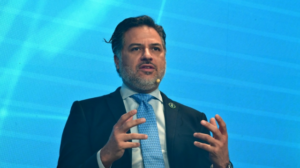
The new phase of implementation of the so-called Vertical Corridor officially begins with the ministerial meeting in Washington in late February, as revealed at the Athens Energy Summit by Joshua Volz, Special Envoy for Global Energy at the U.S. Department of Energy.
This meeting will signal the transition from political discussion to practical implementation, with the participation of all countries and stakeholders involved along the route from Greece to Ukraine.
From cost to security
Mr. Volz placed the discussion within the broader geopolitical context, making a clear distinction between the “accounting” cost of energy and the “absolute cost,” which relates to security, international relations, and strategic autonomy.
As he noted, Russia’s invasion of Ukraine highlighted in the most emphatic way how vulnerable countries can be when they are overly dependent on a single supplier. “Natural gas has been used as a tool of political influence,” he stressed.
U.S. strategy and the Euro-Atlantic alliance
According to Volz, Washington’s key priority is to leverage U.S. energy abundance to offer allies more options, with an emphasis on diversification, security of supply, and long-term stability.
Within this framework falls the strong Euro-Atlantic alignment in the energy sector, spearheaded by the European Union’s commitment to purchase €750 billion worth of U.S. energy resources, as well as the goal of full disengagement from Russian resources by 2027.
Why Greece is at the center
Volz underlined that Greece is a pivotal link in Europe’s new energy map, combining geographic location, critical infrastructure, and political will.
As he noted, both Prime Minister Kyriakos Mitsotakis and Minister of Environment and Energy Stavros Papastavrou have consistently positioned Greece as a pillar of energy security and diversification for the region.
Ask me anything
Explore related questions