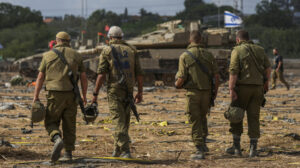
The Israeli military said today that it launched airstrikes in the southern part of the Gaza Strip, at the exit of a tunnel, and “neutralized three terrorists,” another incident that demonstrates how fragile the ceasefire is.
The strikes were launched in the Rafah area, where there is a crossing point to Egypt, the only one connecting Gaza to the outside world that does not pass through Israel. Both Palestinians in the enclave and humanitarian organizations and the UN are eagerly awaiting the reopening of this border crossing.
Before dawn, Israeli soldiers spotted “eight terrorists” exiting underground structures east of Rafa and “the Israeli air force targeted (them) and neutralized three” of them, the army said in a statement.
According to the statement, Israeli forces launched additional strikes on areas where the others fled, while Israeli forces “continue to search the area in order to locate and neutralize all the terrorists.”
“The (Israeli) troops remain deployed based on the ceasefire agreement and will continue to act to neutralize any immediate threat,” the army added.
Under US pressure, Israel and Hamas reached a ceasefire agreement, which came into force on October 10, 2025, just over two years after the war began.
At a time when the two sides are daily accusing each other of violating the ceasefire and failing to meet all of their commitments under the first phase of the plan, Washington announced in mid-January the start of the second phase, which is to lead to the end of the war.
The first phase provided, among other things, for the release or return of all Israeli and foreign hostages, living and dead, held by Hamas or its allies in the Gaza Strip, in exchange for the release of Palestinians held by Israel and the surrender of the bodies of Gazans killed since the beginning of the war.
This concluded yesterday (Thursday) with the handover to Gaza authorities, through the Red Cross, of the bodies of 15 Palestinians, a day after the funeral of the last Israeli hostage whose remains were found earlier this week in a cemetery in northern Gaza by the Israeli army.
Disarmament;
The Israeli government had announced on Monday that it had agreed to the limited reopening of the Rafah border crossing, exclusively for pedestrians, after the last body had been returned to Israel, but did not commit to a specific date.
More than 24 hours after the funeral of Ran Gwili, a policeman killed on October 7, Gazans are waiting for this announcement to be implemented, which falls far short of their expectations and those of the humanitarian community, which hopes that more humanitarian aid can enter the enclave through Rafah and that patients can be removed from the enclave.
The humanitarian situation remains dramatic for the more than two million Palestinians in the Gaza Strip, who are largely living in tents exposed to the elements in the midst of winter.
The reopening of the Rafah is also expected to allow the arrival of members of the National Commission for the Administration of Gaza, a group of 15 technocrats created under a plan by US President Donald Trump that will take over the management of the enclave during a transitional period.
Under the terms of that plan, which was approved in November by the UN Security Council, the second phase of the ceasefire calls for, among other things, the disarmament of Hamas, the gradual withdrawal of the Israeli army, which still controls more than half of Gaza, and the deployment of an international stabilization force.
“Many say they will never disarm, (but) it looks like they will,” Trump said yesterday (Thursday), referring to Hamas, which until this morning had not reacted to those statements.
Ask me anything
Explore related questions