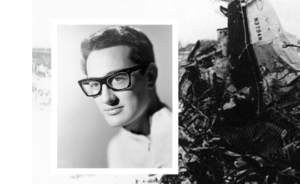
In 1959, alongside Elvis Presley — whose raw sexuality electrified audiences and especially young women across the United States — stood Buddy Holly. A young musician with a clean-cut face, a warm voice, and distinctive horn-rimmed glasses, Holly was already reshaping the sound of rock ’n’ roll.
That promise was cut short abruptly 67 years ago today, when Holly died in a tragic small-plane crash — an event Americans would later call “the day the music died.”
The 22-year-old Buddy Holly was killed along with two fellow musicians: Ritchie Valens, just 17 years old, and J.P. “The Big Bopper” Richardson, aged 28.
The crash sent shockwaves through young people of the era.
Immortalized in “American Pie”
Twelve years later, singer-songwriter Don McLean would immortalize the tragedy in his song American Pie, a work steeped in nostalgia for an earlier time — and for the three talented performers whose lives were cut short.
Buddy Holly, in particular, had already changed the landscape of rock music just before the genre exploded in the 1960s.
He was a true pioneer: a singer-songwriter who wrote both lyrics and music himself (still rare at the time), an arranger, and a performer of his own material.
Artists who followed owed him a great deal — from The Rolling Stones and The Beatles, then just teenagers taking their first musical steps, to later musicians like Bruce Springsteen, who was only ten years old at the time.
Bob Dylan, just 17, had seen Holly perform two days before the crash. Decades later, in his 2017 Nobel Prize lecture, Dylan recalled:
“Something about him seemed permanent and filled me with confidence. Then suddenly something strange happened. He looked straight into my eyes and transmitted something — something I didn’t know what it was. It sent a shiver through me.”
Poor Planning and Extreme Weather
The tragedy was the result of poor planning and severe weather conditions.
The three musicians were touring together with great success. Their schedule was grueling, with long distances between cities — often in brutal cold and along rural roads. Tour buses struggled in the weather, sometimes without functioning heating.
During the tour, Valens and Richardson fell ill with the flu, while Buddy Holly’s drummer suffered from frostbite in his feet.
The night before the crash, they performed in Clear Lake, Iowa. Their next concert, scheduled for the following day, was in Moorhead, Minnesota, nearly 600 kilometers away.
To avoid the exhausting bus journey, they decided to charter a single-engine Beechcraft Bonanza to Fargo, the closest airport to Moorhead. The plane seated three passengers and a pilot. On board were Buddy Holly, Richardson (because of his illness), and Valens, who had won his seat in a coin toss with another musician.
Before departure, Holly jokingly told his band’s bassist, “I hope your old bus freezes again.”
The reply — chilling in hindsight — was: “I hope your plane crashes.”
The Fatal Flight
The plane took off shortly after 1 a.m., but it never contacted air traffic control.
At first light, search crews discovered the wreckage about 10 kilometers from the airport. One wing had gouged a trench into the frozen ground. All four people on board were killed instantly, with three of the victims found outside the cabin.
Multiple factors contributed to the disaster. The pilot lacked sufficient experience in instrument flight, and the airline was certified only for visual flight conditions — conditions that were absent that night. The sparsely populated area offered no ground references to assist navigation.
Compounding the danger, the pilot had not been informed of the worsening weather: falling temperatures, snow, strong winds, and dangerously low visibility.
Thus ended the lives of three young men — and a moment in history that would echo forever as the day the music died.
Ask me anything
Explore related questions