





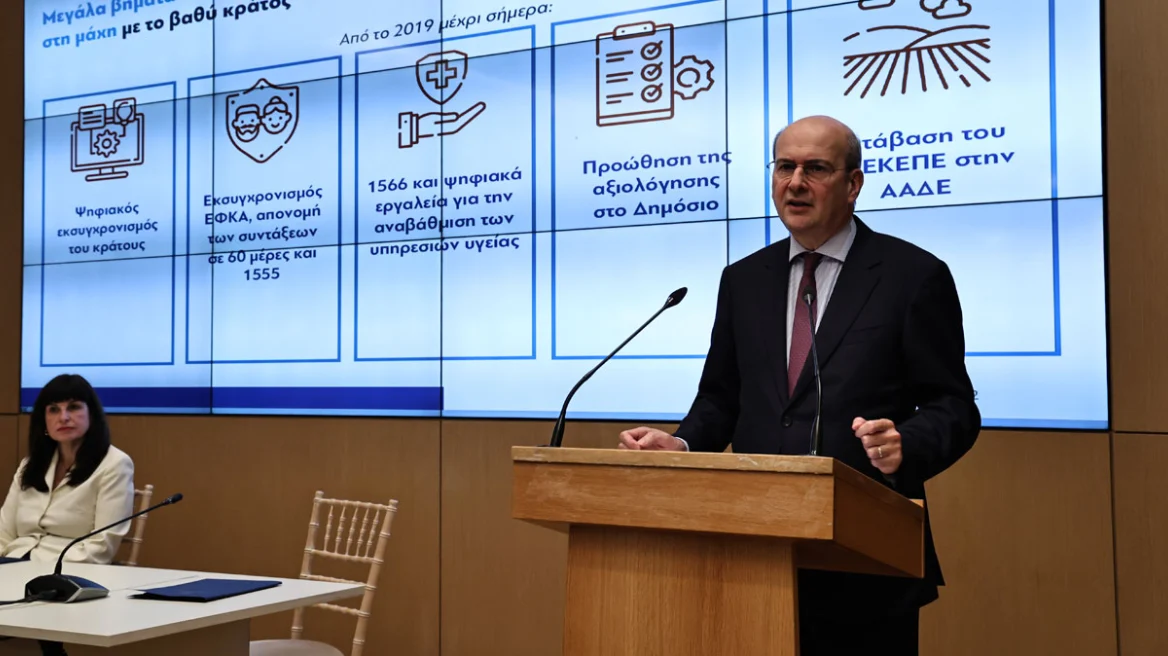
The government’s bill aimed at reducing bureaucracy and ending the daily inconvenience faced by millions of citizens in their dealings with the public sector was presented by Deputy Prime Minister Kostis Hatzidakis.
The bill, titled “Interventions for a More Citizen-Friendly State,” includes a series of administrative reforms, among them:
- changes to how certificates are requested by public authorities,
- The expansion of the EFKA model using certified professionals for transactions with the state,
- new rules for informing citizens about circulars and service hours,
- and the transformation of notaries into one-stop service hubs.
“Tangible results in the fight against the deep state”
Mr. Hatzidakis noted that the government has already delivered concrete results in tackling entrenched bureaucracy, citing the modernization of EFKA, where pension processing times now match those of Germany, as well as reforms such as public-sector evaluations, the transition of OPEKEPE to the Independent Authority for Public Revenue (AADE), and the introduction of performance monitoring.
He added that the next steps include:
- further expansion of public-sector evaluations,
- The introduction of the digital work card in the public sector,
- legislative reform of urban planning services,
- and restructuring of the Hellenic Railways Organization (OSE).
The bill, he stressed, relies on simple, common-sense administrative solutions to eliminate what citizens often experience as “everyday madness.”
The 14 Anti-Bureaucracy Measures
1. Replacing certificates with sworn declarations
Citizens will no longer be required to submit documents already held by the administration (such as marital status, degrees, citizenship or property certificates). Instead, a sworn declaration will suffice, until full system interoperability is achieved. False declarations will carry heavier fines and criminal penalties, and offenders will lose the right to submit such declarations.
2. State withdrawal from property ownership claims
The state will refrain from claiming ownership or filing lawsuits against private individuals when property titles were legally registered before 1975, or when properties were granted by official state decisions (e.g. refugee settlements). Pending cases in these categories will be dropped, with exceptions for public-use land, archaeological sites, coastlines and forests.
3. Digital tracking of applications
Citizens will be able to track the status of their applications online, including the responsible authority, current stage and estimated completion time.
4. Monitoring complaints via the Integrity Advisor
The Integrity Advisor will systematically oversee complaints and report to the competent minister. Citizens will track named complaints using a unique reference code.
5. No appeals by the state in socially sensitive cases
The public sector will refrain from legal appeals in cases involving moral damages due to death, disability or injury arising from disasters, public infrastructure accidents, public transport incidents, terrorist attacks or medical malpractice in public hospitals.
6. Enforcement of court rulings through internal audit units
All court decisions will be forwarded to the relevant Internal Audit Units to ensure compliance, eliminating the need for citizens to seek enforcement through additional legal action.
7. Mandatory publication of circulars
Circulars must be posted on official websites within six months of publication in the Government Gazette, otherwise they will be deemed invalid.
8. Online publication of service hours
All public services must publish their operating hours online within three months of the law’s entry into force.
9. Unified interpretation of legislation
A central body will ensure consistent interpretation of laws when handling citizens’ appeals, preventing unequal treatment across regions.
10. Expansion of the EFKA model
Certified professionals (such as agronomists, veterinarians, accountants) may be authorized to carry out specific public-sector procedures, following the successful EFKA pension-processing model.
11. Notaries as one-stop service centers
Notaries will collect documents, submit tax declarations, withhold public debts, pay registry fees and complete procedures, with parties required to appear only for signing.
12. Abolition of mandatory topographic diagrams
For property transfers in fully planned urban areas with approved implementation acts, topographic diagrams will no longer be required.
13. Inheritance tax payment upon property transfer
Inheritance tax may be paid at the time of transferring inherited property.
14. Final release of seized properties by AADE
AADE will be able to permanently lift seizure restrictions to allow property transfers under specific conditions.
Ask me anything
Explore related questions


